We talked about running today. How running, for some is not just an activity to do, to get healthy, to reach somewhere, but a lifestyle choice. A way of living. And I thought about that while I was running this morning. A snow storm was brewing and getting out was so nice and easy. I've developed this very enjoyable gait, it's slow and comfortable and I can think and not feel tired.
And I felt the snow crunching under my feet and all I could think about was how good this felt. How wonderful this was. Yet the storm was starting to blow and there was water on my face as the huge snowflakes melted on my warm face. I was wearing my spikes and so wasn't too concerned about slipping. My steps felt just as good as if I had been running on the dry pavement.
And as I turned around into another corner, down a street still fast asleep, quiet, dark and lit only by the street lights, I finally came to the conclusion, it hit me like a brick, that this is what I wanted to do. I got up well, I was feeling good, and for the first time in a really long time, I felt as though I never wanted this run to ever end.
About an hour later I changed my mind, but the point is that I know, finally, that I will never struggle to get outside and run, ever again. It's what I do.
It's not about getting from here to there, it's about being there.
Sunday, August 16, 2015

Friday, August 14, 2015
The Omelette
The spinach, red pepper, cheese omelette. A very tasty dish.
You need:


Now that's starting to look good. Your sautéed spinach and peppers should be looking like this by now.

You can flip the eggs over for about 30 seconds, then flip them back before adding the sautéed veggies.

Fold it over.

Let it cook on medium heat for about another two minutes. Don't forget, the sautéed veggies are done, and it's just to let the flavours seep through.
When you're done, you can toast a bagel, slice a couple of strawberries for garnishing, and you should have something like this.

Enjoy!
You need:
- A couple of leafs of spinach (to taste)
- A quarter of a bell red pepper
- Two eggs
- Grated aged 2-year Balderson cheese (OK, just kidding any salty old cheese will do)
- Salt and pepper
- Olive oil (or coconut oil, or even sunflower oil - just don't use motor oil)
Pour a tablespoon of olive oil (or whatever oil you got) into the pan. At medium heat. Not too hot to sizzle the oil.
Chop up the spinach and the red pepper and put this into the pan.

Look at the colour. Isn't it beautiful?
Grate your cheese.

While your spinach and red pepper are cooking, break a couple of eggs and add about a tablespoon of milk. If you run, you can substitute that for cream. You can even use soya milk.

Whip the eggs and then put them in the frying pan.

Now that's starting to look good. Your sautéed spinach and peppers should be looking like this by now.

You can flip the eggs over for about 30 seconds, then flip them back before adding the sautéed veggies.

Fold it over.
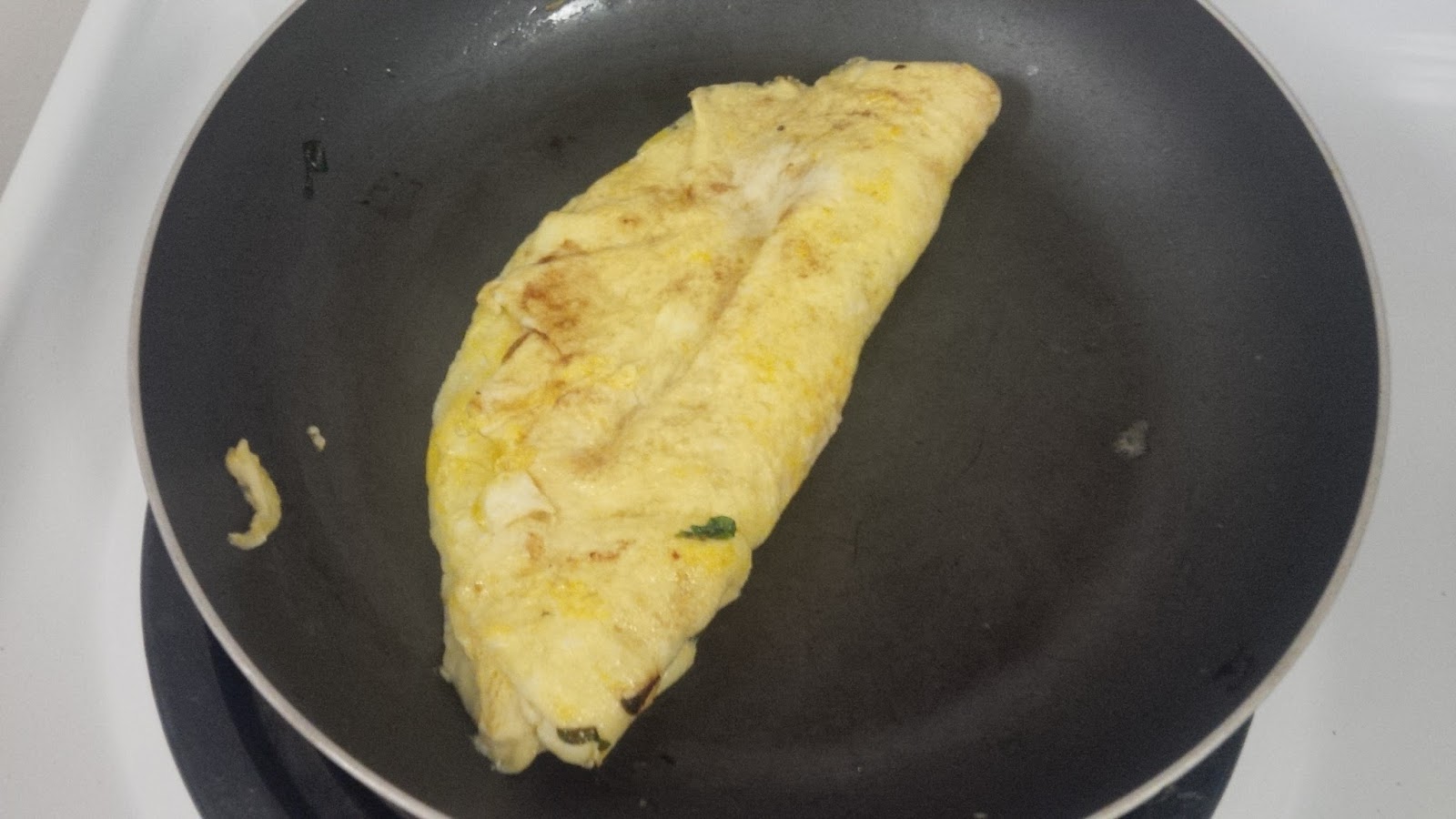
Let it cook on medium heat for about another two minutes. Don't forget, the sautéed veggies are done, and it's just to let the flavours seep through.
When you're done, you can toast a bagel, slice a couple of strawberries for garnishing, and you should have something like this.

Enjoy!
Michael Crichton
I read a book written by Michael Crichton when he was still a medical student, writing under the handle Jeffery Hudson called "A Case of Need" exceptionally well written, fast paced with no fillers at all.

An early book showing how good he was going to get. I don't know if he got better at narrative, but his storytelling was already formed at that early stage.
"A Case of Need" is a story about abortion. Weaving through the thriller, Michael Crichton talks honesty about the medical industry (because an industry it is), about the moral, ethical, political and health issues regarding abortion as well as educating the reader on medical terminology and the hierarchy and politics that exist within hospitals.
He knows his stuff and it shows from the story and how it's told.
I'm envious of the ability to tell a story so clearly, lucidly and engagingly. I'm envious of how much he knows about the subject and how easily he can tell it. It's a gift no doubt, that he has and not too many doctors do. In fact, not too many professional storytellers have that gift, the ability to hone in on the absolute minimum number of words to say what you have to say. Not only that, the ability to decide what's important and interesting and only give those details.
It's storytelling not just for the sake of having something to write about, but storytelling because you're dying to say something. You have something that you're passionate about, interested in and you really want others to hear it.
And Michael Crichton's interest in medicine shows. He cares about what he's talking about. He's interested in getting to the end of the story and he makes sure that his characters are believable.

I don't think that's something that you can be taught in school. In fact, the older I get, the more I'm disappointed with the formal systems we have of educating our youth. I think it breaks down somewhere near the teenage years.
In "A Case of Need" Michael Crichton has about three or four themes running through. There's the story of his friend, a doctor, who's been convicted of killing the daughter of a wealthy family (also a medical family) by performing an abortion. The friend never really features in the story, but through the story the depth of the friendship is explored, superficially. Then there's the issue around abortion. How they're done, why they're done, how risky they are, what a baby is, the moral issue of life and when it begins and so forth. There's the investigation, the relationship of police and doctors and finally the different disciplines in the medical field. Surgeons, pathologists, anestheologists, gynocologists plus the cast of different professions all running the hospital. We are interested in open heart surgery, and the operation of this complex machine we call our body.
I'm definitely going to read the rest of his Jeffery Hudson books as well as books he wrote as John Lange and one with his brother Douglas Crichton under the pseudonym Michael Douglas.
An early book showing how good he was going to get. I don't know if he got better at narrative, but his storytelling was already formed at that early stage.
"A Case of Need" is a story about abortion. Weaving through the thriller, Michael Crichton talks honesty about the medical industry (because an industry it is), about the moral, ethical, political and health issues regarding abortion as well as educating the reader on medical terminology and the hierarchy and politics that exist within hospitals.
He knows his stuff and it shows from the story and how it's told.
I'm envious of the ability to tell a story so clearly, lucidly and engagingly. I'm envious of how much he knows about the subject and how easily he can tell it. It's a gift no doubt, that he has and not too many doctors do. In fact, not too many professional storytellers have that gift, the ability to hone in on the absolute minimum number of words to say what you have to say. Not only that, the ability to decide what's important and interesting and only give those details.
It's storytelling not just for the sake of having something to write about, but storytelling because you're dying to say something. You have something that you're passionate about, interested in and you really want others to hear it.
And Michael Crichton's interest in medicine shows. He cares about what he's talking about. He's interested in getting to the end of the story and he makes sure that his characters are believable.
I don't think that's something that you can be taught in school. In fact, the older I get, the more I'm disappointed with the formal systems we have of educating our youth. I think it breaks down somewhere near the teenage years.
In "A Case of Need" Michael Crichton has about three or four themes running through. There's the story of his friend, a doctor, who's been convicted of killing the daughter of a wealthy family (also a medical family) by performing an abortion. The friend never really features in the story, but through the story the depth of the friendship is explored, superficially. Then there's the issue around abortion. How they're done, why they're done, how risky they are, what a baby is, the moral issue of life and when it begins and so forth. There's the investigation, the relationship of police and doctors and finally the different disciplines in the medical field. Surgeons, pathologists, anestheologists, gynocologists plus the cast of different professions all running the hospital. We are interested in open heart surgery, and the operation of this complex machine we call our body.
I'm definitely going to read the rest of his Jeffery Hudson books as well as books he wrote as John Lange and one with his brother Douglas Crichton under the pseudonym Michael Douglas.
Through the fire
Running through the fire.
Or running through pain.
Is when you get stronger.
Is when you become and realise who you are.
Running means forcing.
It means not taking your time.
It means being a little stressed.
It means following your heart, your heartbeat.

Through that moment of pain.
Perhaps more than a moment.
And you're inside yourself.
You think.
It's hard.
And it's agonising.
And it hurts.
Your lungs bursting.
Through the fire.
You pass.
The Power of the Story
The Story.
Before writing there was sound. Pictures painted in the mind. With voices. With actions. The story was acted out by the actor. The actor acted. And the story was transferred from the actor to the listener.
But the story was more than just a means of information. The story was entertainment. Listening to the story and watching the story, we became engaged. We became a part of the story and so lived in the world of the storyteller.
The story has never left us. We live for the story. Without the story our humanity would not exist. We live for the story. We are only about the story. Because the story inspires. The story allows us to reach higher goals. To walk on the moon. To build hovercrafts. To create medicines that heal and medicines that strengthen. The story encourages us to wake up each morning and drive through the day inspired that we matter. The story creates and then recreates us. And so we need to be reminded of the story every day. So that we can rewrite it. Every day. Every moment. We sculpt our story every single moment. And review it and change it.

I'm listening to my mind telling me that tomorrow will bring the same things that today brought. That tomorrow will be a repeat of today. But that's not what I want. I don't want familiarity. I don't want the same story. I want a new one. But if I'm the author of my own story, then I cannot write it until its done. I cannot write that story until it unfolds. Only then can I see what the story was. A contradiction. Not so.
Back to posting
Been a long time
Since you touched me
And made me feel that wonderful glow
The way you do
Been a long time
Since you held me and squeezed me
So I wonder what's come over you
Since you touched me
And made me feel that wonderful glow
The way you do
Been a long time
Since you held me and squeezed me
So I wonder what's come over you
--- Ashford & Simpson
The last time I posted on this blog was a while back. That's because the holidays were here and I threw myself into spending time with family. I'm borderline workaholic and the change of pace was good.
So far, August 2015, there have been only 6 posts for the year. You cannot call yourself a blogger with an average of a single post a year. And most of them in May.
But we're back with a commitment to make up for the lost time. There have been a lot of lessons learned, stuff read, experiences had and much to say. I'm 50 now (since December 2014) and perhaps the fright of the big five-o somewhat got to me.

I've been watching a lot of documentaries while working. I watched Lance Armstrong's fall from grace. And I understand. I watched Mike Tyson's fall from grace. And this one's a little harder to understand. I watched a couple of documentaries on vegetable juice diets. Interesting, but I see health risks with those. And I've continued to run. If there's anywhere I find complete solace, it's at 4k mark.

This post wasn't supposed to be inspiring, but just a way to get back onto the keyboard and write.
Thursday, May 28, 2015
I won't always be this age
When I turned 30, I thought nothing of age. I thought nothing of death. I thought nothing of incapacity. I could do anything. Possibly even better than in my 20's. I was getting stronger and running harder.
I turned 40. I gave age a fleeting thought. It was more philosophical. Not yet quite real. We were a young family still. I was oblivious of life's challenges, which I knew people were going through. I didn't have to struggle much. I worked hard and everything was looked at philosophically. I was an idealist. Not a realist. And every action was wrapped around a metaphysical context.
I'm now 50. The kids are not kids anymore. I have whatever's left of my life back. And I can slip back into my philosophical shell. The practical life of earning money to live is still here, but the end of that life is closer.
At 50, I've spent time looking at pictures. And boy, I've aged. I'm so much older. I can see it now. The incremental changes that were happening over the years were barely noticeable. It's like I stepped into a black hole and came out on the other side in a different civilization. I'm no longer the kid. I'm no longer the dad. I'm almost the granddad.
I came across a picture of myself at 11 years of age. I could see some resemblance. I looked small, timid and subdued. And I have so many pictures of me during my university days. Life was a full time job. It wasn't what you did in the evenings or on weekends. We lived twenty-four hours a day, seven days a week, twelve months a year. Interrupted by periods of education. When I look at pictures of myself during my university days, I looked so happy. I didn't have much money. But money wasn't a source of pleasure. It wasn't what drove happiness. Money was an enabler. But even if you didn't have it. You still were able to find happiness. We read a lot. We read so much and spent a lot of time talking and discussing ideas. We built models of balsa wood. Of cardboard. Models even using cut up beer cans. We were creative. And life was good.
But as I sit here, I'm thinking different thoughts. Hopefully I get to sixty, then seventy and beyond. I'll probably look back at 50 and think, "boy, that doesn't look so bad!" So that's how I should behave now. That 50 doesn't look that bad. And live 24 hours a day, 7 days a week, 12 month a year. All the way to 60.
And when I get to 60, take a moment to look in the rear-view mirror, only for a second before charging forward again.
There was a time in my mid-40's where I was trying to search for my life back. Get that "joie de vivre" back. If I was to draw a "smart curve," it would look like the following:

Smartness on the y-axis and age on the x-axis. I think that I was smartest between 20 and 30. Those were the university days. Running marathons in 3:12 to 3:20 easily. I recall passing the half at 1:10 during the Ottawa marathon. Reading Kant, Descartes, Socrates, C. S. Lewis, Bertrand Russell, John Stewart Mill, Michel Foucoult among others. And learning about China's history of art and architecture. Drawing. Living like a true Leonardo da Vinci. A master of all trades.
But still some John Grisham, Umberto Eco, Michael Crichton and the stuff that takes you away from this life into the fantastical.
The philosophical quest died when I started working. Art, drawing and architecture followed soon. And all that was left was the shell of the engineering mind and the books of fantasy. And feeding your brain with that stuff does not get you very far. Garbage in. Garbage out.
But now I'm fifty. I will never be this age again. I look at myself ten, twenty years ago and wonder where the time went? I was busy mowing the lawn. Running to the grocery store. Working extended hours. Not talking to my family. Disconnected from mum and dad. That's what I was busy doing. I look at pictures of dad in his youth. And pictures of dad today. You can see the youthful man, inside the older man's body.
And that's what I want to do and be. I want to look back at 80. And still see this fifty year old inside.
Sunday, May 03, 2015
Time and death
I recently watched a YouTube speech by Sam Harris - Sam Harris - Death and the Present Moment. Sam says, death, the fear of death, is one of the major components of religion. We are, apparently, incapable imagining a world where we're not a part of it. We cannot imagine life before we were here. And we cannot imaging a world going on once we're gone. Hence the promise by religion that we are not going away for good. That there is a life after this one.
It's an interesting speech. A different perspective from the regular atheist perspective which tends to ask for proof. Clearly religion cannot prove what they claim. It's all inductive reasoning. The type of reasoning that says, "there must be something after death" because "there's no better explanation."
Another dead end.
Another dead end argument.
Sam is an interesting character. A neuroscientist who's very interested in philosophical questions about spirituality. I sometimes tend to think that Sam thinks that it's quantifiable.
He presents death in a very understandable language. He says:
And...
Finally...
The speech is very engaging in its two parts. First, the obsession with death, a future event that is definite. An event that we cannot, in this moment, do anything about. A future event. And secondly, what are we doing in this present moment, the only moment that we live in.
Ultimately, it isn't wrong to contemplate death, or a life after death. It is our human condition to want to understand our environment. Questions like "where did we come from?" and "where are we going?" are philosophical questions that we will continue to ask. The problem comes from drawing conclusions, just because we cannot think of a better answer.
Science proceeds by formulating theories, and then testing them. There's a hope in the scientist, that someone will come along and prove them wrong. Because their theories explain some part of the physical world. Religion is not testable. At least in the scientific sense. However, there are many things not testable that we can rely on and make decisions on. Dinesh D'Souza, who has since proven that he's an intellectual fraud, once gave this example of something we know exists, however cannot prove. For example, love. You may love someone, but cannot scientifically prove that you do. And you make marriage decisions and commitments based on an intuition that you have.
Science cannot prove that the claims made by religion are false.
Science cannot prove that there is no life after death.
However, the burden of proof is on religion to prove that the claims it makes are true.
Bertrand Russell's teapot is a good example of how the burden of proof remains with one who makes the claim.
What did I understand from the speech?
We need to know that we are not the focus of the universe. That we will ultimately go away. That life doesn't care whether we're here or not. Knowing that, we should use the time we have, this present moment, wisely. Caring about things that matter. Not worrying about things that have passed. Or spending it on too much planning about things to come. As Ram Dass says, "Be Here Now."
It's an interesting speech. A different perspective from the regular atheist perspective which tends to ask for proof. Clearly religion cannot prove what they claim. It's all inductive reasoning. The type of reasoning that says, "there must be something after death" because "there's no better explanation."
Another dead end.
Another dead end argument.
Sam is an interesting character. A neuroscientist who's very interested in philosophical questions about spirituality. I sometimes tend to think that Sam thinks that it's quantifiable.
He presents death in a very understandable language. He says:
Most of us do our best not to think about death. But there’s always part of our minds that knows this can’t go on forever. Part of us always knows that we’re just a doctor’s visit away, or a phone call away, from being starkly reminded with the fact of our own mortality, or of those closest to us.
And...
But the one thing people tend to realize at moments like this is that they wasted a lot of time, when life was normal. And it’s not just what they did with their time – it’s not just that they spent too much time working or compulsively checking email. It’s that they cared about the wrong things. They regret what they cared about. Their attention was bound up in petty concerns, year after year, when life was normal. This is a paradox of course, because we all know this epiphany is coming. Don’t you know this is coming? Don’t you know that there’s going to come a day when you’ll be sick, or someone close to you will die, and you will look back on the kinds of things that captured your attention, and you’ll think ‘What was I doing?’. You know this, and yet if you’re like most people, you’ll spend most of your time in life tacitly presuming you’ll live forever. Like, watching a bad movie for the fourth time, or bickering with your spouse. These things only make sense in light of eternity. There better be a heaven if we’re going to waste our time like this.
Finally...
As a matter of conscious experience, the reality of your life is always now. I think this is a liberating truth about the human mind. In fact, I think there is nothing more important to understand about your mind than that if you want to be happy in this world. The past is a memory. It's a thought arising in the present. The future is merely anticipated, it is another thought arising now. What we truly have is this moment. And this. And we spend most of our lives forgetting this truth. Repudiating it. Fleeing it. Overlooking it. And the horror is that we succeed. We manage to never really connect with the present moment and find fulfillment there because we are continually hoping to become happy in the future, and the future never arrives.
The speech is very engaging in its two parts. First, the obsession with death, a future event that is definite. An event that we cannot, in this moment, do anything about. A future event. And secondly, what are we doing in this present moment, the only moment that we live in.
Ultimately, it isn't wrong to contemplate death, or a life after death. It is our human condition to want to understand our environment. Questions like "where did we come from?" and "where are we going?" are philosophical questions that we will continue to ask. The problem comes from drawing conclusions, just because we cannot think of a better answer.
Science proceeds by formulating theories, and then testing them. There's a hope in the scientist, that someone will come along and prove them wrong. Because their theories explain some part of the physical world. Religion is not testable. At least in the scientific sense. However, there are many things not testable that we can rely on and make decisions on. Dinesh D'Souza, who has since proven that he's an intellectual fraud, once gave this example of something we know exists, however cannot prove. For example, love. You may love someone, but cannot scientifically prove that you do. And you make marriage decisions and commitments based on an intuition that you have.
Science cannot prove that the claims made by religion are false.
Science cannot prove that there is no life after death.
However, the burden of proof is on religion to prove that the claims it makes are true.
Bertrand Russell's teapot is a good example of how the burden of proof remains with one who makes the claim.
What did I understand from the speech?
We need to know that we are not the focus of the universe. That we will ultimately go away. That life doesn't care whether we're here or not. Knowing that, we should use the time we have, this present moment, wisely. Caring about things that matter. Not worrying about things that have passed. Or spending it on too much planning about things to come. As Ram Dass says, "Be Here Now."
Saturday, May 02, 2015
The Lazy Person's Guide to Running Marathons

This was a toastmaster's speech that I gave, probably around 2011. Speech #8 in the Toastmaster's Competent Communicator (CC) program. This speech is about using visual material. I sometimes use examples and analogies about runners, or running, when speaking. I know how hard it is to run, especially as an adult. I've been there. And because I've been there, I'm a great ambassador for the sport. Perhaps the greatest ambassador since without a doubt, I was the poorest runner in my high school. Kids much younger than me could outrun me even on my best days.
So in this speech, rather than give examples, I dive directly into the art, or science, of running. I began by saying that running is one of the sports that isn't actually taught in school. Unlike football, or basketball, or swimming or tennis, running isn't taught. There seems to be no technique. The running coach stands on the side of the track and yells "RUN!!!"
But there is a technique.
And it can be taught.
And it can be learned.
(ps: that foot you see in the photos is mine ;), I had my drawings on the floor taking pictures and couldn't be bothered to re-take them after I saw my foot in them).

Drawing 1. I ask. Why Marathons? There are three sections in that slide where I split running into three categories. Fast 100m to 400m dash. Middle distance running. 1500m to 10,000m. And finally, long distance running. The point of that slide is to illustrate how calm the long distance runner looks, in comparison to the short and middle distance runners. That the effort in running marathons is acceptable to the "lazy" runner.

Drawing 2. In most sports, you need money and equipment. Hockey is expensive since you also need to find a rink. Same goes for skiing. But with running, a good pair of running shoes (also optional) and cheap clothes will do it. No need to go looking for a track, you can step out of your house and start running. When I put up this slide, I had completely shaved my head, so the "HAIR (optional)" got a few laughs.

Drawing 3. Here's where we get serious about running technique. And I present the three techniques, philosophies, that are getting traction in the running world. Chi running emphasises posture, a mid-foot strike and a slight lean forward to take advantage of gravity. Pose running emphasises posture as well, but they also focus on an "S" position where knees are slightly bent. A slight lean forward to take advantage of gravity. And they encourage landing on the balls of the feet. Evolution running also emphasises running economy by focusing on minimising vertical displacement. Don't bounce up and down. Land on the most elastic part of your foot (the front). Land close to your centre of gravity. They're all fairly similar in that they address three key items. Posture. Foot strike. Cadence.

Drawing 4. Posture. Maintain an upright posture with a slight lean forward. Leonardo Da Vinci's quote: Motion is created from the destruction of BALANCE. What this means is that the forward motion will be created automatically by leaning forward. Not by forcefully pushing forward with your legs. Your legs serve to spring off the ground - and we'll see that in a later drawing. By keeping your centre of balance close to where your foot will land, you move naturally.

Drawing 5. Foot Strike. Minimise heel striking. Land on the front of your foot, or the middle. Sprinters run on their toes. Most adults tend to run on their heels. Most of this due to the type of shoes. Try to run without shoes, barefoot. And you'll find it impossible to heel strike. The shoes you run will either aid in avoiding heel striking or encourage it. Heel striking as illustrated has a braking effect. While landing near the front of the foot encourages elastic motion which returns energy from the Achilles. You also land closer to your centre of gravity if you land near the front of your foot, or the middle.

Drawing 6. Cadence. The number of steps you take per minute. Most elite, professional, distance runners have a cadence of about 180 spm. Some as high as 190 spm. Proper cadence allows the Achilles to stretch, therefore storing energy, and then return it while pushing off. Try running with a cadence of about 180 spm. At least close to 170 to 180. With a slow cadence, the energy stored by the Achilles is lost and you don't get the benefit of the energy return. With each footfall, you loose most of the energy from your spring to the ground. Elite athletes will get 40% to 50% of that energy returned to them.
Blogging
Everyone has a journalistic impulse. The impulse to tell a story. To speak at least. Families sit around the dinner table, and tell each other how the day went. Co-workers go out for lunch and chat. Lovers cuddle up tell each other how they feel.
We all like to talk.
Rarely do we like to write.
I've blogged before about the pen and the keyboard. The effects of email versus the handwritten note.
 I grew up during a time when there were no computers. Everything was manual. Which means that we laboured for the simplest tasks. Writing was indeed a chore. It took a long time and we didn't have backspace, cut-and-paste, or the Internet.
Everything had to be carefully pre-planned. Everything was very carefully done. Words were not wasted. And each and every thing written was crafted. Designed.
In this age of technology, of the Internet. We ramble on, like I'm doing. Knowing that words are cheap. Knowing that we can cobble up a story from a variety of sources in very little time.
It's the fast-food mentality. Things are being done very quickly, almost without thought. If I need to write something on the devastation of the white rhino in Africa, I can have an acceptable story in a hour. It may not be passionate, but I can cobble it up. Because of the Internet.
But a pen in the hand is slow. Words don't rush out the way they do on a keyboard. And your brain is ahead of your hand. And you are, in my impression, a little bit more thoughtful.
Expression, and self- expression in print was limited to a chosen few. Some had talent. Some only had money. We read a handful of writers in newspapers. Some good authors, but they were the same ones. You had to go to school. Earn a degree in journalism, or writing. Get a job. And then you could tell your story.
The new media is the Internet. And on the Internet, everyone is a journalist. Everyone is an artist. Blogging is the new media. The traditional newspapers are struggling. Print subscriptions are limited to those who grew up with print media. The new generation is focussed on getting their information from digital media. The Internet. And not only from professionals. From anyone who cares to write. Even me.
That said, I encourage everyone to blog. Since camping and face-to-face socialising is on the decline. This is an acceptable substitute. Blogging will allow you as a professional, or expert, in your field, to share your knowledge in ways that you were not able to before. How was the engineer who discovered an amazing way to design a helpful product able to share it in the past? It was so difficult, and cumbersome, as to make sharing not worth it. However, that same engineer can now go online, write, draw and publish their work. For the world to see and learn from.
Blog often. Blog every day if you can. Sometimes, you'll hit on a good idea. A good theme. Often you may not. But the media is here. And the opportunity to inform is greater than it ever was before. But the more you blog, the better you'll get.
A last thing about blogging and sharing. Wikipedia.
I heard somewhere, that there are doctors who consult Wikipedia for medical information. This is extreme. We all know by now that the Internet is a great platform for sharing information, but the trustworthiness of the information depends greatly on the source. Wikipedia isn't a trustworthy source. There's a lot of good information there. But there's also a lot of garbage. Anyone can edit pages in Wikipedia making it an excellent target for misinformation. As a layman, getting superficial medical information from Wikipedia is acceptable. If we take it for what it is. Information from an unknown, potentially incorrect, source. But medical professionals must have better references. Like the PDR (Physicians Desktop Reference). Shame on them.
I have a Wikipedia account, and from time-to-time, go online and edit some of the pages. I've never created a page from scratch, but I've logged into my account on an editing binge. To correct misinformation. It's a difficult task. To its credit, Wikipedia is an amazing platform and shows how collaboration can work. I don't know what the percentage would be, but wouldn't be surprised if I heard that more than 30% of the information on Wikipedia was garbage.
That said, its a better world with Wikipedia than without it. Just as it's a better world with blogs than without it. At the end of the day, with over seven billion people on this planet, your words, pictures, thoughts are bound to inspire someone out there. And that's worth the effort.
We all like to talk.
Rarely do we like to write.
I've blogged before about the pen and the keyboard. The effects of email versus the handwritten note.
Everything had to be carefully pre-planned. Everything was very carefully done. Words were not wasted. And each and every thing written was crafted. Designed.
In this age of technology, of the Internet. We ramble on, like I'm doing. Knowing that words are cheap. Knowing that we can cobble up a story from a variety of sources in very little time.
It's the fast-food mentality. Things are being done very quickly, almost without thought. If I need to write something on the devastation of the white rhino in Africa, I can have an acceptable story in a hour. It may not be passionate, but I can cobble it up. Because of the Internet.
But a pen in the hand is slow. Words don't rush out the way they do on a keyboard. And your brain is ahead of your hand. And you are, in my impression, a little bit more thoughtful.
Expression, and self- expression in print was limited to a chosen few. Some had talent. Some only had money. We read a handful of writers in newspapers. Some good authors, but they were the same ones. You had to go to school. Earn a degree in journalism, or writing. Get a job. And then you could tell your story.
The new media is the Internet. And on the Internet, everyone is a journalist. Everyone is an artist. Blogging is the new media. The traditional newspapers are struggling. Print subscriptions are limited to those who grew up with print media. The new generation is focussed on getting their information from digital media. The Internet. And not only from professionals. From anyone who cares to write. Even me.
That said, I encourage everyone to blog. Since camping and face-to-face socialising is on the decline. This is an acceptable substitute. Blogging will allow you as a professional, or expert, in your field, to share your knowledge in ways that you were not able to before. How was the engineer who discovered an amazing way to design a helpful product able to share it in the past? It was so difficult, and cumbersome, as to make sharing not worth it. However, that same engineer can now go online, write, draw and publish their work. For the world to see and learn from.
Blog often. Blog every day if you can. Sometimes, you'll hit on a good idea. A good theme. Often you may not. But the media is here. And the opportunity to inform is greater than it ever was before. But the more you blog, the better you'll get.
A last thing about blogging and sharing. Wikipedia.
I heard somewhere, that there are doctors who consult Wikipedia for medical information. This is extreme. We all know by now that the Internet is a great platform for sharing information, but the trustworthiness of the information depends greatly on the source. Wikipedia isn't a trustworthy source. There's a lot of good information there. But there's also a lot of garbage. Anyone can edit pages in Wikipedia making it an excellent target for misinformation. As a layman, getting superficial medical information from Wikipedia is acceptable. If we take it for what it is. Information from an unknown, potentially incorrect, source. But medical professionals must have better references. Like the PDR (Physicians Desktop Reference). Shame on them.
I have a Wikipedia account, and from time-to-time, go online and edit some of the pages. I've never created a page from scratch, but I've logged into my account on an editing binge. To correct misinformation. It's a difficult task. To its credit, Wikipedia is an amazing platform and shows how collaboration can work. I don't know what the percentage would be, but wouldn't be surprised if I heard that more than 30% of the information on Wikipedia was garbage.
That said, its a better world with Wikipedia than without it. Just as it's a better world with blogs than without it. At the end of the day, with over seven billion people on this planet, your words, pictures, thoughts are bound to inspire someone out there. And that's worth the effort.
Friday, May 01, 2015
Body, Spirit and Mind
The Body:
We live in a cultural wasteland. A virtual blend of everything that is antisocial, yet we still crave contact, so we design environments, artificial environments, to make this contact happen.
Our neighbors are the world. Unlike centuries ago when we didn't know a lot about anything a few miles away, we now know everything about everyone. We know what the Prime Minister in Australia is doing even before many of his citizens do.
And what's the value of that.
We no longer need to exercise. In fact, I see the day when exercise will be futile. Because it won't be necessary to keep in shape.
Remember that movie with Bruce Willis? Surrogates. Where humans lived via remotely controlled androids, or clones. They stayed in their homes and operated the clones using amazing technology. And apparently experienced "real life" using those clones.
If you haven't seen the movie, then you should because it mirrors what's happening today.
We live online. We experience everything via our computers, phones or tablet devices. We would stay all day, and all night, in the comfort of our beds, except that we need to make money and eat. If clones were around today, society would disappear.
And so the short of it is that we've neglected our bodies. But have no fear. Medicine will solve that. The makers of The Matrix were not too far off.
But I've been thinking. Is a life without a body a complete life? After all, our mental faculties are really just chemistry. At the end of the day, it's ALL physical, isn't it. Not having good physique must impact your mental and spiritual state, at some level.
That's why beer and wine are so popular. They alter your mental state.
Do.
That's the keyword.
Do.
Leonardo Da Vinci said: I have been impressed with the urgency of doing. Knowing is not enough; we must apply. Being willing is not enough; we must do.
Johann Wolfgang von Goethe said: Knowing is not enough; we must apply.
In this information age, we are creating information, some of us. But a majority are consumers.
The body is inextricably linked to the mind. Which is linked to the spirit. Your desires and feelings. It goes like this. Your mind is restless. So you infuse your body with a drug. Your mind then goes into a Zen mode. And you become spiritual. You calm down.
Even though you can be good, great or at least OK even if you ignore your body. You are better off if you don't. Unplug from the grid and look up into the sky. George Carlin said that everyone should spend an hour looking up into the sky and dreaming. It's difficult to unplug from the matrix. Because our minds need to keep busy. But unplugging to do something is so vitally important for mental health.

The Spirit:
I've never really understood the trinity, but there is something to be said about the fact that we have a spirit. I used to think that the spirit and the mind were the same thing, until someone gave me this distinction. The spirit feels. The mind decides and acts. But just as the mind is affected by the body, so is the spirit. When I go on a really long run. And the endorphins kick in. I have a sense of the sublime. The numinous. I feel spiritually connected to everything on the planet. I'm happy. Even if things are not going well at work, or at home. At that moment, when I've exhausted my body. I feel wonderful. And my mind feels the same way too. Clarity of thought.
This connection has nothing to do with religion. Has nothing to do with meditation. Has nothing to do with spiritual consciousness, of the type preached by Deepak Chopra. This is a euphoria that springs from physical activity. Not consciously forced by meditation or a spiritual belief. Something that simply wells up when the body works.
The spirit guides by intuition. The mind by logic.
The Mind:
In computer terminology, this would be called the central processing unit. It's primary purpose is to receive data from the outside world, and determine the options available. See Lion. What to do? See girlfriend. What to do? See boss walking towards you. And you haven't handed in that assignment. What to do? It doesn't always answer the question. Sometimes "See Lion" is answered by, "push friend forward." Or, "scream!" Or "push friend forward, scream and then run."
The mind is housed inside this shell. The body. The mind is a physical thing. Even though it seems to be doing intangible, non-physical things. We think of the mind as separate from the body, but in reality, it isn't. It's a piece of flesh, with chemistry just like muscles, kidneys and lungs. When damaged, it affects the entire body. However, it can be righted by physical stimuli. Dangerous criminals, whose minds tell them to do terrible things, can be quietened by lobotomy. Or by injecting them with chemicals to alter the brain chemistry.
Like the body, the mind becomes better with use. You get stronger if you stress your body. Similarly, your mind grows when it's challenged. Make it do complex things. Stuff that it doesn't want to do. Just like lifting heavy weights makes you stronger. Or running long distances makes you stronger. Making the brain really work will only make it better.
You make the brain work by giving it tasks. Work to do. Not just input. But mainly output. Not watching television or listening to music or reading all the time. But also engaging it by making it write, solve puzzles, paint, do math and also make music. The mind grows when it does.
Do.
The trinity is connected.
We live in a cultural wasteland. A virtual blend of everything that is antisocial, yet we still crave contact, so we design environments, artificial environments, to make this contact happen.
Our neighbors are the world. Unlike centuries ago when we didn't know a lot about anything a few miles away, we now know everything about everyone. We know what the Prime Minister in Australia is doing even before many of his citizens do.
And what's the value of that.
We no longer need to exercise. In fact, I see the day when exercise will be futile. Because it won't be necessary to keep in shape.
Remember that movie with Bruce Willis? Surrogates. Where humans lived via remotely controlled androids, or clones. They stayed in their homes and operated the clones using amazing technology. And apparently experienced "real life" using those clones.
If you haven't seen the movie, then you should because it mirrors what's happening today.
We live online. We experience everything via our computers, phones or tablet devices. We would stay all day, and all night, in the comfort of our beds, except that we need to make money and eat. If clones were around today, society would disappear.
And so the short of it is that we've neglected our bodies. But have no fear. Medicine will solve that. The makers of The Matrix were not too far off.
But I've been thinking. Is a life without a body a complete life? After all, our mental faculties are really just chemistry. At the end of the day, it's ALL physical, isn't it. Not having good physique must impact your mental and spiritual state, at some level.
That's why beer and wine are so popular. They alter your mental state.
Do.
That's the keyword.
Do.
Leonardo Da Vinci said: I have been impressed with the urgency of doing. Knowing is not enough; we must apply. Being willing is not enough; we must do.
Johann Wolfgang von Goethe said: Knowing is not enough; we must apply.
In this information age, we are creating information, some of us. But a majority are consumers.
The body is inextricably linked to the mind. Which is linked to the spirit. Your desires and feelings. It goes like this. Your mind is restless. So you infuse your body with a drug. Your mind then goes into a Zen mode. And you become spiritual. You calm down.
Even though you can be good, great or at least OK even if you ignore your body. You are better off if you don't. Unplug from the grid and look up into the sky. George Carlin said that everyone should spend an hour looking up into the sky and dreaming. It's difficult to unplug from the matrix. Because our minds need to keep busy. But unplugging to do something is so vitally important for mental health.
The Spirit:
I've never really understood the trinity, but there is something to be said about the fact that we have a spirit. I used to think that the spirit and the mind were the same thing, until someone gave me this distinction. The spirit feels. The mind decides and acts. But just as the mind is affected by the body, so is the spirit. When I go on a really long run. And the endorphins kick in. I have a sense of the sublime. The numinous. I feel spiritually connected to everything on the planet. I'm happy. Even if things are not going well at work, or at home. At that moment, when I've exhausted my body. I feel wonderful. And my mind feels the same way too. Clarity of thought.
This connection has nothing to do with religion. Has nothing to do with meditation. Has nothing to do with spiritual consciousness, of the type preached by Deepak Chopra. This is a euphoria that springs from physical activity. Not consciously forced by meditation or a spiritual belief. Something that simply wells up when the body works.
The spirit guides by intuition. The mind by logic.
The Mind:
In computer terminology, this would be called the central processing unit. It's primary purpose is to receive data from the outside world, and determine the options available. See Lion. What to do? See girlfriend. What to do? See boss walking towards you. And you haven't handed in that assignment. What to do? It doesn't always answer the question. Sometimes "See Lion" is answered by, "push friend forward." Or, "scream!" Or "push friend forward, scream and then run."
The mind is housed inside this shell. The body. The mind is a physical thing. Even though it seems to be doing intangible, non-physical things. We think of the mind as separate from the body, but in reality, it isn't. It's a piece of flesh, with chemistry just like muscles, kidneys and lungs. When damaged, it affects the entire body. However, it can be righted by physical stimuli. Dangerous criminals, whose minds tell them to do terrible things, can be quietened by lobotomy. Or by injecting them with chemicals to alter the brain chemistry.
Like the body, the mind becomes better with use. You get stronger if you stress your body. Similarly, your mind grows when it's challenged. Make it do complex things. Stuff that it doesn't want to do. Just like lifting heavy weights makes you stronger. Or running long distances makes you stronger. Making the brain really work will only make it better.
You make the brain work by giving it tasks. Work to do. Not just input. But mainly output. Not watching television or listening to music or reading all the time. But also engaging it by making it write, solve puzzles, paint, do math and also make music. The mind grows when it does.
Do.
The trinity is connected.
Monday, April 27, 2015
The Fountain Pen versus the Keyboard

Clearly outmatched, the fountain pen struggles back to its feet. "This can't be the end," she cries.
Most of her friends are long gone. Only she's left. She's feeling frail and alone in a world that has abandoned her.
Quietly she slips into her corner, where nobody can see her. To reminisce.
It's keyboard city. They're loud and brash. Care nothing about delicacy. About art. It's about banging stuff out. Repetitively hitting key after key. As though there was meaning.
There is no meaning.
Only production. Is this what we were meant for? Even they're envious of one another. Looking at each other, but not seeing. They're only interested in themselves. "How much do you know about me?" "Let me tell you another story, yes, about me." Pompous braggarts they are. The noise they make is completely unintelligible. It's unintelligent. It's pure nonsense. They're not thinking. They're too hurried to look where they're going. Like clones. This work looks exactly like that work. The cacophony masks the underlying mediocrity.
There is no meaning.
Meanwhile, in her little corner, the fountain pen remembers how it used to be. It wasn't like this. Mont Blanc's Sheaffer's Lamy's, Cross' and sometimes they'd even let Parker's hang out with them at the cafe. There was no competition. Just mutual admiration. They'd argue into the night about serifs and the beauty of the bowed upstrokes of lowercase letters. The majesty of uppercase, how sprinkling a few here and there brought order to the parchment. And soon Caran d'Ache, Faber-Castell and Waterman arrived. And they looked at each other. And all they saw was good.
And there was meaning.
But the writing was on the wall when the Biro arrived. That was the beginning of the end. The end of beauty. Those ball point pens were the first attack. No fineness. Scratching along uncontrollably on the page. Discarded after a short life. Expendable. Having nothing to live for, they drank themselves to exhaustion. But they've managed to survive. Somehow, they've managed to slip behind the masses of keyboards. Like their serfs. Their servants. Their lackeys. They believe it's a partnership. But the keyboard doesn't even notice that they're there.
And still there is no meaning.
The majestic fountain pen refuses to be anyone's slave. She will bow down to nobody. She's come to the realisation that everything ends. In the circle of life. It's good to have lived. It will be good to be remembered. This is a world she does not care for. Everything ends.
Everything.
One day she will be relegated to the annals of an art to be forgotten. Displayed in a glass case, in a museum. Where children will ask what she is. And with the impatience of youth, wonder why anyone would painstakingly use such an object. Like a scribe in ancient times, laboriously mixing pigment and using a reed to record a single stroke.
But she is also well aware, that the keyboard will also die out. They do not know it. Laughing and polluting the world with their noise. Meaningless noise. It is not that the knowledge in the world doubles every year. It's the noise.
She turns around, seeking the only person who cares.
And I am there.
Sunday, November 02, 2014
Happiness
I recently watched a documentary on Netflix titled, "Happy." The film makers asked a relatively simple question, "What would you like to get out of life?" -- or something along those lines. In nearly all cases, the response was "I want to be happy." There was another more difficult question, "What do you need to make you happy?" One response from a young black man, well dressed, obviously conscious of his appearance and his definition of success was, "lots of money! Oh yeah, money."

I suspect that that response is truer than most people, me included, would like to admit. Even though we know at a basic level, that it's not the money we want, but the things that the money would bring, it's those things that would bring happiness. The freedom to do what we think we wish we want to do.
But have we really reflected on those things? Those things that we'd like to do that sit in our imagination most of the time. Those things that money is supposed to bring, or at some point in life, does the pursuit of money itself become so overwhelming that it becomes the goal. A goal which doesn't make sense when you think of happiness.
There's a principle in psychology known as the Hedonic Treadmill. It's about the tendency for humans to quickly return to a relative stable level of happiness. This means that even in that euphoric state of feeling good, you quickly adapt to feeling normal about that situation. For example, getting a raise. There's a feeling of the world of possibilities opening up, that this is an endorsement of your work, a sign of the respect that you're getting and ultimately a great step forward in now getting to the point where you become truly happy. But you quickly settle into that new salary and quicker than you can imagine, you begin to look forward to the next step and the pursuit begins again. Oscar award winners will speak of the moment that their name is called and they walk up to the podium to accept their golden statue. The feeling of walking up there, basking in the applause, speaking of the challenges of having made that movie and the acting and the role, and then walking back out of the limelight. From time to time returning to that place by meditating on the event past, looking at the statue in their award closet, but already focussed on the next event.

If happiness cannot be found in the present moment of doing the activity, then you can never be truly happy.
But not to negate the effect of money, clearly in this life, money is the enabler of a lot of things. But as in the documentary, the essential point is "how much." I believe that many of us, especially those of us who live in this western world of middle to high incomes, already have the things to make us happy right in front of us. It's really identifying with them. There's a difference if you spend a lot of your time worrying about where you're going to get your next meal, or where to go for shelter. But the difference between that person who makes $100,000 a year and $200,000 isn't that big. It's even less between $500,000 and $1,000,000. And clearly the happiness meter isn't affected by money when you're thinking about the difference between a salary of $10,000,000 and $100,000,000 (or even a billion).
If you cannot be happy earning $1,000,000, I doubt that money's the problem.

Another interesting titbit from this movie came from the opinion of a couple of psychologists and neuroscientists. Apparently, 50% of your ability to be happy comes from your genes. 50% of the wiring of your ability to be happy is handed down from your parents. That's a huge amount, but don't despair if your parents aren't the champions of happiness and well-being, you still have 50% to work with. Of that remaining 50%, 10% is attributed to the things that we're told are important. Having a good job, working hard, achieving professional success and even making money. The last 40% however, depends on your active pursuit of it. By actively engaging in, not pursuing, but doing the things that generate happiness. Meditation is one. The act of sitting still, pondering your own happiness and reflecting in how you can achieve it and not just letting things happen. Doing something each day to help someone else. Saying something nice to at least a couple of people each day. Going out of your way to make someone else happy.

The key idea here is to "do." It's amazing how so many times, happiness is tied to physical activity. Walking or running. Farming. Painting. Writing. Acting. Exercising. Climbing. Cooking. Cleaning. At times, I think that we're loosing touch with that physical world as we become more technologically advanced. Even as I type this, I wrote the salient parts in a book, by hand, with a fountain pen that I had to fill with ink. I'm not transcribing this word-for-word, but I'm paraphrasing what I paraphrased and thinking about what it meant. It's true, spending time thinking about how happy you'd like to be is important, like taking showers or eating. Something you need for good health. Activities you do with pleasure and are happy to engage in.
And so the challenge to you is to make sure you find some time to stop whatever you're doing and spend time thinking about your happiness. Irrespective of how much money you're making, you need to ask yourself if you were engaged in an activity today that made you happy. Today. When I wake up in the morning to run, I'm not the happiest person. When I take that first step outside, it sometimes hurts and I'm sore and tired. But I know, after a few minutes I begin to think differently. Think of how fortunate I am that I can do this.
And then I'm happy.
I suspect that that response is truer than most people, me included, would like to admit. Even though we know at a basic level, that it's not the money we want, but the things that the money would bring, it's those things that would bring happiness. The freedom to do what we think we wish we want to do.
But have we really reflected on those things? Those things that we'd like to do that sit in our imagination most of the time. Those things that money is supposed to bring, or at some point in life, does the pursuit of money itself become so overwhelming that it becomes the goal. A goal which doesn't make sense when you think of happiness.
There's a principle in psychology known as the Hedonic Treadmill. It's about the tendency for humans to quickly return to a relative stable level of happiness. This means that even in that euphoric state of feeling good, you quickly adapt to feeling normal about that situation. For example, getting a raise. There's a feeling of the world of possibilities opening up, that this is an endorsement of your work, a sign of the respect that you're getting and ultimately a great step forward in now getting to the point where you become truly happy. But you quickly settle into that new salary and quicker than you can imagine, you begin to look forward to the next step and the pursuit begins again. Oscar award winners will speak of the moment that their name is called and they walk up to the podium to accept their golden statue. The feeling of walking up there, basking in the applause, speaking of the challenges of having made that movie and the acting and the role, and then walking back out of the limelight. From time to time returning to that place by meditating on the event past, looking at the statue in their award closet, but already focussed on the next event.
If happiness cannot be found in the present moment of doing the activity, then you can never be truly happy.
But not to negate the effect of money, clearly in this life, money is the enabler of a lot of things. But as in the documentary, the essential point is "how much." I believe that many of us, especially those of us who live in this western world of middle to high incomes, already have the things to make us happy right in front of us. It's really identifying with them. There's a difference if you spend a lot of your time worrying about where you're going to get your next meal, or where to go for shelter. But the difference between that person who makes $100,000 a year and $200,000 isn't that big. It's even less between $500,000 and $1,000,000. And clearly the happiness meter isn't affected by money when you're thinking about the difference between a salary of $10,000,000 and $100,000,000 (or even a billion).
If you cannot be happy earning $1,000,000, I doubt that money's the problem.
Another interesting titbit from this movie came from the opinion of a couple of psychologists and neuroscientists. Apparently, 50% of your ability to be happy comes from your genes. 50% of the wiring of your ability to be happy is handed down from your parents. That's a huge amount, but don't despair if your parents aren't the champions of happiness and well-being, you still have 50% to work with. Of that remaining 50%, 10% is attributed to the things that we're told are important. Having a good job, working hard, achieving professional success and even making money. The last 40% however, depends on your active pursuit of it. By actively engaging in, not pursuing, but doing the things that generate happiness. Meditation is one. The act of sitting still, pondering your own happiness and reflecting in how you can achieve it and not just letting things happen. Doing something each day to help someone else. Saying something nice to at least a couple of people each day. Going out of your way to make someone else happy.
The key idea here is to "do." It's amazing how so many times, happiness is tied to physical activity. Walking or running. Farming. Painting. Writing. Acting. Exercising. Climbing. Cooking. Cleaning. At times, I think that we're loosing touch with that physical world as we become more technologically advanced. Even as I type this, I wrote the salient parts in a book, by hand, with a fountain pen that I had to fill with ink. I'm not transcribing this word-for-word, but I'm paraphrasing what I paraphrased and thinking about what it meant. It's true, spending time thinking about how happy you'd like to be is important, like taking showers or eating. Something you need for good health. Activities you do with pleasure and are happy to engage in.
And so the challenge to you is to make sure you find some time to stop whatever you're doing and spend time thinking about your happiness. Irrespective of how much money you're making, you need to ask yourself if you were engaged in an activity today that made you happy. Today. When I wake up in the morning to run, I'm not the happiest person. When I take that first step outside, it sometimes hurts and I'm sore and tired. But I know, after a few minutes I begin to think differently. Think of how fortunate I am that I can do this.
And then I'm happy.
Friday, October 24, 2014
Plantar Fasciitis
I'd heard about it. Even knew some people with it. But in almost fifty years on this planet, never experienced it for myself.

Except now.
Compared to the hamstring tendinitis, which has plagued me on-and-off for the past fifteen years, this one takes the cake. Not only is it painful to run, but even if you manage the pain, it changes the way your foot lands on the ground, altering your stride, forcing you to use more effort with each stride and get exhausted, tired much quicker.

Plantar Fisciitis is a pain in the Plantar tendon that's on the sole of your foot. It's tendinitis of the Plantar but could be more than just overuse. In my case, I switched shoes from my regular Saucony Ride (8mm toe to heel) with a comfortable instep a couple of years ago. My new shoe for the past couple of years was the Saucony Kinvara 4's (4mm toe to heel). It's a flatter shoe, lighter and now getting close to minimal, but not quite. Finally took the leap to an even lighter shoe, a shoe that makes your foot feel like it has no shoes at all! The New Balance Minimus
 This is the Kinvara, by Saucony. Look closely at towards the heel and you can see the instep support.
I have flat-ish feet and this instep was perfect. With my previous Saucony Ride's, the 8mm was a bit too supportive so my foot wasn't working properly. Probably the reason for the numerous hamstring incidents.
 A closer look at the instep on the Kinvara's to the right.
 Now here's the Minimus, by New Balance. The first New Balance shoes I've ever bought and when I bought them in the store, they felt really good and light. I thought they'd be a great next step, because I really was trying to get to the most minimal shoe.
The Minimus

 The sole is made by Vibram, same company that makes the Five Fingers shoe, the ultimate in minimalist running.
On this sole, you can "feel" the ground. It's really like you have no shoe. All the tiny bits of gravel on the pavement.
And it really is a very, very light shoe.
 And I must say, this is the shoe that did me in. I think the lack of cushioning meant that my instep was working much harder, even though there's a 4mm heel-to-toe for both the Kinvara's and the Minimus, the total lack of cushioning was the difference.
So I'm back to the Kinvara's. I'll keep the Minimus for walking around in, but the amount of mileage I do requires a lot of cushioning.
Except now.
Compared to the hamstring tendinitis, which has plagued me on-and-off for the past fifteen years, this one takes the cake. Not only is it painful to run, but even if you manage the pain, it changes the way your foot lands on the ground, altering your stride, forcing you to use more effort with each stride and get exhausted, tired much quicker.
Plantar Fisciitis is a pain in the Plantar tendon that's on the sole of your foot. It's tendinitis of the Plantar but could be more than just overuse. In my case, I switched shoes from my regular Saucony Ride (8mm toe to heel) with a comfortable instep a couple of years ago. My new shoe for the past couple of years was the Saucony Kinvara 4's (4mm toe to heel). It's a flatter shoe, lighter and now getting close to minimal, but not quite. Finally took the leap to an even lighter shoe, a shoe that makes your foot feel like it has no shoes at all! The New Balance Minimus
I have flat-ish feet and this instep was perfect. With my previous Saucony Ride's, the 8mm was a bit too supportive so my foot wasn't working properly. Probably the reason for the numerous hamstring incidents.
The Minimus
On this sole, you can "feel" the ground. It's really like you have no shoe. All the tiny bits of gravel on the pavement.
And it really is a very, very light shoe.
So I'm back to the Kinvara's. I'll keep the Minimus for walking around in, but the amount of mileage I do requires a lot of cushioning.
Sunday, October 12, 2014
Conditioning
It takes a really short time to lose conditioning. I didn't run from September 15 till October 2, that's 2-1/2 weeks of no running.
Before September 15, I was running 16.5 K at a 5:30 split and finishing in about 1 hour and 30 minutes.

When I got back to running on October 3, I decided to start with a shorter distance, I knew that I needed some time to build back, and so I was running 14.5 K. However the splits were really slow. Over 6 minutes per K and I was finishing just over 1 hour 30 minutes. I lost 2 K in that 2-1/2 weeks.
It's incredible to me how quickly you loose conditioning if you stop an activity. I suspect this conditioning loss is much faster as we age. If I were in my twenties, then a 2-1/2 week hiatus would mean nothing. Now that I'm closer to fifty, a week of no activity is a lot to lose.

I've been running consistently for about the past two weeks. I recently climbed back to 16.5 K but don't know if I will maintain this throughout the week. I suspect that I need one more week at 14.5 K, then try to run the rest of October, into November at 16.5 K. Once the snow starts, things will be decidedly very different.
Lessons learned:
Before September 15, I was running 16.5 K at a 5:30 split and finishing in about 1 hour and 30 minutes.
When I got back to running on October 3, I decided to start with a shorter distance, I knew that I needed some time to build back, and so I was running 14.5 K. However the splits were really slow. Over 6 minutes per K and I was finishing just over 1 hour 30 minutes. I lost 2 K in that 2-1/2 weeks.
It's incredible to me how quickly you loose conditioning if you stop an activity. I suspect this conditioning loss is much faster as we age. If I were in my twenties, then a 2-1/2 week hiatus would mean nothing. Now that I'm closer to fifty, a week of no activity is a lot to lose.
I've been running consistently for about the past two weeks. I recently climbed back to 16.5 K but don't know if I will maintain this throughout the week. I suspect that I need one more week at 14.5 K, then try to run the rest of October, into November at 16.5 K. Once the snow starts, things will be decidedly very different.
Lessons learned:
- Even when injured, keep some level of activity. Walking, swimming and dancing.
- If the injury doesn't mean you have to stay off your feet, then don't keep track of the distance, pace or time.
- Meditate, sleep and eat well.
- Always take care of your legs, they are your greatest asset (at least as a runner).
- Stretch.
Tuesday, August 19, 2014
Running past 15
The air was slightly chilly at 5:00 am when I got out to run. But it was crisp and clean. The sprinklers around the building were still washing the grass, before the sun came out. My left instep was still sore, so I hobbled onto the sidewalk, favoring my left foot, stepping gingerly on it, but landing a little bit harder on my right foot.
Fall's fast approaching, summer seems to have given up. Normally at 5:00 am I can see a lot of light in the sky, the tell tale signs that the sun is inching its way up the horizon, climbing westward. But not today, the sun's lazy and it refuses to get up. Slowly dragging its feet out of bed, sort of like me.

The first K is hard. I'm still rigid, sore, sleepy and fighting the urge to get a few more minutes of sleep. The days are long and I'm anticipating a long day of work. Why am I up so early. I jog onto Widdicombe, the music playing from my mp3 player's making a difference. I'm not thinking of how tough the day's going to be. I'm beginning to relax.
Eglinton's busy. Already there are cars waiting at the stop light and even though its dark, the light from the brightly lit gas station's making a mockery of the sun. The street lights are bright also. I feel safer turning off Widdicombe, from the darkness. It's a short uphill run and I feel much better now. My legs are warmer even though I'm barely four-hundred meters from my building. That's one lap around a track.
But the gods are with me an I run through the green light to the other side of Eglinton, turning right, I'm heading west on the sidewalk. There's a bicycle path, but it's too dark and at this time I don't want to run into a raccoon, or a skunk. It's getting late in the summer and those animals are big and well fed.

It's so crisp and clear and I'm inside my head with my thoughts. It's times like this that I really enjoy running. I've upped my distance. My morning runs used to be about 11 k, about a couple of years ago. And back then I felt that I was really running well. But I injected a couple more k's last year making a 14.5 k run standard. It took a while to get used to that distance but eventually I did. It would take from 70 minutes on a really fast day, to 80 minutes. And so this year I've gone one step further. 16.5 k in the morning. I pace myself well, at 5 minutes 30 seconds per k. It's a 90 minute run.
The perfect distance, the perfect amount of running, the perfect time.
By the time I come back home, 6:30 am if I leave at 5, I feel a sense of real accomplishment. My mind's clear. I'm wide awake. I'm fatigued, but in a good way. A strong way. Not collapsing at the finish line, but pleasantly mellow, relaxed. Having meditated along the way, sometimes listening to music, sometimes dredging out the problems of the previous day, the previous week, the previous month, year and even life so far. Yes, there are times when I'm bouncing along and not even conscious of the fact that I'm running. The legs are on automatic pilot and my head's free to wander.

During those runs, I often think of how I started running. Of good running routes in Mississauga. Of running in Montreal. Of running in Kenya. How each run starts difficultly, moves into quiet meditation, through tiredness, sweat and fatigue and ends up with a feeling of being alive. That this life, is the only one that we have. How do I go from physical exertion to wonders of the spirit?
As much as I don't want to think about it, I know that all of this will one day end. My legs are carrying me today, but soon they won't be able to do it so easily. So today I celebrate them, and push them past the 15 k. One day soon, I'll be running a daily 20. I only have four more k to get there. With my current speed, that's an additional 20 minutes comfortably.
Keep running!
Fall's fast approaching, summer seems to have given up. Normally at 5:00 am I can see a lot of light in the sky, the tell tale signs that the sun is inching its way up the horizon, climbing westward. But not today, the sun's lazy and it refuses to get up. Slowly dragging its feet out of bed, sort of like me.
The first K is hard. I'm still rigid, sore, sleepy and fighting the urge to get a few more minutes of sleep. The days are long and I'm anticipating a long day of work. Why am I up so early. I jog onto Widdicombe, the music playing from my mp3 player's making a difference. I'm not thinking of how tough the day's going to be. I'm beginning to relax.
Eglinton's busy. Already there are cars waiting at the stop light and even though its dark, the light from the brightly lit gas station's making a mockery of the sun. The street lights are bright also. I feel safer turning off Widdicombe, from the darkness. It's a short uphill run and I feel much better now. My legs are warmer even though I'm barely four-hundred meters from my building. That's one lap around a track.
But the gods are with me an I run through the green light to the other side of Eglinton, turning right, I'm heading west on the sidewalk. There's a bicycle path, but it's too dark and at this time I don't want to run into a raccoon, or a skunk. It's getting late in the summer and those animals are big and well fed.
It's so crisp and clear and I'm inside my head with my thoughts. It's times like this that I really enjoy running. I've upped my distance. My morning runs used to be about 11 k, about a couple of years ago. And back then I felt that I was really running well. But I injected a couple more k's last year making a 14.5 k run standard. It took a while to get used to that distance but eventually I did. It would take from 70 minutes on a really fast day, to 80 minutes. And so this year I've gone one step further. 16.5 k in the morning. I pace myself well, at 5 minutes 30 seconds per k. It's a 90 minute run.
The perfect distance, the perfect amount of running, the perfect time.
By the time I come back home, 6:30 am if I leave at 5, I feel a sense of real accomplishment. My mind's clear. I'm wide awake. I'm fatigued, but in a good way. A strong way. Not collapsing at the finish line, but pleasantly mellow, relaxed. Having meditated along the way, sometimes listening to music, sometimes dredging out the problems of the previous day, the previous week, the previous month, year and even life so far. Yes, there are times when I'm bouncing along and not even conscious of the fact that I'm running. The legs are on automatic pilot and my head's free to wander.
During those runs, I often think of how I started running. Of good running routes in Mississauga. Of running in Montreal. Of running in Kenya. How each run starts difficultly, moves into quiet meditation, through tiredness, sweat and fatigue and ends up with a feeling of being alive. That this life, is the only one that we have. How do I go from physical exertion to wonders of the spirit?
As much as I don't want to think about it, I know that all of this will one day end. My legs are carrying me today, but soon they won't be able to do it so easily. So today I celebrate them, and push them past the 15 k. One day soon, I'll be running a daily 20. I only have four more k to get there. With my current speed, that's an additional 20 minutes comfortably.
Keep running!
Sunday, August 17, 2014
Forwards ever, backwards never.
I was chatting with a friend over lunch, just chatting. About how times have passed. It was only fifteen years ago, a time I remember like it was just yesterday, that we were running about, trying not to waste precious time. Things were chaotic, and we needed to get stuff done.
And stuff got done.

And now we're here, sitting having lunch and wondering what happened to all that stuff we got done. Is this how we want to be remembered?
To my friend, it was nostalgic to look back and think of times past, times that will never come back again. Wonder about the good things that are lost and comparing them with the confusion around us today.
 For me it was the absolute opposite. I'd never want to go back to those days again. Not that they weren't good, but that the experience was had. Life was lived. Loves were lost. Opportunities were squandered. And I moved on. I'm here today because of the life that I've lived. If I were to go back to re-live it again, I'd end up right where I am right now.
So how many times do I need to go around? Only once.
But I do understand what my friend was saying. That this world isn't ours any more. Our world is gone. The world where we were free and loved to breath every single thing. We loved running and hanging out and living life without feeling that there was an end. Life had absolutely no end. Things were going to go on and on and on forever.
But now we see that they won't. And we're slightly sad that things will end.
And stuff got done.
And now we're here, sitting having lunch and wondering what happened to all that stuff we got done. Is this how we want to be remembered?
To my friend, it was nostalgic to look back and think of times past, times that will never come back again. Wonder about the good things that are lost and comparing them with the confusion around us today.
For me it was the absolute opposite. I'd never want to go back to those days again. Not that they weren't good, but that the experience was had. Life was lived. Loves were lost. Opportunities were squandered. And I moved on. I'm here today because of the life that I've lived. If I were to go back to re-live it again, I'd end up right where I am right now.So how many times do I need to go around? Only once.
But I do understand what my friend was saying. That this world isn't ours any more. Our world is gone. The world where we were free and loved to breath every single thing. We loved running and hanging out and living life without feeling that there was an end. Life had absolutely no end. Things were going to go on and on and on forever.
But now we see that they won't. And we're slightly sad that things will end.
Saturday, August 16, 2014
Saturday's Run
I've been suffering from a sore instep on my left foot. The pain starts from just below the ankle, on the inside, to a point on the instep, but not directly under the foot.
 It really hurts.
So I took a week off running, but even by the end of the week, the improvement was marginal. Still hobbling about, treading very gingerly on that foot.
But I've started running again. I start very slowly since it still hurts, but by the end of the first kilometer I'm not limping along. I'm still favoring that foot, but I'm striding and not thinking too much about it.
A couple of runs ago I wasn't able to do my regular 16.5 K route, but I'm back on track.

I suspect that in about a week from now I'll be back on track. I've got some strange, but potent, balm rub on the foot and ice. I think the ice is doing about 80% of the work and the balm is there for the 20% placebo encouragement. I've always been suspicious of balms and creams that aim to get rid of pain. I'm more of the "ingest medicine" type.
But if my Garmin watch is correct, some of the laps I did today were right on target at getting back to my old self.
So I took a week off running, but even by the end of the week, the improvement was marginal. Still hobbling about, treading very gingerly on that foot.
But I've started running again. I start very slowly since it still hurts, but by the end of the first kilometer I'm not limping along. I'm still favoring that foot, but I'm striding and not thinking too much about it.
A couple of runs ago I wasn't able to do my regular 16.5 K route, but I'm back on track.
I suspect that in about a week from now I'll be back on track. I've got some strange, but potent, balm rub on the foot and ice. I think the ice is doing about 80% of the work and the balm is there for the 20% placebo encouragement. I've always been suspicious of balms and creams that aim to get rid of pain. I'm more of the "ingest medicine" type.
But if my Garmin watch is correct, some of the laps I did today were right on target at getting back to my old self.
Monday, July 07, 2014
Fire in Soweto...
Fire in Soweto,
Burning all the people...
.
.
Tell me where you going to go
When Voster come
Tell me where you're going to hide
When the Voster go
Sonny Okosun
Soweto was really on fire back then, Namibia too, Angola, Mozambique and Zimbabwe. We Africans needed to unite to reclaim our history. To reclaim our dignity and our right to enjoy the continent that gave birth to humanity. We Africans one.
The Runner's High
Back on top of the game. Running smoothly and easily. At that point, about an hour out, feeling light, heady, smooth. The ground moves easily under you, looking straight ahead, you feel bouncy.
The runner's high comes in fits and starts. Surging from the ground upwards, through your legs, into your hips and pushing you upwards.

It's easy to block out the world, forget everything, remember nothing. Just sail along smoothly. You've done your homework. Your body feels smooth and light. Your legs easily manage your body.
But just like you rose up, and soared, you must get back down to earth. Maybe it's reaching the crest of that hill. Your legs feeling the Newton's gravitational constant acting on every fibre. Your toes pushing up. Your mind fighting that urge to slow down, to stop.
So you take a deep breath. Close your eyes momentarily, not for very long. Just to send a message down to your body that all is well. We're here with you. We need you to keep going. Let's pull together.
And your legs say "thank you!" "Thank you for thinking about us." "We won't let you down." "Let's soldier on!"
The runner's high comes in fits and starts. Surging from the ground upwards, through your legs, into your hips and pushing you upwards.
It's easy to block out the world, forget everything, remember nothing. Just sail along smoothly. You've done your homework. Your body feels smooth and light. Your legs easily manage your body.
But just like you rose up, and soared, you must get back down to earth. Maybe it's reaching the crest of that hill. Your legs feeling the Newton's gravitational constant acting on every fibre. Your toes pushing up. Your mind fighting that urge to slow down, to stop.
So you take a deep breath. Close your eyes momentarily, not for very long. Just to send a message down to your body that all is well. We're here with you. We need you to keep going. Let's pull together.
And your legs say "thank you!" "Thank you for thinking about us." "We won't let you down." "Let's soldier on!"
Tuesday, October 29, 2013
Writing Beats Everything!
Absolutely beats any other activity you can possibly imagine doing. It's exercise for your brain allowing you to stretch and flex. It's exercise. It's fantastic. The feeling you get after a good workout, fill your lungs with air, stretch out your body, jump and skip, sweat and get tired. That's what writing does.
Drawing does that too.
 Even doodles free the mind. If you want to doodle. People like to write, but not to draw. It's because of that emphasis in school of writing. It's writing, writing, writing all the time.

I had an art teacher in high school. I don't remember art much, that's because early on, she told me that I'd never be good at it. So I didn't take art classes beyond the first year of high school. I switched to metal workshop.

But I later on learned that there's nothing to be afraid of. Just draw. I learned that the best way to learn is by copying. Isn't that what all children do? Hear what their parents and then imitate it. Isn't that what school children are taught? Read this book and then regurgitate it in an examination.

Why are we so drawn to writing? So much to say, so little time. But still we write and continue to speak. It's better than sitting down to watch television. It occupies like no drug occupies. Fills those long drawn moments whether they be in the morning or in the evening.

And so I'll continue to write and draw because it fills a part of me that nothing else is able to fill. I'm happier when I write. I'm happy when I draw.
Drawing does that too.


I had an art teacher in high school. I don't remember art much, that's because early on, she told me that I'd never be good at it. So I didn't take art classes beyond the first year of high school. I switched to metal workshop.

But I later on learned that there's nothing to be afraid of. Just draw. I learned that the best way to learn is by copying. Isn't that what all children do? Hear what their parents and then imitate it. Isn't that what school children are taught? Read this book and then regurgitate it in an examination.

Why are we so drawn to writing? So much to say, so little time. But still we write and continue to speak. It's better than sitting down to watch television. It occupies like no drug occupies. Fills those long drawn moments whether they be in the morning or in the evening.

And so I'll continue to write and draw because it fills a part of me that nothing else is able to fill. I'm happier when I write. I'm happy when I draw.
Subscribe to:
Posts (Atom)
