Sunday, September 23, 2018

Eliud the Super Great

I wrote an article Eliud the Great back in August of 2016. And at that time, I knew that Eliud Kipchoge was the greatest marathon runner in history.

Not just in the recent time.

But the greatest marathon runner in history.

On Sunday, September 16, 2018, Eliud Kipchoge made history, again, at the 45th Berlin Marathon. He is the first person ever to run a marathon in under 2 hours and 2 minutes.

His time, an astonishing 2 hours, 1 minute and 39 seconds broke the former record by almost 1 minute and 20 seconds.


Running at an average pace 2 minutes 83 seconds per kilometre, is simply astounding for 42.2 km. I cannot even sustain that pace for 1 km, even when I was running slightly under 3 hours for the race.

Even on a treadmill, that pace is astounding.

So, how fast can marathoners really go? From the first officially recorded win in 1908, at 2 hours 55 minutes, to Eliud's time of 2 hours 2 minutes (if you just round the numbers), you have a increase in performance of 53 minutes.

In a little over a hundred years, 53 minutes have been knocked off the marathon. And the next challenge is to see if a human being can run in under 2 hours.

Back to Eliud.

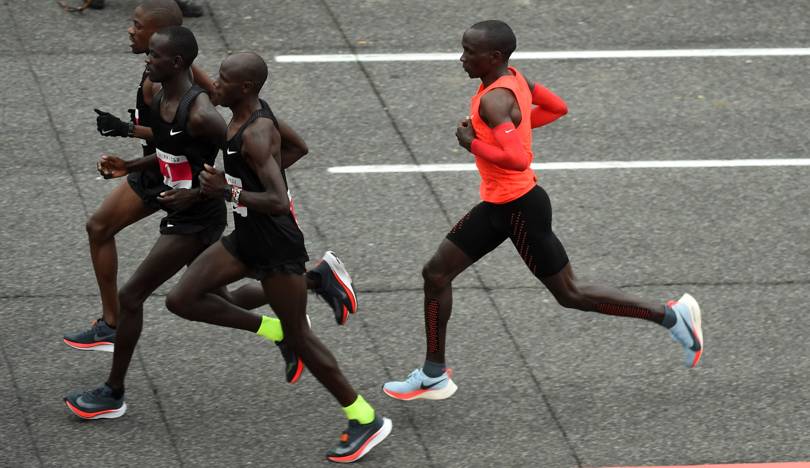
In May 2017, Nike organised a run on a track with three marathoners to see if the marathon 2 hour barrier could be broken.

The event was aptly named Breaking2.

Eluid Kipchoge was in that race and ran the marathon, on the track, in 2 hours and 25 seconds. He was only 25 seconds short of breaking the mark.

The race was not an official marathon race because of many factors. The runners were paced by different pace runners, coming in and out of the race. There was even a pace car. Fluids were handed to the runners, while in a regular marathon, the runners have to get to the water stops and pick up their water bottles off a table - sometimes missing them.

What did we learn from Breaking2?

Wall of pace runners protecting Eliud during Breaking2
Breaking2 taught us that the two hour barrier is a mental one. And while I don't think that it will be broken for the next ten or so years, I believe it will be broken in my lifetime.

David Epstein, the author of "The Sports Gene" had a very interesting TED talk titled, "Are athletes really getting faster, better, stronger?" It's an interesting take on sports and performance. While there is an allusion to the possibility of various forms of enhancement, he sticks to the fact that the human body has evolved. His book, "The Sports Gene," presents a denser academic version of that talk.

Eliud Kipchoge is the greatest marathoner in history. He's run 11 marathons and only lost one (he came second to Wilson Kipsang who broke the world record to beat him).

Eliud Kipchoge is a great ambassador for Kenya, and stands uniquely among those athletes who are true heroes. Soft spoken, intelligent, determined and extremely dedicated to the sport that the world has come to know him for.

Eliud Kipchoge is my hero, and he inspires me to get out and run.

On Writing

Writing is a craft.

Writing is a profession.

Writing is a discipline.

Writing does not happen miraculously.

Writing takes agonising patience and dedication.

Most writers will tell you that the act of writing is the hardest thing that they ever did.

Then why write?

Why?

Because the act of writing, when done well, has spurts of pleasure.

When done well, the act of writing feels as pleasurable as an injection of endorphin.

Like the runner's high.

Samuel Jackson said that, "great works are performed, not by strength, but by perseverance."

While Steven Wright said, "I'm writing a book. I've got the page numbers done."

And the one that I like the best is,

Willa Cather wrote, "Most of the basic material a writer works with is acquired before the age of fifteen."

So, don't let anyone tell you that you cannot write. Write if you have something to say.

Sunday, September 10, 2017

My Relationship with FOOD


Everyone has a relationship with food. Whether it's just for survival, comfort, psychological well-being, socialising, fuelling, competition, or whatever.

I'm not sure if I had any thoughts of what I ate when I was younger, only that it needed to taste good. Chapati, an Indian, pita-like, bread, with stew, preferably either chicken or beef was high on the list of good things. Ugali, a Kenyan dish made of cornmeal was very low. However, facing extreme hunger I would eat ugali.

Unlike people who literally have to beg for food, eat what's given to them, I had a choice of what to eat, ever since I was a child. I had no wants. I had no needs. If I didn't like something, I could find something else that I liked. I had the choice to avoid any food that I did not like to eat. And so during my university years, my selection of foods focussed singularly on only those things that I wanted. And none of the foods I chose had anything to do with a healthy lifestyle.

Why am I eating?

Fuel for my brain. It has to keep ticking and doing the things that it needs to do to keep me gainfully employed. After all, my employment, hence my income, depend on me being able to use my brain. So my brain needs food.

How much food to keep the brain going?  According to my premier source of information, Google, the brain needs oxygen and sugar. But the health of the neurotransmitters is also critical, and they're made of amino acids, proteins. At a minimum, I have to keep breathing and consuming glucose as well as the occasional protein, to help refresh the neurotransmitters.That doesn't seem like an awful lot. Except that the sugar should come from a good clean source, so that there's not a lot of work to make it into the acceptable glucose that my brain needs. And just enough, we don't want to repackage it as fat and store it up. The protein could come from fish.

What about the body?

For me, this is truly a matter of fuel. Energy to do things like run and walk about. Should be for most people. What about when I'm invited out for lunch, or dinner? Should I refuse to eat, just because someone has handed me some food? Not really, since that's rude. You should eat, but then that eating is planned around the other stuff you've eaten that day, plus the other stuff you propose on eating later. It's easy to choose what to eat, even when I'm invited, so it should not be too difficult to continue my brain feeding/body fuelling attitude.

Balance

I tend to think that it's not as easy as eating 2000 calories a day. The debate on that number specifically is well documented online. Just do a Google search for "why are we asked to eat 2000 calories daily?"  and you'll see some interesting stuff.


Food is essentially fuel, but in today's society, it's more than just fuel. It means more and it's used for more. Both the way our food is now made, and the way we use it have become dangerous to our health. And in the end, after all, it is about our health, isn't it?

Quiet...

“So stay true to your own nature. If you like to do things in a slow and steady way, don't let others make you feel as if you have to race. If you enjoy depth, don't force yourself to seek breadth. If you prefer single-tasking to multi-tasking, stick to your guns. Being relatively unmoved by rewards gives you the incalculable power to go your own way.”
        ---- Susan Cain

That quote is taken from Susan Cain's book, "Quiet: The Power of Introverts in a World That Can't Stop Talking."

We live in a world where everyone is interested in talking, but nobody wants to listen. The art of careful reflection is now looked upon as inactivity. The art of careful reflection is seen as an inability to be decisive. An inability to lead and make decisions. As though being quiet isn't a sign that work is being done.

The world of the aggressive, take charge, take no prisoners, lead by intimidation leader has already come to an end. Because the aggressive, take-charge leader of the past was a very different leader than that one of today.

And the wool can no longer be pulled over our eyes.

And it's showing glaringly in the problems we're seeing at the top of the food chain. Unlike the leader of the past, forged from the fires of trial-and-error, having lived and built. Today's fire and brimstone leader is made in the hallways of university. Where the knowledge of "how to lead" is being taught. Today's leader has actually never built anything. They've found something. And they've been placed near the top, to lead it. To bring ideas, mostly having never thought of anything original themselves.

Think of Alexander the Great.

He was skilled. He didn't have followers who knew more than he did. He was a skilled teacher. A skilled leader.


Or Mohandas Karamchand Gandhi?


Or Winston Churchill.


Or Bill Gates.

And I could go on.

Saturday, April 08, 2017

Reading

The Internet has changed the way we interact with books. The way we think. The way we study. The Internet has irreversibly changed us.


But it's not just the easy access to a lot of reading material. It's the very nature of information today. No one has the patience for the epic novel. It's information in titbits. One chunk at a time. A tiny morsel. A buffet of snacks. No sumptuous meal.

Can anyone sit through an epic novel like, say, Leo Tolstoy's War and Peace? All one-thousand two-hundred and twenty-two pages? The patience to read one word at a time. And slowly paint a scene in your mind? How about the six-hundred and seventy-two pages in James Michener's Caribbean?


Patience is a virtue. The ability to sit and wait. To read slowly and digest deliberately. Even in this fast food culture of taking large gulps, it helps to chew slowly. Taking small bites.


Reading is an art form. Grossly undermined. We learn to read as children. Are read to by our parents. Are read to by our teachers. And are read to when we watch TV. It takes a lot of patience to sit quietly alone and read, by yourself, without interference. And this is why it's an art form.

Like drawing, it doesn't come easily. Drawing is about looking and seeing. Not about accurately putting to paper the world as others see it. Drawing is about exploring your world. About looking carefully and observing light, shadow and colour. Drawing is about slowing down to take a really good hard look at your world.

And reading is quite similar. Reading is about taking a string of words off a page, meditating on each one, carefully forming a sentence in your mind with each word and then painting an image. The image is purposeful and real. As real as the words on the page. And therefore when you read a sentence, you absolutely have to pause as your brain assembles the complete picture.

One word at a time.

One sentence, or phrase, at a time.

One paragraph at a time.

One page at a time.


Reading is a physical activity. It involves a huge amount of concentration. Something that we've lost. Like taking a long walk. You get tired and want to rest along the way. Reading is a lot like going for a long marathon run. You should not be looking for the finish line at every step. When running a marathon, you should be concentrated on the moment. The feeling of the moment and what you are doing in the present time. Because if you take care of the present time, the rest will take care of itself. And the finish line will appear.

When you read, to take small bites. You chew. You savour the words in your mouth and roll them around your tongue. You feel the different flavours of each piece, each morsel, each word. You make sure that you also pay attention to the combination of words, the full bodied flavour. Taking in the scent. And finally you swallow and enjoy the feeling of satisfaction. The feeling of having understood what you just experienced. Don't be in a rush to jump into the next sentence. Are you sure you got it all? Was there something in there that's missing?

I know that's a lot of work. I know it's a lot of work to sit there and learn to be patient as you extract meaning out of a sentence. But believe me, once you practice reading this way, you'll never read a different way, ever again.

I once took a speed reading course. Self taught. It was fairly good. Taught you where on the page you should look. How to centre your eyes without too much side-to-side movement. Focusing on a spot, somewhere in the middle of the page, with your eyes between two lines. Trying as much to take an image, a picture, a snapshot of two lines with barely discernible movement of the eyeballs. The image of the two lines now imprinted on the back of the retina, your brain digests and strips the meaning out of the words just read. Without necessarily focussing on individual words. Like taking a handful of peanuts in your hand and throwing them all in your mouth. With great crushing bites, chewing for impact. Not one peanut at a time. That would take too long. Handfuls. Great flavourful lunges of peanut joy. It's OK if you don't get a taste of each nut. You get the big picture by taking handfuls. And very soon, the entire bowl of peanuts is finished and your brain is free to process the experience.

It's one huge experience. Looking only for the message. The climactic finish. No need to enjoy each piece. If you can fly there, why go by car. Why bother walking? It's faster, better, more economic and time saving to fly. Nobody walks any more.

So I always encourage the slow-paced reading method. Even though I thought that the speed reading course was great. And I did get a lot out of it. It was also taxing and tiring. A lot was missed, and hopefully unimportant stuff. But there's a lack of enjoyment when you use the speed reading method. It's like unhealthy fast food (not the tasty fast food, the unhealthy stuff) that makes you feel hungry a few minutes later. Jamming the information into your brain just because. Not really taking the time to savour the richness of what you're trying to understand. Even if you do, re-telling it to your mind with your own words.

Read slowly, purposefully, consciously, contemplatively, meditatively, calmly, respectfully, engaged and inquisitively.

Sunday, August 21, 2016

The Olympic Bragging Competition

As my title says, it's no longer the Games. The Olympics are mostly about showing off. It's an environment for the western world, primarily, to show off.

The playing field isn't level.

The competition can hardly be called fair. The amateur component having been taken off a long time ago, and now, like any professional business, the Olympics is an environment for the wealthier countries to show off.

But I still believe that the games should be held. It's the only place that the world gathers together to meet and compete. Even if the playing field isn't fair, the interaction is worth the effort, even for some of the countries without the means to train and prepare. It's a place for them to come and enjoy the brotherhood and sisterhood of participating in something that does not involve diplomatic muscle.

In that sense, I believe everyone's a winner.


Most of the medals are concentrated in sports that only some of the western world competes in. Or have the technology and wealth to afford.

Even when it comes to determining which place a country places, counting medals is done suspiciously differently by various countries.

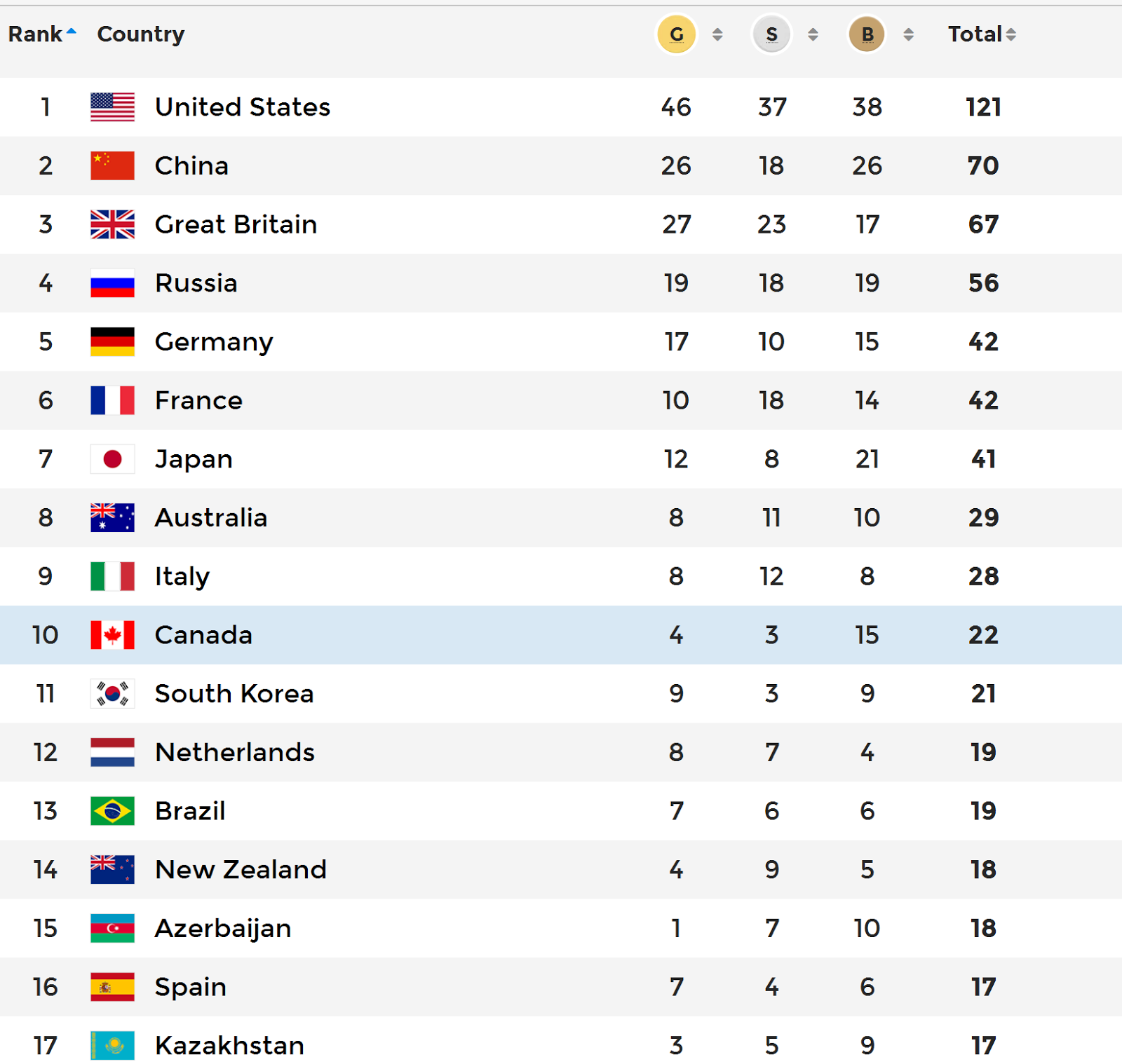
For example, in the 2016 Olympics, it's clear that the U.S. won the entire games. They had the most gold medals of any nation, 46. They had the most silver medals of any nation, 37. And they had the most bronze medals of any nation, 38. They had the most medals of any nation, 121.

Then it gets tricky. China had the next highest total count of medals. 70 medals in total. However, Great Britain had more gold medals than China, so most media was reporting GB in second place.


But as you can see from the list above, Canada isn't listed.

Because here's how the Canadian media is reporting the standings.


To be fair, they give you the option to sort the list, but when you read the various reports on CBC's website, they refer to their position as 10th overall. At a press conference of the Canadian Olympic Committee, they also refer to this 10th place position as being a success given their 12th place overall target.

Similarly, GB's press are extremely excited about having beaten China in the standings.

But did they?

New Zealand has an interesting way to rank countries, which seems much fairer. A metal count per capita.

See http://www.stats.govt.nz/browse_for_stats/population/estimates_and_projections/olympics-2016.aspx

It's hardly possible for a country with a million people to beat one that has three-hundred million in these competitions. Better to look at the events that they're competing in and determine who actually bested whom?

I personally don't like statistics that don't have an ultimate purpose. Something to help humanity. Statistics for statistics sake. Statistics that don't add value to any conversation. Statistics that don't add value to the welfare of humanity. Or provide insight to help us become better. Or give us warning signs.

If you take New Zealand's analysis a bit further you may come to the following interesting facts:

Based on the ratio of total medals won to the number of athletes the country sent, Azerbaijan wins. They sent 56 athletes and won a total of 18 medals. Ratio is 32.1%.

Contrast that with the announced winner, the U.S. They sent 558 athletes who won a combined total of 121 medals. Medals to athletes ratio is 21.7%. In this scenario, the U.S. is in 5th place. Not shabby given the number of athletes.


It gets a little interesting if you focus only on the gold medals to judge ranking. When you do that, the country that won the Rio Olympics is Tajikistan. They sent 7 athletes and won a single gold medal.

In this scenario, the U.S. is in 8th place.


You can see the camaraderie in the opening and closing ceremonies. When all the athletes are together.

Everyone's a winner.

Eliud the Great


On Sunday, August 21, 2016, Eliud Kipchoge won the gold medal in the Rio Olympics. Eliud is no stranger to winning. The winning time was also not special. He normally wins with times five minutes faster. But this was the Olympics and time wasn't the most important thing. Winning was. And Eliud Kipchoge won in style.

The conditions in Rio weren't perfect, which made for the slower times. The leading pack was fairly large well into the race, which only picked up in the latter stages, closer to mile-22 of the 26.2 mile race.


Eliud Kipchoge has a marvellous running style to watch. Bouncy and energetic. There are some who would say that Kipchoge's running style wastes energy, but I think that his style is what uniquely allows him to excel so well.

In the London Marathon in April 2016, he came close to breaking the world record. I watched the race and I think what happened is that in the last mile, Eliud realised how close he was and slipped up into another gear. The gear-changing was a couple of seconds too late. The world record was set by Dennis Kimetto in the 2014 Berlin marathon at 2:02:57. Eliud Kipchoge finished the 2016 London marathon in 2:03:05. And what a close finish.

In Kipchoge style, he looked strong and fresh finishing the London marathon. Nobody wonders whether or not he would have crushed that record if he had kicked sooner. He would have smashed it. But the dynamics of running a marathon necessarily entails listening to your body, watching the other runners and planning your race. After all, it's not a walk in the park.

Again in the Rio marathon, when Kipchoge decided to push the race forward, he did it incrementally. The lead pack of 12 was broken down by twos. To 10 runners, to 8, then 6 finally 4. Eliud Kipchoge, two Ethiopians, Feyisa Lelisa and Lemi Berhanu, and American Galen Rupp. They subsequently dropped Berhanu and for the last couple of miles it was down to three.

Kipchoge dropped Lelisa and Rupp with his constant injection of speed. Rupp was the first to fall back, and finally Lelisa couldn't sustain the increased pace. Not just the increased pace. But the increased pace after two hours of running. Eliud Kipchoge looked like he was just getting going. His face stuck in a permanent smile, enjoying a run. Not a sign of pain, or stress anywhere.


He's 31 years old, so he has another Olympics left inside him. But at the level he's performed at, and he continues to perform at, one wonders if he can maintain the pace.

Since he's switched from the track events to the road racing events, he's won seven of the last eight races he's competed in.

And another thing. I would have thought that running a marathon in April was too close to the Olympics - in August. But Kipchoge was interviewed about that strategy, to which his intelligent response was that he needed to keep his fitness by getting involved in races.

By running the Olympics, Eliud Kipchoge has possibly put himself out of running the Fall/Autumn races. Berlin, Chicago or New York. There are probably non-monetary benefits to being the Olympic champion, that will be useful for Kipchoge later in life.


He is the second Kenyan to win an Olympic gold medal in the marathon. One would think, given Kenya's success in the world major's, the country would have had a streak of winners. But that's not the case. It hasn't been the case. The first ever gold medal in the Olympics was in 2008, Beijing, when Sammy Wanjiru won gold in spectacular style.

In 2016, Kenya has won both the men's and women's gold medals.

On a sidenote, Kenya had three runners in this race. Wesley Korir and Stanley Biwott did not finish.

Thursday, June 30, 2016

Road Rage

and whatever your labors and aspirations,
in the noisy confusion of life,
keep peace in your soul.
with all it's sham, drudgery and broken dreams
it's still a beautiful world
be cheerful
strive to be happy
                             .... bart ehrman - 1927

The problem of road rage is a problem of time. With unlimited time, and patience, road rage goes away. Therefore provided with unlimited time, there is no road rage.
It's funny. Young people, relatively young people, are impatient. Hurried. Brash. They have time but they are rushed. Old people, relatively old people, are patient (for the most part). They're unhurried. Not rushed. Slowly moving from one thing to another, stopping to look at cloud formations and imagine days gone by. They don't have time but they aren't rushed.

One would think that the youth should be lazy and impatient. And the old people would be running around trying to eke the last few years of life.

Back to road rage. So when someone cuts you off, drives slowly, makes an illegal turn, gets in your way the anger you feel that's caused by that obstruction is an issue of time. Given unlimited time, the obstruction wouldn't be an issue. However, now you will be late to pick up that lottery win, the five o'clock deadline having passed, your chance at getting that million dollars gone. Because you were cut off.

Or, even more realistically, you won't be able to get into the door, last minute, just before the beer store closes. And now your evening's ruined because you have no beer. Because you were cut off.

Coffee isn't an option.

Hot chocolate isn't an option.

A chill pill isn't an option.

Ventilation is the only option, so it seems.

But we all know that this shit never ends. As long as you have to deal with people, and it doesn't even have to be on the road, this rage stuff will keep bubbling up inside you. Like a pressure cooker, leaking out from time to time. But eventually, inevitably blowing up.

Admittedly, I've passed other drivers and glanced to see who was driving as I sped past them. Irritated, but not enough angst to shout anything. Let alone gesture.

I'm too calm for that.

But, boy, you should hear what's going on inside my head.

But like Bart Erhman, who wrote the desiderata (in case you were wondering) you should be cheerful and strive to be happy.

Don't waste your time on road rage.

Sunday, December 06, 2015

Super fast custom Biryani

Not all the "required" biryani spices are included, but this was very tasty. This is a highly customised dish and I'll probably get a lot of backlash by calling it biryani - but hay, the end result was very biryani-like and very tasty.

You need:

  • Beef cubes (or mutton if you prefer)
  • Tomatoes
  • Garlic
  • Cloves
  • Salt
  • Black pepper
  • Mr Dash mixed spices (I think the All Spices mix would work as well)
  • Coconut oil
  • A cup of rice.
Chop up the tomatoes into cubes and heat in a pot with low heat.

Add the salt and black pepper as well as the garlic.


Chop up the meat into relatively nice chunks, not too small, not too big.


Add the seasoning (Mr Dash) as well as the cloves to the tomato base as the last step before adding the meat. Not too many cloves, about half a teaspoon will be enough.

At this point, it's OK to cook the rice. I cooked the rice separately to get it "mostly cooked before adding it to the meat.

Under low heat, add the meat to the seasoned tomato base. Increase the heat to allow the meat to slightly sear. This should only be for about 5 to 10 minutes.

Then reduce the heat and allow it to cook very, very, very slowly.

It took me 1 hour to cook the dish. At about 50 minutes, I added the rice.

Of course, the dish can be made a little bit more complex by adding vegetables, or even cooking the rice with the meat and using a broth.

Saturday, December 05, 2015

Another year older

Everything must change
Nothing stays the same
Everyone must change
No one stays the same

The young become the old
And mysteries do unfold
Cause that's the way of time
Nothing and no one goes unchanged

There are not many things in life
You can be sure of
Except rain comes from the clouds
Sun lights up the sky
And hummingbirds do fly

Winter turns to spring
A wounded heart will heal
But never much too soon
Yes everything must change

_________________________George Benson

I turned 51 on December 2nd, 2015. And it looked like it was just yesterday that I turned 50. Where did the year go? Absolutely frightening because for the first time, I'm looking back at the year and it seems like the accomplishments are few. The year disappeared while I was busy doing what?

Even my running seems to have suffered. No races this year. Not a single one, just wasn't motivated to get out and do the hard work. But I was working, on maintaining my technology career.

I've noticed that my patience with tasks has waned over time. I used to spend time drawing - and that takes both time and a lot of patience. I don't have the patience to work on a single drawing for hours and hours, taking pleasure in seeing the form grow, straining to blend colour and form, light and shadow. I'm slowly melding into the fast food of everything world. The "just get it done" world. A world that was very unfamiliar since stuff got done, but the urgency was never there. Or at least, it was never imposed.

And I don't just want to get things done. I want also to enjoy doing them. Making what I do a craft.

And so suddenly, in this 51st year. And only because it happened so quickly. I've started thinking about how much time I have left. Turning 50 was a breeze. That was nothing. I ran a 15k at a 5:30 min/k pace just to prove that the body was still intact. I'm now struggling to keep close to the 6 min/k pace. That's a 4 hour 14 minute marathon finish. And I'm still looking to finish a race close to 3 hours 10 minutes. At least under 3 hours 15 minutes. The dedication required to do that insists that I clock 100 k a week, and get that pace down to 5:30 - comfortably.

So I need a couple of things. Dedication and motivation and a complete change of lifestyle. Wealth must be accounted in terms of health, not money. My wealth should be how healthy I am. What I'm eating and how my body feels. The 3:15 finish can come in as early as next year, Fall races. But the dedication must start now.

Slow down. Pace it. Work on quality. Don't rush. Take time. Be really good!

Wednesday, November 18, 2015

Storage wars.

Storage must be very cheap. Google offers you 15 GB of free storage shared between emails, Google Drive and Google Photos.

However, documents, spreadsheets and drawings that you create using Google Drive do not count towards the storage limit. I don't know if there's a limit there, but if you create documents in Google Docs, looks like the sky's the limit.

Google Storage on November 18, 2015

But Yahoo! has more. Yahoo! gives you 1 TB of free storage. Storage indeed must be cheap. Here's the storage I had on November 18, 2015.

Yahoo! Storage on November 18, 2015

My question is, who's going to trust Yahoo! to keep their 1 TB of data safe and secure. There's obviously no obligation from Yahoo!'s perspective to do this. In fact, the day that Yahoo! folds, you'll have to scramble to export your precious data off their servers, or lose it forever.

1 TB is a lot of data. It's huge! Unless you're working with media files, video and high resolution art. In which case, you need a different service.

The thing that worries me the most about most of these technology companies that offer this free stuff, is that we've all seen them come and go. AltaVista, one of the pioneers in search technology folded unceremoniously. They're gone and they're not coming back. Fortunately, they didn't have any data to store.

Google's a different story. They have all your email (if you use their service like I do). And now they have your documents, spreadsheets and drawings. And with the ease in which it takes to simply open up Google Docs and write, and write and write, you'll soon have a ton of documents, that you don't want to delete, just in case.

I'm a lazy blogger. I used to take too long to write and post since I was taught to be very disciplined in what I said. But that's because I come from the age when writing was considered an art.

Now everyone with a keyboard is writing. And thanks to Google, Yahoo!, WordPress and all the other free sites, we can get free storage to publish ourselves.

Ten years from now, we will look back and wonder how we will contain all these documents! We'll get to the point where all the information we've written about, thought about, contemplated, articulated, debated and argued will be a maze of unstructured noise. Not only will we not be able to find anything. But the stuff that's there will be much like that crackling, static noise you hear on a bad telephone connection.

Still, I will continue to blog, this time a bit more unstructured. Ten years from now, I'll read this and wonder what drug I was on that day.

Monday, September 14, 2015

Michael Jackson, the genius

There's a place in your heart
And I know that it is love
And this place
could be much brighter than tomorrow
And if you really try
You'll find there's no need to cry
In this place
You'll feel there's no hurt or sorrow
There are, ways to get there
If you care enough for the living
Make a little space
Make a better place
.
Heal the world
Make it a better place
For you and for me
And the entire human race
There are, people dying
If you care enough for the living
Make it a better place
For you and for me
Heal the world by Michael Jackson.

The smooth sound of Michael Jackson's voice as he sung this song reminds me of his other song, Will you be there.

For all the noise that was made about his private life, Michael was a genius. And that genius came from hard work. For it's true, nobody is born with all advantages, and everyone can aspire to become more than they are.

As the Spanish violinist, Pablo Sarasate, said "A genius! For 37 years I've practised fourteen hours a day, and now they call me a genius!". Or in Michaelangelo's, words, "If people knew how hard I had to work to gain my mastery, it wouldn't seem so wonderful at all.

But I wonder if the genius would have come out if his father, Joe Jackson, hadn't pushed them so hard. A part of me wants to think that the discipline that Joe enforced on his boys would have emerged all by itself. But I doubt it. What about Janet Jackson? She didn't go through that same hardship? But she had established role models inside her home to look up to and to learn from. Just like Whitney.

It's truly incredible what Michael Jackson accomplished in his life, which ended when he was 50 years old. Same age as I am as I write this today. And I'm amazed at how influential and full a life he lived. Though he had his challenges, which I don't see as challenges. Still they were challenges.

Like Amy Winehouse, or Whitney Houston, or Macaulay Culkin, or Brigitte Nielsen. Being a celebrity definitely has it's challenges. Life in general has it's challenges.

When Michael Jackson first walked onto the world stage, on the Ed Sullivan Show, the world fell in love. If you watch footage of that show, you can see that Michael was having a lot of fun. The road to stardom was amazing. The journey was good.

And then he achieved greatness, and it seems that the journey had come to an end. Apparently no challenge. Nothing to aspire to. Music wasn't hard. Whatever he thought, he could do.

And that's what happens when the challenge stops being a challenge. And the question therefore is how do you keep the challenge in life, even when you no longer need the money. When money isn't an issue.

Michael didn't find the answer. Neither did Todd Bridges. Actually, all of the kids of Different Strokes had issues related to success.

It's up to us to keep ourselves alive. It's up to us to ensure that success isn't measured by reaching a pinnacle. That success is measured by the journey, and the walk. It isn't about getting there. But it's all about the moving forward and always looking.

To Michael Jackson, and the Jackson Five, I say; well done, congratulations, but I hoped that you would have stayed a little longer.

Sunday, August 16, 2015

It's not about getting from here to there, it's about being there

We talked about running today. How running, for some is not just an activity to do, to get healthy, to reach somewhere, but a lifestyle choice. A way of living. And I thought about that while I was running this morning. A snow storm was brewing and getting out was so nice and easy. I've developed this very enjoyable gait, it's slow and comfortable and I can think and not feel tired.

And I felt the snow crunching under my feet and all I could think about was how good this felt. How wonderful this was. Yet the storm was starting to blow and there was water on my face as the huge snowflakes melted on my warm face. I was wearing my spikes and so wasn't too concerned about slipping. My steps felt just as good as if I had been running on the dry pavement.

And as I turned around into another corner, down a street still fast asleep, quiet, dark and lit only by the street lights, I finally came to the conclusion, it hit me like a brick, that this is what I wanted to do. I got up well, I was feeling good, and for the first time in a really long time, I felt as though I never wanted this run to ever end.

About an hour later I changed my mind, but the point is that I know, finally, that I will never struggle to get outside and run, ever again. It's what I do.

It's not about getting from here to there, it's about being there.


Friday, August 14, 2015

The Omelette

The spinach, red pepper, cheese omelette. A very tasty dish.

You need:

  • A couple of leafs of spinach (to taste)
  • A quarter of a bell red pepper
  • Two eggs
  • Grated aged 2-year Balderson cheese (OK, just kidding any salty old cheese will do)
  • Salt and pepper
  • Olive oil (or coconut oil, or even sunflower oil - just don't use motor oil)
Pour a tablespoon of olive oil (or whatever oil you got) into the pan. At medium heat. Not too hot to sizzle the oil.

Chop up the spinach and the red pepper and put this into the pan.

Look at the colour. Isn't it beautiful?

Grate your cheese.


While your spinach and red pepper are cooking, break a couple of eggs and add about a tablespoon of milk. If you run, you can substitute that for cream. You can even use soya milk.


Whip the eggs and then put them in the frying pan.


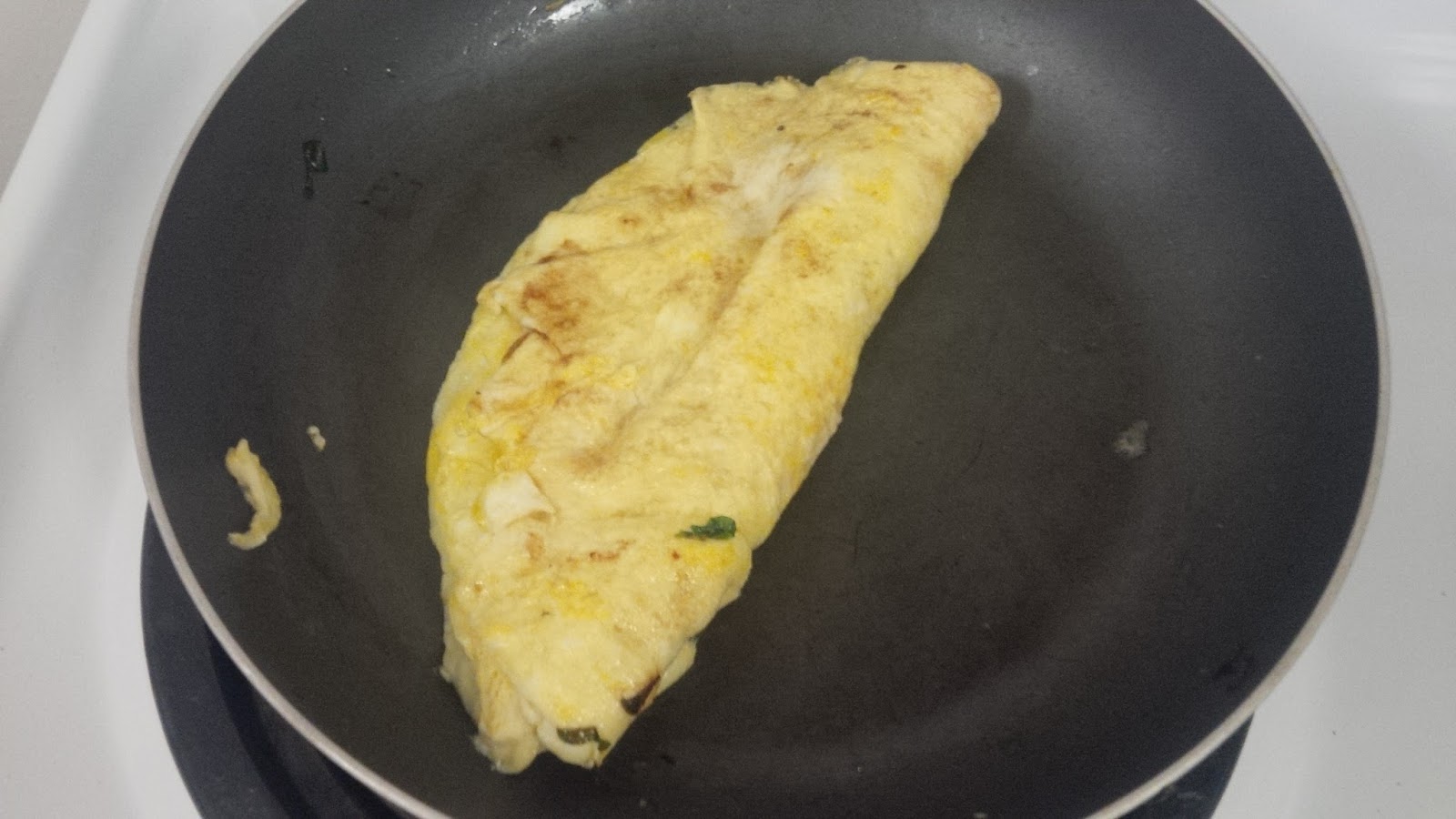
Now that's starting to look good. Your sautéed spinach and peppers should be looking like this by now.


You can flip the eggs over for about 30 seconds, then flip them back before adding the sautéed veggies.


Fold it over.


Let it cook on medium heat for about another two minutes. Don't forget, the sautéed veggies are done, and it's just to let the flavours seep through.

When you're done, you can toast a bagel, slice a couple of strawberries for garnishing, and you should have something like this.


Enjoy!

Michael Crichton

I read a book written by Michael Crichton when he was still a medical student, writing under the handle Jeffery Hudson called "A Case of Need" exceptionally well written, fast paced with no fillers at all.


An early book showing how good he was going to get. I don't know if he got better at narrative, but his storytelling was already formed at that early stage.

"A Case of Need" is a story about abortion. Weaving through the thriller, Michael Crichton talks honesty about the medical industry (because an industry it is), about the moral, ethical, political and health issues regarding abortion as well as educating the reader on medical terminology and the hierarchy and politics that exist within hospitals.

He knows his stuff and it shows from the story and how it's told.

I'm envious of the ability to tell a story so clearly, lucidly and engagingly. I'm envious of how much he knows about the subject and how easily he can tell it. It's a gift no doubt, that he has and not too many doctors do. In fact, not too many professional storytellers have that gift, the ability to hone in on the absolute minimum number of words to say what you have to say. Not only that, the ability to decide what's important and interesting and only give those details.

It's storytelling not just for the sake of having something to write about, but storytelling because you're dying to say something. You have something that you're passionate about, interested in and you really want others to hear it.

And Michael Crichton's interest in medicine shows. He cares about what he's talking about. He's interested in getting to the end of the story and he makes sure that his characters are believable.

I don't think that's something that you can be taught in school. In fact, the older I get, the more I'm disappointed with the formal systems we have of educating our youth. I think it breaks down somewhere near the teenage years.

In "A Case of Need" Michael Crichton has about three or four themes running through. There's the story of his friend, a doctor, who's been convicted of killing the daughter of a wealthy family (also a medical family) by performing an abortion. The friend never really features in the story, but through the story the depth of the friendship is explored, superficially. Then there's the issue around abortion. How they're done, why they're done, how risky they are, what a baby is, the moral issue of life and when it begins and so forth. There's the investigation, the relationship of police and doctors and finally the different disciplines in the medical field. Surgeons, pathologists, anestheologists, gynocologists plus the cast of different professions all running the hospital. We are interested in open heart surgery, and the operation of this complex machine we call our body.

I'm definitely going to read the rest of his Jeffery Hudson books as well as books he wrote as John Lange and one with his brother Douglas Crichton under the pseudonym Michael Douglas.


Through the fire

Running through the fire. 
Or running through pain. 
Is when you get stronger. 
Is when you become and realise who you are. 
Running means forcing. 
It means not taking your time. 
It means being a little stressed.
It means following your heart, your heartbeat.


Through that moment of pain.
Perhaps more than a moment.
And you're inside yourself.
You think.
It's hard.
And it's agonising.
And it hurts.
Your lungs bursting.

Through the fire.
You pass.

The Power of the Story

The Story.

Before writing there was sound. Pictures painted in the mind. With voices. With actions. The story was acted out by the actor. The actor acted. And the story was transferred from the actor to the listener.

But the story was more than just a means of information. The story was entertainment. Listening to the story and watching the story, we became engaged. We became a part of the story and so lived in the world of the storyteller.

The story has never left us. We live for the story. Without the story our humanity would not exist. We live for the story. We are only about the story. Because the story inspires. The story allows us to reach higher goals. To walk on the moon. To build hovercrafts. To create medicines that heal and medicines that strengthen. The story encourages us to wake up each morning and drive through the day inspired that we matter. The story creates and then recreates us. And so we need to be reminded of the story every day. So that we can rewrite it. Every day. Every moment. We sculpt our story every single moment. And review it and change it.


I'm listening to my mind telling me that tomorrow will bring the same things that today brought. That tomorrow will be a repeat of today. But that's not what I want. I don't want familiarity. I don't want the same story. I want a new one. But if I'm the author of my own story, then I cannot write it until its done. I cannot write that story until it unfolds. Only then can I see what the story was. A contradiction. Not so.

Back to posting

Been a long time
Since you touched me
And made me feel that wonderful glow
The way you do
Been a long time
Since you held me and squeezed me
So I wonder what's come over you
                                             --- Ashford & Simpson

The last time I posted on this blog was a while back. That's because the holidays were here and I threw myself into spending time with family. I'm borderline workaholic and the change of pace was good.

So far, August 2015, there have been only 6 posts for the year. You cannot call yourself a blogger with an average of a single post a year. And most of them in May.

But we're back with a commitment to make up for the lost time. There have been a lot of lessons learned, stuff read, experiences had and much to say. I'm 50 now (since December 2014) and perhaps the fright of the big five-o somewhat got to me.


I've been watching a lot of documentaries while working. I watched Lance Armstrong's fall from grace. And I understand. I watched Mike Tyson's fall from grace. And this one's a little harder to understand. I watched a couple of documentaries on vegetable juice diets. Interesting, but I see health risks with those. And I've continued to run. If there's anywhere I find complete solace, it's at 4k mark.


This post wasn't supposed to be inspiring, but just a way to get back onto the keyboard and write.

Thursday, May 28, 2015

I won't always be this age

When I turned 30, I thought nothing of age. I thought nothing of death. I thought nothing of incapacity. I could do anything. Possibly even better than in my 20's. I was getting stronger and running harder.

I turned 40. I gave age a fleeting thought. It was more philosophical. Not yet quite real. We were a young family still. I was oblivious of life's challenges, which I knew people were going through. I didn't have to struggle much. I worked hard and everything was looked at philosophically. I was an idealist. Not a realist. And every action was wrapped around a metaphysical context.

I'm now 50. The kids are not kids anymore. I have whatever's left of my life back. And I can slip back into my philosophical shell. The practical life of earning money to live is still here, but the end of that life is closer.

At 50, I've spent time looking at pictures. And boy, I've aged. I'm so much older. I can see it now. The incremental changes that were happening over the years were barely noticeable. It's like I stepped into a black hole and came out on the other side in a different civilization. I'm no longer the kid. I'm no longer the dad. I'm almost the granddad.

I came across a picture of myself at 11 years of age. I could see some resemblance. I looked small, timid and subdued. And I have so many pictures of me during my university days. Life was a full time job. It wasn't what you did in the evenings or on weekends. We lived twenty-four hours a day, seven days a week, twelve months a year. Interrupted by periods of education. When I look at pictures of myself during my university days, I looked so happy. I didn't have much money. But money wasn't a source of pleasure. It wasn't what drove happiness. Money was an enabler. But even if you didn't have it. You still were able to find happiness. We read a lot. We read so much and spent a lot of time talking and discussing ideas. We built models of balsa wood. Of cardboard. Models even using cut up beer cans. We were creative. And life was good.

But as I sit here, I'm thinking different thoughts. Hopefully I get to sixty, then seventy and beyond. I'll probably look back at 50 and think, "boy, that doesn't look so bad!" So that's how I should behave now. That 50 doesn't look that bad. And live 24 hours a day, 7 days a week, 12 month a year. All the way to 60.

And when I get to 60, take a moment to look in the rear-view mirror, only for a second before charging forward again.

There was a time in my mid-40's where I was trying to search for my life back. Get that "joie de vivre" back. If I was to draw a "smart curve," it would look like the following:


Smartness on the y-axis and age on the x-axis. I think that I was smartest between 20 and 30. Those were the university days. Running marathons in 3:12 to 3:20 easily. I recall passing the half at 1:10 during the Ottawa marathon. Reading Kant, Descartes, Socrates, C. S. Lewis, Bertrand Russell, John Stewart Mill, Michel Foucoult among others. And learning about China's history of art and architecture. Drawing. Living like a true Leonardo da Vinci. A master of all trades.

But still some John Grisham, Umberto Eco, Michael Crichton and the stuff that takes you away from this life into the fantastical.

The philosophical quest died when I started working. Art, drawing and architecture followed soon. And all that was left was the shell of the engineering mind and the books of fantasy. And feeding your brain with that stuff does not get you very far. Garbage in. Garbage out.

But now I'm fifty. I will never be this age again. I look at myself ten, twenty years ago and wonder where the time went? I was busy mowing the lawn. Running to the grocery store. Working extended hours. Not talking to my family. Disconnected from mum and dad. That's what I was busy doing. I look at pictures of dad in his youth. And pictures of dad today. You can see the youthful man, inside the older man's body.

And that's what I want to do and be. I want to look back at 80. And still see this fifty year old inside.