So it's all in your head, and you need to write it as it sounds. You shouldn't care, at least not initially, about political correctness, but should just wander about the literary landscape painting the colours you see and chopping down the walls with your bare hands. Sometimes it might be necessary to trip up small children and laugh but it's not evil, it's only rolling about in your head.
And there are times when you'll reach a road block. You can't seem to go further. Or in runners terms, you hit the wall. Your muscles are laced with lactic acid and you can't move an additional step. But somehow, you take one more. You stop thinking about the distance, about the pain, about how long its taking you and how much further you still have to go. You're down to the sub atomic level. Thinking only about that next step.
And so it is with writing. During writing practice, you'll be tempted to go over to the fridge and fetch a glass of water. Perhaps just a quick drink. You remember suddenly that all important email you were supposed to send, and it's amazing how communicative we are on email. We can write volumes. But it's back to writing practise and you're stumped. You can't move a muscle.
With writing practise, writing exercises, and writing novels, short stories or anything else that you're trying to communicate, you have to free your mind to think and put down anything that it wants to. It makes no sense to censor yourself at the start line since you won't be able to get off the blocks when the gun goes off. When the gun goes off, you won't be ready to race to the finish and you'll stay where you are, adjusting your shoes, untying and tying your shoe laces, since they aren't just right. Wondering if you look OK in those blue shorts, or perhaps you should wear something brighter. Perhaps you should take a sip of water before you run, after all, you want to be properly hydrated before you run. And that's another excuse. Sometimes when we sit down to write, we want to pen down our best thoughts, we don't want to just write anything, we want the stuff that comes out to have been filtered to purity. Like cool refreshing aqua spring water, but with all the minerals and deposits ionised and then the water distilled. There's nothing in there but hydrogen and oxygen molecules.
But we know the truth. We aren't on our best form all the time. We're barely at our best for more than a few seconds each day, and some days are best forgotten altogether. Yet we're still able to do some of the most basic things. Writing isn't one of them. Thinking is. We're able to think through good feelings and bad feelings. We're even able to relate these feelings to our friends and co-workers. "You'll never believe the weekend I just had!" you exclaim as you launch into a fifteen minute monologue over lunch. And our ancestors knew that this was the best way to pass on information, from person to person, word of mouth. I watched the movie Shaka Zulu, sometime back. In it, the movie, Shaka's introduced to writing as a means of communication or preservation of history. In that movie, we're led to believe that Shaka distrusts the written word though he learns enough to write down his name and sign a dubious treaty giving away land to some British explorers.
And our ancestors acted out plays in the evening. These plays, drama, supposed to pass on their knowledge to the youth and entertain as well. By repeating various parts of the story, the message is continually reinforced. Stories of victories won, loves lost, growing up and becoming a warrior, judging good and evil, praying, respect. These lessons were taught by the spoken word and by the acted play. Not transmitted by writing.
In the second lesson in this series, we talked about non-stop writing without thinking. Just pour out what's in your head. Just write and not edit. Don't even stop to think about the words you just wrote or the sentence you just constructed. You'll come back to it later. Later it will be easier to kill it, erase it and forget it, because you didn't put too much effort into putting it down. Shouldn't take much to kill it. But don't think of that now. You'll come to that later. Right now it's time to direct our attention to that table, or that person, or that latte, or that cup of coffee. It's time to keep the hand moving.
In this lesson, we're emphasising the ability to talk to ourselves in stories, whole complete stories. Where in writing practise we don't stop but we do things in a disconnected way, here, we do the same thing, but when we get tired, when that call for a drink of water comes, we don't stop. In order to do this, we'll have to have a mechanism of timing ourselves. This could be time, but I think the better measure is distance. When I run, I have a loop that's about 14 kilometres that I must run. If I run fast, I can make it in about an hour and fifteen minutes. If I'm slow, an additional five minutes appears from nowhere. I've even been known to finish this in an hour and thirty minutes. I was really tired that morning and that's my excuse. In any case, when constructing a story, I'd encourage the use of distance, this time by using a page as a measure of distance. So, start your story, and commit yourself to writing at least two pages. If it takes you thirty minutes, woo hoo! Of you go, perhaps add another page, consider it a lap of honour for your first place finish. If it takes you fifteen minutes, boy, were you hot that day or what! If it takes an hour to write two pages, well, perhaps we'll do better next time. Glad that's over. Whew, it was tough getting past that last four or five sentences. When you're on that second page, you're heading down the home stretch, you know you only have to do half the distance you've already done. One word at a time. And so, even though you can find something else to do, just keep typing, or writing, watching the lines as they roll off, one at a time.
Sometimes, it's not about fidgeting with the quality of the thought, but just making the thought. You have this idea in your head, you just can't get it on paper, but it has something to do with paper, and something also about roughness, colours are there also, but you can't define it. It's during the day and slowly as you're thinking out loud, and on paper, much like I'm doing right now, you begin to define the path you're walking on. At first it's a grassy opening, and as you walk up and down, trampling the grass, you begin to form a path that's defined. You can see the earth. You recognise how you should walk. And later, you'll be able to lead people down that path.
This section then emphasises what we stared in part 2. Just write, find that voice in your head, catch it and transfer it to paper. And when distractions come, like those moments when you feel better if you just switch on the television, for background noise you tell yourself, or go get a glass of water, pass by the washroom and then you're suddenly fascinated by the dust on the living room floor, give yourself a quota. A set of pages that must be completed before you get up. Consider it the 35 kilometer mark in the 42 kilometer marathon. You have seven more kilometres left. They may not be your best work, but if you keep running daily, writing daily, thinking out loud daily, you'll form a habit and it will get easier and easier to pen things down.
Tuesday, August 09, 2011

Monday, August 08, 2011
Finding your voice: Part 2 of 10
In the first section, we discussed that voice in your head. That running dialogue that you maintain during your waking state. When you're asleep, it's called dreaming. Entire epic stories are created, fabricated, while you sleep. While you're awake, going through the motions of work, play, associating with co-workers, salespeople, negotiating your way through traffic, on the road, on the side-walks, you're taking in the sights and analysing them. Thinking about them, comparing them with sights, smells, sounds that you've heard before. Creating your own story. Imagining your own history. Later, when you're back in your home, you can retell it to your spouse, your children, your brother or sister, or simply sit and think about it.
There's no way to stop the analysis from happening and two friends watching a sports game will each be watching a different game. Their viewpoint is what makes the story. Like that scene from the television show Seinfeld where Kramer and Newman are telling Jerry, George and Elaine what happened outside a ballgame. It's where they accuse Keith Hernandez of spitting on them after a Mets game. It's a short idea but well played out. The story's funny and Jerry, who wasn't at the game provides the analysis, and the joke. I like detail like that. It's part of my personality. I'll be walking across the street and see someone walking towards me and I can assume, by the way they walk, by their demeanour, what type of mood they're in and I try to guess what they're thinking about. Most people are inside their heads all the time and I believe that most of us, even when we're out and about, we're preoccupied by what's going on in our heads.
George Carlin, a man who I believe to be extremely intelligent once did a skit about the stuff that people have. In the skit, he talks about the number of cars that American families own. The gadgets that they carry around with them when they go on vacation. In particular, video cameras. The craziness of videotaping everything that we encounter and not taking the time just to stop and enjoy it, live. We're saving it for later so that we can relive the thing that we're missing while videotaping it. As though it's not important for us to be in the moment, rather it's important for us to collect the imagery, the sounds and the pictures, so that we can show them off to our friends and relatives who couldn't make it.
In the first section we also discussed Natalie Goldberg's writing practice. The art of sitting down for a timed writing session and keeping your pen on the paper, not letting yourself stop and edit words. It's important to make it as realistic as it really is. When you're inside your head, your dialogue with yourself isn't edited. However, when you sit down to write, you feel pressed to make sure that the words you put down actually say what you mean to say. Even though, you will probably construct about ten sentences in your head, and only write one of them down. Having discarded the other nine. The tenth, you think, is the real thought.
And so the challenge in this second part is to try out Natalie Goldberg's writing practice, but with a twist. The words that are in your head should not be edited, but should be written as thought. But there's a problem here, a real problem. Your mind works lightning fast, and your hand isn't so fast. Even if you decide that your writing instrument of choice is the computer, and you're a very fast typist, you'll find that your hand slows you down greatly. While it was possible to take in a view from a lookout in one great sweep, writing down that one great sweep takes time.
And so here's my suggestion to get over this handicap, this disability. Edit the writing, but not the imagery. See the scene in your head and ask your hand to move and write, but as your mind moves on to the next thought, cut yourself off and continue with that next thought. Just don't stop your mind from moving on and thinking. And the reason for this is that you really can't stop your mind from thinking. While you sit and write the words, the auto mobile was moving along the German autobahn and blurring the landscape behind it, you couldn't make out the trees any more, only smudged green and brown tones, and some blue from the sky peeking behind. The black car also a smudge on a grey background, the lines on the road, invisible. Your mind's already thinking of the weather and the other cars around the one you're writing about. So at some point you continue with red smudges of red cars, blue smudges of blue cars and bright yellow smudges of yellow cars, mostly Volkswagens, the German car of choice, of course the latest Volkswagens, not those unsightly beetles that they sold in mass in the late seventies, but gorgeous, sleek, aerodynamic engineering marvels, the sharks of the land. And again you're already switched to the engines and the noise and the other stuff that cars and motion mean to you.
And when you get stuck, and bored, you can imagine, what would it be like for one of these things to take flight? How about something falling from the sky? How about falling asleep on the wheel, lulled to sleep by the quietness of everything? You can even get crazy and interrupt yourself because you are now thinking of that boss that grinds you at work, and you're all of a sudden feeling the angst of loss of power. Doesn't matter what you write, the important thing is to keep your hand moving.
Get the point. The car, the autobahn was my example, but yours could be the lion chasing you, in the zoo, you transforming into spider-man and swinging to safety. Or winning the Nobel prize for physics, or chemistry. Or the underwater coral growing so fast that the ships are unaware of the dangers. The sharks in the water. The rain falling so hard that they knock the squirrels unconscious. It's the heavy water, the deuterium in the water that's causing the density. How on earth did you move from the autobahn to the heavy deuterium? Who cares, the point is, that's how your brain's working and that's all that really matters. Writing the stuff that's in your head.
You can begin your writing with the words, I see... and continue from there. Or I think... and continue from there. Or The noise... and so on. I think's a particularly good one since you can extrapolate from that point to anywhere in the universe. Same with I see. I see a day when the African continent reclaims the Sahara desert, much like the Dutch reclaimed parts of the sea and made it into habitable land. Windmills are also interesting and can provide a few minutes of writing.
So the idea behind this second post, Finding your voice: Part 2, urges you to write, anything, the more disconnected, the better. You can review it later and see how your mind actually works. You'll be surprised that it isn't as disconnected as you might think originally.
There's no way to stop the analysis from happening and two friends watching a sports game will each be watching a different game. Their viewpoint is what makes the story. Like that scene from the television show Seinfeld where Kramer and Newman are telling Jerry, George and Elaine what happened outside a ballgame. It's where they accuse Keith Hernandez of spitting on them after a Mets game. It's a short idea but well played out. The story's funny and Jerry, who wasn't at the game provides the analysis, and the joke. I like detail like that. It's part of my personality. I'll be walking across the street and see someone walking towards me and I can assume, by the way they walk, by their demeanour, what type of mood they're in and I try to guess what they're thinking about. Most people are inside their heads all the time and I believe that most of us, even when we're out and about, we're preoccupied by what's going on in our heads.
George Carlin, a man who I believe to be extremely intelligent once did a skit about the stuff that people have. In the skit, he talks about the number of cars that American families own. The gadgets that they carry around with them when they go on vacation. In particular, video cameras. The craziness of videotaping everything that we encounter and not taking the time just to stop and enjoy it, live. We're saving it for later so that we can relive the thing that we're missing while videotaping it. As though it's not important for us to be in the moment, rather it's important for us to collect the imagery, the sounds and the pictures, so that we can show them off to our friends and relatives who couldn't make it.
In the first section we also discussed Natalie Goldberg's writing practice. The art of sitting down for a timed writing session and keeping your pen on the paper, not letting yourself stop and edit words. It's important to make it as realistic as it really is. When you're inside your head, your dialogue with yourself isn't edited. However, when you sit down to write, you feel pressed to make sure that the words you put down actually say what you mean to say. Even though, you will probably construct about ten sentences in your head, and only write one of them down. Having discarded the other nine. The tenth, you think, is the real thought.
And so the challenge in this second part is to try out Natalie Goldberg's writing practice, but with a twist. The words that are in your head should not be edited, but should be written as thought. But there's a problem here, a real problem. Your mind works lightning fast, and your hand isn't so fast. Even if you decide that your writing instrument of choice is the computer, and you're a very fast typist, you'll find that your hand slows you down greatly. While it was possible to take in a view from a lookout in one great sweep, writing down that one great sweep takes time.
And so here's my suggestion to get over this handicap, this disability. Edit the writing, but not the imagery. See the scene in your head and ask your hand to move and write, but as your mind moves on to the next thought, cut yourself off and continue with that next thought. Just don't stop your mind from moving on and thinking. And the reason for this is that you really can't stop your mind from thinking. While you sit and write the words, the auto mobile was moving along the German autobahn and blurring the landscape behind it, you couldn't make out the trees any more, only smudged green and brown tones, and some blue from the sky peeking behind. The black car also a smudge on a grey background, the lines on the road, invisible. Your mind's already thinking of the weather and the other cars around the one you're writing about. So at some point you continue with red smudges of red cars, blue smudges of blue cars and bright yellow smudges of yellow cars, mostly Volkswagens, the German car of choice, of course the latest Volkswagens, not those unsightly beetles that they sold in mass in the late seventies, but gorgeous, sleek, aerodynamic engineering marvels, the sharks of the land. And again you're already switched to the engines and the noise and the other stuff that cars and motion mean to you.
And when you get stuck, and bored, you can imagine, what would it be like for one of these things to take flight? How about something falling from the sky? How about falling asleep on the wheel, lulled to sleep by the quietness of everything? You can even get crazy and interrupt yourself because you are now thinking of that boss that grinds you at work, and you're all of a sudden feeling the angst of loss of power. Doesn't matter what you write, the important thing is to keep your hand moving.
Get the point. The car, the autobahn was my example, but yours could be the lion chasing you, in the zoo, you transforming into spider-man and swinging to safety. Or winning the Nobel prize for physics, or chemistry. Or the underwater coral growing so fast that the ships are unaware of the dangers. The sharks in the water. The rain falling so hard that they knock the squirrels unconscious. It's the heavy water, the deuterium in the water that's causing the density. How on earth did you move from the autobahn to the heavy deuterium? Who cares, the point is, that's how your brain's working and that's all that really matters. Writing the stuff that's in your head.
You can begin your writing with the words, I see... and continue from there. Or I think... and continue from there. Or The noise... and so on. I think's a particularly good one since you can extrapolate from that point to anywhere in the universe. Same with I see. I see a day when the African continent reclaims the Sahara desert, much like the Dutch reclaimed parts of the sea and made it into habitable land. Windmills are also interesting and can provide a few minutes of writing.
So the idea behind this second post, Finding your voice: Part 2, urges you to write, anything, the more disconnected, the better. You can review it later and see how your mind actually works. You'll be surprised that it isn't as disconnected as you might think originally.
Saturday, August 06, 2011
Finding your voice: Part 1 of 10
Nathalie Goldberg in her book Writing Down The Bones emphasises the importance of writing practice. Until I read that book, it seemed that the advice that writers give to aspiring writers is to go out and write. You can't teach creativity, that's something inside you, or so it's assumed to be. Just write.
There's the story of novelist Lewis Sinclair when asked to give a lecture at Columbia University, walked up to the podium and asked the students, how many of you here are really serious about being writers? Many hands shot up. And then he said, well then, why the hell aren't you at home writing? And he walked off the podium. Now that was instructive in some way. The message, that the only way to learn something is to do it. The only way to get better at writing is to write. Nathalie Goldberg takes this a step further and introduces writing practice. An exercise in which you sit down and you pen down what comes. Thinking, but not. Not worrying about the things that normally you'd worry about when writing. Sentence structure, grammar, punctuation and even, logic. Just going on and on. Letting your hand get used to putting down letters, words, sentences and paragraphs. Just keeping the pen on the paper and not lifting it up, so to speak.
It's a wonderful book and if you haven't read it, I suggest you do. What I found, during writing practice, is that it's easy to start. It's amazingly easy to put down a couple of thoughts and then you lose that trail. What Natalie calls, the monkey brain starts to edit your words. And when this editing starts, you lose traction and stop. That's probably why it's easy to write simple comments, short stories, observations, make witty comments. But it's difficult to pen entire novels and weave whole stories. After a while your hand gets tired. Writing practice engages your hands so that when you are doing serious writing, it doesn't get tired. After all, your brain doesn't get tired.
Have you ever wondered how easy it is to keep that running dialogue in your head going? It's easy to have a conversation with yourself for a long time. You can sit down, close your eyes and have a discussion about anything and this discussion can last for hours. But to sit down and do the same thing on paper is difficult. Why? How different is that discussion in your head from the one on paper?
The first reason has to do with censorship. In your head, you're brainstorming. Literally. There's no censor in there and if she's in there, the censorship becomes part of the discussion. That's your own voice arguing with itself. On paper, it's different. You're putting down words that the world might see. You're baring your soul, and that's difficult to do. The mumbled, garbled thoughts that cancel each other out, going nowhere sometimes, aren't confusing. Even if you're in a dreamlike state, thinking about something that's going to happen. Say, a vacation. You imagine in your head packing your stuff, getting the suitcase from the store. Finding everything that you need in your closet and buying the ones that you don't have. Toothpaste, brush, towels, hoping that they have soap and toiletries. You anticipate calling the cab to take you to the airport if you're flying. You can see this cab in your head clearly. It's a black cab driven by a foreigner. You could describe this person and the musty smell in the cab. The small talk all the way to the airport. Checking in and eventually taking off. You are comfortable. Probably it's a cruise and you can see the ship. Walking up the gangway, wondering why they even call it a gangway. You're excited now and as you sit there dreamily, all you can think of is how small your cabin might be. But you don't care since all you need to do is drop your stuff in there and head for the bar. It's the bar that you were thinking of all that time that you were packing. All the time that you were buying the suitcase and putting your clothes in it, you were imagining sitting at the bar, on a barstool, or perhaps on one of those comfy chairs as they served you a nice cool drink. Perhaps it's a beer, or a Martini.
You see, all of this can run around in your head quickly, fast and furious and you can sit and even dream up people you're going to meet. The captain, who you don't take a liking to immediately, but later proves to be an asset as they help you use ships services that are off limits. That guy you're going to meet, handsome, perhaps, or rich. The money that you wish you had, you now have. Perhaps this entire trip was forged in your mind from having imagined to have won the lottery. You're rich beyond imagination and your first item is to take this long deserved vacation.
Thinking is fast, writing is slow but you still have the ability to keep the hand moving, like the mind. The main difference is that in the mind, you never censor your thoughts. You never think consciously about correct grammar or word placement. If the words aren't there, the pictures take their place. The description of the car isn't a literal one. It's a picture in your mind but you can see the details. You just don't need to mouth them. It occurs in your mind in a vivid flash.
Natalie's book taught me something really important about that aspect of writing. That monkey brain needs to be quietened. That you can write down what comes to your mind without thinking and then later censor, or edit, it. Not worrying about who's going to read it and what they're going to say about it. It doesn't matter, in much the same way as thinking and feeling. You are sitting in a meeting, the speaker is going on and on about something or the other, boring you to tears. You're trying majestically to stay awake and so you recede into your mind. As they flick the PowerPoint slide to display a graph that you care nothing about, you're already on the beach in Honolulu. Doesn't matter that you've never actually been there, the only thing is that you've seen magazine pictures of Honolulu and can overlay feelings of beaches that you've actually been to. Looking around the conference room, you can see that other people are also on vacation. Nobody's writing. They're all just staring at the speaker, but many of them aren't here.
That's the first part of finding your voice. Your writing voice. Quietening down monkey brain. Taking a pen and keeping the hand moving. Not worrying about what you're writing. In Writing Down The Bones, Natalie Goldberg has some excellent ideas on how to keep the hand moving and the ideas flowing. Stephen King in his book On Writing discusses how he does his craft, writing. He starts with a question. What if... and that leads to the movement of the hand. In the book Cujo he talks about what would happen if the family dog decided to attack the family. Natalie also has some ideas on questions that you might ask yourself as you continue to write. When you get to that point where you put a period, the sentence ended, having forgotten what you were going to say next, and you pause. That pause lasting a few seconds, coming dangerously close to lasting minutes and then to the point where you get up to get a drink of water. Natalie shows us how to ask the next question to start the hand moving again.
You talk to yourself all the time in your head, so you need to learn to talk to yourself on paper. It's something like I'm doing right now. Having a conversation with you. This is actually the way we'd talk. In our discussion though, you'd be an active participant, and you'd have your own input, things to say. In a novel, I'd make those up, just like I'd make up the dialogue that would happen as I walked up the gangway onto the cruise ship. I can already see the crew at the top in their ship's whites waiting to check my boarding ticket. Welcome to the QEW, may I see your boarding pass please? Or something like that. Maybe not as rigid, but when you're thinking in your head, you don't have to worry about being impressive all the time.
Just talk to yourself, yatter about, yak on without a care as to who's listening. Once you get the hang of writing practice, you'll be able to go on for pages, and hours, without stopping.
In the next segment, we'll talk more about that voice. How does it actually sound in your head and how to we extract it onto paper.
There's the story of novelist Lewis Sinclair when asked to give a lecture at Columbia University, walked up to the podium and asked the students, how many of you here are really serious about being writers? Many hands shot up. And then he said, well then, why the hell aren't you at home writing? And he walked off the podium. Now that was instructive in some way. The message, that the only way to learn something is to do it. The only way to get better at writing is to write. Nathalie Goldberg takes this a step further and introduces writing practice. An exercise in which you sit down and you pen down what comes. Thinking, but not. Not worrying about the things that normally you'd worry about when writing. Sentence structure, grammar, punctuation and even, logic. Just going on and on. Letting your hand get used to putting down letters, words, sentences and paragraphs. Just keeping the pen on the paper and not lifting it up, so to speak.
It's a wonderful book and if you haven't read it, I suggest you do. What I found, during writing practice, is that it's easy to start. It's amazingly easy to put down a couple of thoughts and then you lose that trail. What Natalie calls, the monkey brain starts to edit your words. And when this editing starts, you lose traction and stop. That's probably why it's easy to write simple comments, short stories, observations, make witty comments. But it's difficult to pen entire novels and weave whole stories. After a while your hand gets tired. Writing practice engages your hands so that when you are doing serious writing, it doesn't get tired. After all, your brain doesn't get tired.
Have you ever wondered how easy it is to keep that running dialogue in your head going? It's easy to have a conversation with yourself for a long time. You can sit down, close your eyes and have a discussion about anything and this discussion can last for hours. But to sit down and do the same thing on paper is difficult. Why? How different is that discussion in your head from the one on paper?
The first reason has to do with censorship. In your head, you're brainstorming. Literally. There's no censor in there and if she's in there, the censorship becomes part of the discussion. That's your own voice arguing with itself. On paper, it's different. You're putting down words that the world might see. You're baring your soul, and that's difficult to do. The mumbled, garbled thoughts that cancel each other out, going nowhere sometimes, aren't confusing. Even if you're in a dreamlike state, thinking about something that's going to happen. Say, a vacation. You imagine in your head packing your stuff, getting the suitcase from the store. Finding everything that you need in your closet and buying the ones that you don't have. Toothpaste, brush, towels, hoping that they have soap and toiletries. You anticipate calling the cab to take you to the airport if you're flying. You can see this cab in your head clearly. It's a black cab driven by a foreigner. You could describe this person and the musty smell in the cab. The small talk all the way to the airport. Checking in and eventually taking off. You are comfortable. Probably it's a cruise and you can see the ship. Walking up the gangway, wondering why they even call it a gangway. You're excited now and as you sit there dreamily, all you can think of is how small your cabin might be. But you don't care since all you need to do is drop your stuff in there and head for the bar. It's the bar that you were thinking of all that time that you were packing. All the time that you were buying the suitcase and putting your clothes in it, you were imagining sitting at the bar, on a barstool, or perhaps on one of those comfy chairs as they served you a nice cool drink. Perhaps it's a beer, or a Martini.
You see, all of this can run around in your head quickly, fast and furious and you can sit and even dream up people you're going to meet. The captain, who you don't take a liking to immediately, but later proves to be an asset as they help you use ships services that are off limits. That guy you're going to meet, handsome, perhaps, or rich. The money that you wish you had, you now have. Perhaps this entire trip was forged in your mind from having imagined to have won the lottery. You're rich beyond imagination and your first item is to take this long deserved vacation.
Thinking is fast, writing is slow but you still have the ability to keep the hand moving, like the mind. The main difference is that in the mind, you never censor your thoughts. You never think consciously about correct grammar or word placement. If the words aren't there, the pictures take their place. The description of the car isn't a literal one. It's a picture in your mind but you can see the details. You just don't need to mouth them. It occurs in your mind in a vivid flash.
Natalie's book taught me something really important about that aspect of writing. That monkey brain needs to be quietened. That you can write down what comes to your mind without thinking and then later censor, or edit, it. Not worrying about who's going to read it and what they're going to say about it. It doesn't matter, in much the same way as thinking and feeling. You are sitting in a meeting, the speaker is going on and on about something or the other, boring you to tears. You're trying majestically to stay awake and so you recede into your mind. As they flick the PowerPoint slide to display a graph that you care nothing about, you're already on the beach in Honolulu. Doesn't matter that you've never actually been there, the only thing is that you've seen magazine pictures of Honolulu and can overlay feelings of beaches that you've actually been to. Looking around the conference room, you can see that other people are also on vacation. Nobody's writing. They're all just staring at the speaker, but many of them aren't here.
That's the first part of finding your voice. Your writing voice. Quietening down monkey brain. Taking a pen and keeping the hand moving. Not worrying about what you're writing. In Writing Down The Bones, Natalie Goldberg has some excellent ideas on how to keep the hand moving and the ideas flowing. Stephen King in his book On Writing discusses how he does his craft, writing. He starts with a question. What if... and that leads to the movement of the hand. In the book Cujo he talks about what would happen if the family dog decided to attack the family. Natalie also has some ideas on questions that you might ask yourself as you continue to write. When you get to that point where you put a period, the sentence ended, having forgotten what you were going to say next, and you pause. That pause lasting a few seconds, coming dangerously close to lasting minutes and then to the point where you get up to get a drink of water. Natalie shows us how to ask the next question to start the hand moving again.
You talk to yourself all the time in your head, so you need to learn to talk to yourself on paper. It's something like I'm doing right now. Having a conversation with you. This is actually the way we'd talk. In our discussion though, you'd be an active participant, and you'd have your own input, things to say. In a novel, I'd make those up, just like I'd make up the dialogue that would happen as I walked up the gangway onto the cruise ship. I can already see the crew at the top in their ship's whites waiting to check my boarding ticket. Welcome to the QEW, may I see your boarding pass please? Or something like that. Maybe not as rigid, but when you're thinking in your head, you don't have to worry about being impressive all the time.
Just talk to yourself, yatter about, yak on without a care as to who's listening. Once you get the hang of writing practice, you'll be able to go on for pages, and hours, without stopping.
In the next segment, we'll talk more about that voice. How does it actually sound in your head and how to we extract it onto paper.
Technical Support Guidelines
It is often not clear where the duties of the technical support staff end, and where the responsibilities of the end user begin. In many organisations, when things don't work, everyone blames the equipment. There's something wrong with my computer. What normally goes on in the mind of the technical support person is, "Yeah, there's something wrong with your computer. There's an idiot using it!"
Rule 1: Not everyone likes computers like you do.
For most people, it's just a tool, a thing to use to get stuff done. Like a car, it must be easy and comfortable. A mechanic will want to pop open the hood, stare at the twin cams and glow in admiration, but we're not interested. We just want to put the key in the ignition, hope it starts on the first turn and that the ride is quiet and smooth. So too with computers. Most people just want to push the on button, hope that it starts quickly and that they can click on their programs to get their stuff done. Who cares if it's Microsoft Windows, or Linux, or a Mac? So when you're talking to users, all you need to do is find out what they actually want to accomplish. What were they trying to do, what did they do and what did they see.
Rule 2: People generally don't like to type.
Clickety, clickety, click. In fact those were too many clicks. One click's the way to go. And don't ask them to remember more than one password. One password to get to everything's the way to go. So for those of us command line aficionados this click to access the world mentality, though simplistic, is what people want.
Rule 3: Teach them the language.
I used to think that users don't need to understand what the word protocol meant, but now I'm different. If they're using FTP to copy files from websites, and they need HTTP to browse the Internet, then they need to understand the different technologies at work. And I don't let them get away with saying FTP when they really mean SFTP. Yup, they need to realise that there's a difference between SFTP and FTP, just like there's a difference between HTTP and HTTPS. And those certificate thingys that bring up warning dialogs that people aren't reading. Well, you don't have to read the dialog warning if you're aware that it's a warning, but if you click on it, and accept it's warning not to proceed, but you proceed anyway, then if you get a flu, it's totally your own fault. Don't come crying to support that your fifty page essay that you've worked on for the past six months has just been shredded by the system and that you need it recovered from the backup tapes immediately. We'll recover it, but it won't be immediate. And there's a possibility that your copy on backup might have some infections too.
Rule 4: Teach them to fish.
There's a saying, give a man a fish and you feed them for a day, but teach them to fish and you feed them for a lifetime. Every technical support call is an opportunity to teach them to fish. And for this reason, sometimes, even if I know the answer right away, I'll see if I can point something out. This approach can backfire since all they really need to do is get an answer and proceed on their way. They don't need a lecture. And they might develop a habit of not asking you any questions, even when they have a problem, since they're thinking, Andrew's always so wordy and preachy when I ask questions and he makes me feel so dumb, and you don't want this to happen. But sometimes, there are opportunities to teach.
Rule 5: Know when to give up.
Some problems don't have a solution that's effective in a given time frame. Some answers take too long to find and the cost of all the searching doesn't pay off. The answer's not worth it. The problem isn't worth solving. It's possible that you've been asked a question which the person was only curious about. They've given you a ton of work to do and you don't really need to give them an answer since they don't really need it.
Rule 6: Be proactive.
Some people will approach you with every little thing that's bothering them and some won't ask any questions and will prefer to stew and simmer with the problem. It's those shy ones that need to be approached most of the time to find out if everything's going well. Like the shy kid in the back of the class. The teacher can choose to spend all their time with the kids that are asking the questions, demanding attention, and ignore the quiet one at the back painfully struggling through the exercises, or they can choose to go over to little Johnny and ask intelligent questions. Start an intelligent conversation and leave them with some tidbit of information.
Rule 7: Not every problem's a computer problem.
This should have been rule 1. And sometimes it's not a user problem either. Someone trying to send an email attachment but isn't getting very far. Perhaps a courier or snail mail might help. Someone's got a thousand page document that seems to black out and cause the entire computer to crash when they try to scroll down to page one thousand. Well, perhaps the document needs to be reconstructed, or broken down, or cut-and-pasted into a new document, or printed, or abandoned. I see these Excel-type requests all the time. How come the same document seems to work on their home computer, but when they bring it in to work, it blows up? Unfortunately we don't have access to the home computer so that troubleshooting bit can't be done. We'll just have to take your word for it. However, there may be things that you've inserted into the document that aren't available at work... so, it's so sad, too bad.
Rule 8: Some users are beyond help.
This should have been rule 2! They say we shouldn't judge people, pigeon hole them, categorise and label them, but it's tough to do. Some people just got it all wrong years ago when they were introduced to computers. To make matters worse, in most cases, it's this group of people who think that they actually know more than they do and so they tend not to listen when you're giving advice. It's tempting to put them in their place, but that's not right. It would be rude and of no benefit to you or them. So, my advice in this case is just to solve the problem and move on. When they tell you that they tried the steps that you just performed, and it didn't work for them, and how come it worked for you, you can politely shrug your shoulders, and say something like, there's a whole lot going on in there, it's tough to say. Let them off and move on.
Rule 9: Take time for lunch.
We're tempted to jump at every problem and solve it to the detriment of taking time for ourselves. This is really important. You have to work within schedules, taking time to help people, continue to grow in your profession, which means taking courses and reading and learning, as well as taking lunch, coffee/tea breaks and vacations. Many of the technical people I know, me included, spend way too much time in front of computers. They're warm and friendly. They interest us in how they can do so many things. We're always crunching out code, building web sites, bit fiddling, compressing files, squeezing memory and over-clocking the CPU. And there's a real danger of making them more than the tools they are. It's like a carpenter who's always sawing and shaping wood, just for the sake of it. Not building anything, but even during their down time, finding a piece of wood to shave. And like we have to say NO to people sometimes, there are times when we have to say NO to ourselves.
Rule 10: Pass it on.
One of the best ways to get better at something is to teach it to someone else. Learn to pass on your skill.
Rule 1: Not everyone likes computers like you do.
For most people, it's just a tool, a thing to use to get stuff done. Like a car, it must be easy and comfortable. A mechanic will want to pop open the hood, stare at the twin cams and glow in admiration, but we're not interested. We just want to put the key in the ignition, hope it starts on the first turn and that the ride is quiet and smooth. So too with computers. Most people just want to push the on button, hope that it starts quickly and that they can click on their programs to get their stuff done. Who cares if it's Microsoft Windows, or Linux, or a Mac? So when you're talking to users, all you need to do is find out what they actually want to accomplish. What were they trying to do, what did they do and what did they see.
Rule 2: People generally don't like to type.
Clickety, clickety, click. In fact those were too many clicks. One click's the way to go. And don't ask them to remember more than one password. One password to get to everything's the way to go. So for those of us command line aficionados this click to access the world mentality, though simplistic, is what people want.
Rule 3: Teach them the language.
I used to think that users don't need to understand what the word protocol meant, but now I'm different. If they're using FTP to copy files from websites, and they need HTTP to browse the Internet, then they need to understand the different technologies at work. And I don't let them get away with saying FTP when they really mean SFTP. Yup, they need to realise that there's a difference between SFTP and FTP, just like there's a difference between HTTP and HTTPS. And those certificate thingys that bring up warning dialogs that people aren't reading. Well, you don't have to read the dialog warning if you're aware that it's a warning, but if you click on it, and accept it's warning not to proceed, but you proceed anyway, then if you get a flu, it's totally your own fault. Don't come crying to support that your fifty page essay that you've worked on for the past six months has just been shredded by the system and that you need it recovered from the backup tapes immediately. We'll recover it, but it won't be immediate. And there's a possibility that your copy on backup might have some infections too.
Rule 4: Teach them to fish.
There's a saying, give a man a fish and you feed them for a day, but teach them to fish and you feed them for a lifetime. Every technical support call is an opportunity to teach them to fish. And for this reason, sometimes, even if I know the answer right away, I'll see if I can point something out. This approach can backfire since all they really need to do is get an answer and proceed on their way. They don't need a lecture. And they might develop a habit of not asking you any questions, even when they have a problem, since they're thinking, Andrew's always so wordy and preachy when I ask questions and he makes me feel so dumb, and you don't want this to happen. But sometimes, there are opportunities to teach.
Rule 5: Know when to give up.
Some problems don't have a solution that's effective in a given time frame. Some answers take too long to find and the cost of all the searching doesn't pay off. The answer's not worth it. The problem isn't worth solving. It's possible that you've been asked a question which the person was only curious about. They've given you a ton of work to do and you don't really need to give them an answer since they don't really need it.
Rule 6: Be proactive.
Some people will approach you with every little thing that's bothering them and some won't ask any questions and will prefer to stew and simmer with the problem. It's those shy ones that need to be approached most of the time to find out if everything's going well. Like the shy kid in the back of the class. The teacher can choose to spend all their time with the kids that are asking the questions, demanding attention, and ignore the quiet one at the back painfully struggling through the exercises, or they can choose to go over to little Johnny and ask intelligent questions. Start an intelligent conversation and leave them with some tidbit of information.
Rule 7: Not every problem's a computer problem.
This should have been rule 1. And sometimes it's not a user problem either. Someone trying to send an email attachment but isn't getting very far. Perhaps a courier or snail mail might help. Someone's got a thousand page document that seems to black out and cause the entire computer to crash when they try to scroll down to page one thousand. Well, perhaps the document needs to be reconstructed, or broken down, or cut-and-pasted into a new document, or printed, or abandoned. I see these Excel-type requests all the time. How come the same document seems to work on their home computer, but when they bring it in to work, it blows up? Unfortunately we don't have access to the home computer so that troubleshooting bit can't be done. We'll just have to take your word for it. However, there may be things that you've inserted into the document that aren't available at work... so, it's so sad, too bad.
Rule 8: Some users are beyond help.
This should have been rule 2! They say we shouldn't judge people, pigeon hole them, categorise and label them, but it's tough to do. Some people just got it all wrong years ago when they were introduced to computers. To make matters worse, in most cases, it's this group of people who think that they actually know more than they do and so they tend not to listen when you're giving advice. It's tempting to put them in their place, but that's not right. It would be rude and of no benefit to you or them. So, my advice in this case is just to solve the problem and move on. When they tell you that they tried the steps that you just performed, and it didn't work for them, and how come it worked for you, you can politely shrug your shoulders, and say something like, there's a whole lot going on in there, it's tough to say. Let them off and move on.
Rule 9: Take time for lunch.
We're tempted to jump at every problem and solve it to the detriment of taking time for ourselves. This is really important. You have to work within schedules, taking time to help people, continue to grow in your profession, which means taking courses and reading and learning, as well as taking lunch, coffee/tea breaks and vacations. Many of the technical people I know, me included, spend way too much time in front of computers. They're warm and friendly. They interest us in how they can do so many things. We're always crunching out code, building web sites, bit fiddling, compressing files, squeezing memory and over-clocking the CPU. And there's a real danger of making them more than the tools they are. It's like a carpenter who's always sawing and shaping wood, just for the sake of it. Not building anything, but even during their down time, finding a piece of wood to shave. And like we have to say NO to people sometimes, there are times when we have to say NO to ourselves.
Rule 10: Pass it on.
One of the best ways to get better at something is to teach it to someone else. Learn to pass on your skill.
What to do...
Boredom, boredom, boredom.... it's amazing how time just passes. I had my morning long run, from 7:45am till just after 11. Long, and slow. Took everything and then, laundry, shower, food. Intending to sit down and get some quality writing done, but I zonked out. Sleep took over. A huge, dense, cloudy sleep. The kind of sleep that rises from your belly suddenly knocking you out. Nausea hits, you feel like vomiting if you don't lie down and close your eyes. Might have been the popcorn that I ate. I really should have had something more nutritious, but it was popcorn and a Dr. Pepper. That's quality rejuvenation food for you right there.
And that was earlier on, it's now close to 6pm and I haven't done a thing today. Not a jot. Not a single word penned down. I don't feel too bad about it though, I feel like something will come out of today. I'd hate to lose my entire Saturday to just running. Running's great, but there's more to life.
It seems like most long run days are like this. I manage to do the stuff that's scheduled, like laundry. That has to be done or there'll be no clean clothes for the week, or a basket full of dirty clothes going into the week. But the unscheduled, the stuff that can wait, well, it just waits. Like writing. I should do a bit of it every day, but since it can wait, it waits. Sometimes for days. And days, and days.
And I watch a TV show while I'm recuperating, recovering from the long run, or at least that's how I like to think about it. And a movie will kill two hours easily. Before you know it, the afternoon's completely gone. And if the afternoon's gone, you can kiss the evening goodbye. And that's because tomorrow, Sunday, we're scheduled for another 32k run. And that run will kill the morning, which will kill the afternoon, and the evening will be shot too. And so the weekend will be gone and we'll cruise into the week having accomplished nothing all weekend. And when people in the office ask, how was your weekend, you can say, it was excellent, I did some running and stuff.
I have an idea, a thought, some notes on finding your voice. It's a writing topic that's supposed to help writers remove the fear of the empty page. But it's not the empty page that's scary, it's how to write with your own voice. Not John Grisham's voice, not Stephen King's voice, but yours. What's your voice? What does it sound like. I enjoy reading Simon Singh. He's got a way of explaining science that I enjoy. I also enjoy reading Dan Brown. He weaves a story very well. So does Michael Connelly and Jeffery Deaver. I envy their style. They seem to have an easy way with words. They seem to be able to take complex subjects and explain them with such ease. Like Simon Singh's The Code Book. About mathematics and encryption. Who would have thought?
Finding your voice is like talking to yourself. Explaining things to yourself. Not imagining the crowd, the audience, but talking inside your head to yourself and telling yourself stuff.
I'm writing now so I'd best get back to my real work.
And that was earlier on, it's now close to 6pm and I haven't done a thing today. Not a jot. Not a single word penned down. I don't feel too bad about it though, I feel like something will come out of today. I'd hate to lose my entire Saturday to just running. Running's great, but there's more to life.
It seems like most long run days are like this. I manage to do the stuff that's scheduled, like laundry. That has to be done or there'll be no clean clothes for the week, or a basket full of dirty clothes going into the week. But the unscheduled, the stuff that can wait, well, it just waits. Like writing. I should do a bit of it every day, but since it can wait, it waits. Sometimes for days. And days, and days.
And I watch a TV show while I'm recuperating, recovering from the long run, or at least that's how I like to think about it. And a movie will kill two hours easily. Before you know it, the afternoon's completely gone. And if the afternoon's gone, you can kiss the evening goodbye. And that's because tomorrow, Sunday, we're scheduled for another 32k run. And that run will kill the morning, which will kill the afternoon, and the evening will be shot too. And so the weekend will be gone and we'll cruise into the week having accomplished nothing all weekend. And when people in the office ask, how was your weekend, you can say, it was excellent, I did some running and stuff.
I have an idea, a thought, some notes on finding your voice. It's a writing topic that's supposed to help writers remove the fear of the empty page. But it's not the empty page that's scary, it's how to write with your own voice. Not John Grisham's voice, not Stephen King's voice, but yours. What's your voice? What does it sound like. I enjoy reading Simon Singh. He's got a way of explaining science that I enjoy. I also enjoy reading Dan Brown. He weaves a story very well. So does Michael Connelly and Jeffery Deaver. I envy their style. They seem to have an easy way with words. They seem to be able to take complex subjects and explain them with such ease. Like Simon Singh's The Code Book. About mathematics and encryption. Who would have thought?
Finding your voice is like talking to yourself. Explaining things to yourself. Not imagining the crowd, the audience, but talking inside your head to yourself and telling yourself stuff.
I'm writing now so I'd best get back to my real work.
Tuesday, August 02, 2011
IQ Testing
I don't know much about the IQ test and until recently couldn't tell you what a good score was. But if you score less than 55, you're severely challenged. A score above 85 is average and above 115 is much better than the average person.
What does this mean in life? Absolutely nothing. It's said that one of Einstein's teachers told him that he'd never amount to much. And so if that teacher was giving out an evaluation, poor Einstein would have been at the back of the class with the "D" students.
I'm against testing for intelligence because I believe that it's learned experience. Learned experience, from having evaluated and seen and done. I suppose that it's OK to test for acceptance for a certain role, where you're looking for specific characteristics, personality traits, ways of thinking, but seeing whether someone can complete the next two digits in the Fibonacci sequence isn't a show of intelligence.
 Some people have that innate ability to be quite forceful. They're leaders only because that part of their personality has been nurtured. Other people are quite reserved and have an inner strength, comparable to, but not equal to, the loud obnoxious types.
So in IQ testing, how do you differentiate between those types of unmeasurable quantities? The Q in IQ is a measurement, a Quotient. A calculation. We've observed that the subject takes a longer stride with the left leg than with the right leg, therefore, we conclude that the left brain is slightly deformed, and therefore the creative capability has been reduced by a measure of 8.6%. In addition to that, we observe that he seems to turn to the right and is unable to walk in a straight line. This, of course, makes it difficult to carry out inebriation tests.
But I suppose that we must continue to test and measure. It's the gift that the Greeks left us with. Analyse and catalogue everything. Put names on everything and then classify them. Once classified, rate and rank and then reorganise again. Repeat this exercise until you can't breathe properly any longer, and then stop before you faint.
To be blunt, I'd rather be me than to be Einstein. I'm sure he was a great guy, but my IQ, whatever it is, should be fine.
What does this mean in life? Absolutely nothing. It's said that one of Einstein's teachers told him that he'd never amount to much. And so if that teacher was giving out an evaluation, poor Einstein would have been at the back of the class with the "D" students.
I'm against testing for intelligence because I believe that it's learned experience. Learned experience, from having evaluated and seen and done. I suppose that it's OK to test for acceptance for a certain role, where you're looking for specific characteristics, personality traits, ways of thinking, but seeing whether someone can complete the next two digits in the Fibonacci sequence isn't a show of intelligence.

So in IQ testing, how do you differentiate between those types of unmeasurable quantities? The Q in IQ is a measurement, a Quotient. A calculation. We've observed that the subject takes a longer stride with the left leg than with the right leg, therefore, we conclude that the left brain is slightly deformed, and therefore the creative capability has been reduced by a measure of 8.6%. In addition to that, we observe that he seems to turn to the right and is unable to walk in a straight line. This, of course, makes it difficult to carry out inebriation tests.
But I suppose that we must continue to test and measure. It's the gift that the Greeks left us with. Analyse and catalogue everything. Put names on everything and then classify them. Once classified, rate and rank and then reorganise again. Repeat this exercise until you can't breathe properly any longer, and then stop before you faint.
To be blunt, I'd rather be me than to be Einstein. I'm sure he was a great guy, but my IQ, whatever it is, should be fine.
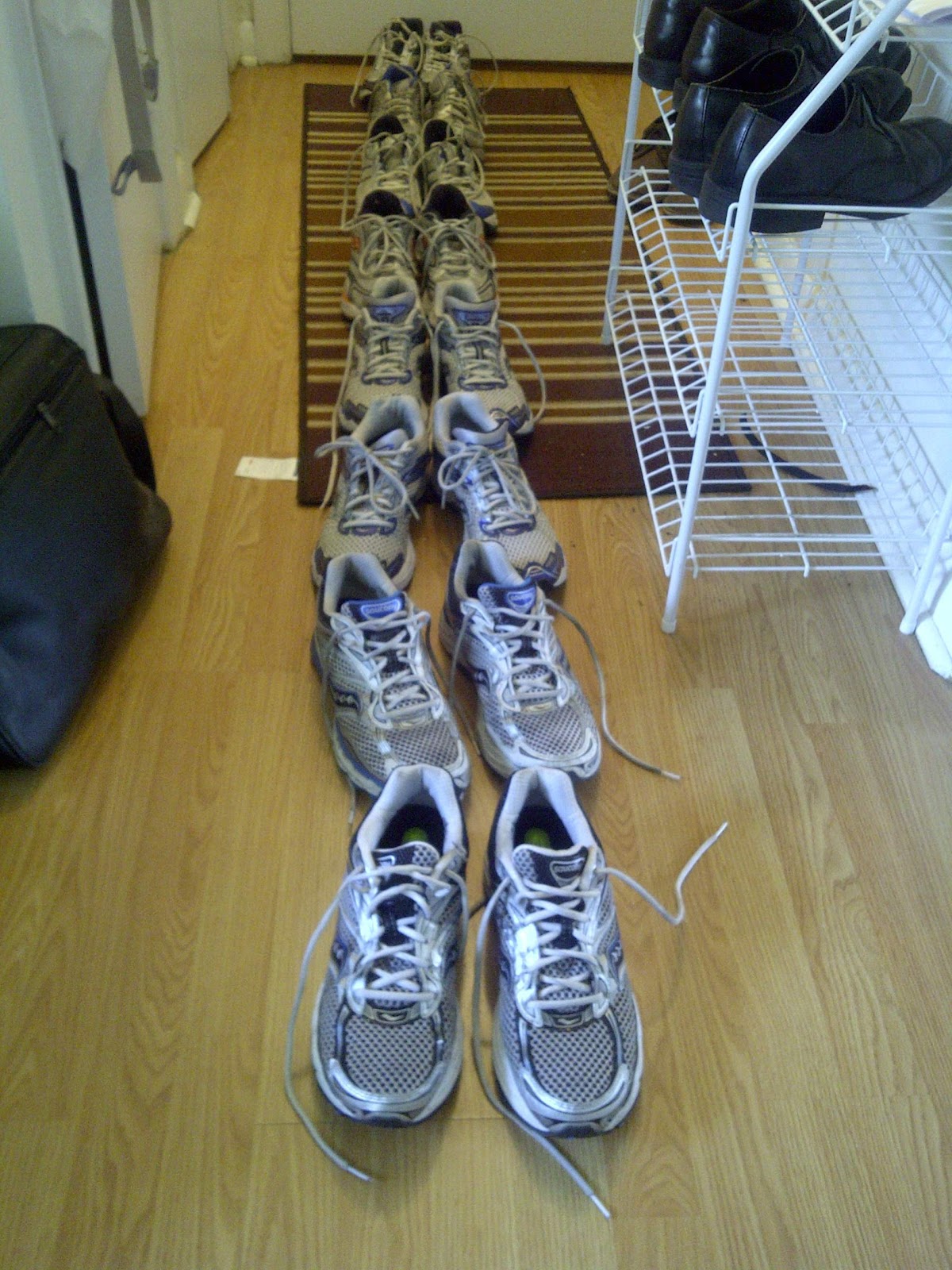
More running shoes
Here's where we are in August 2011, already 5 pairs of running shoes into the year. Averaging about 600k per shoe and stepping into the sixth shoe soon. The one at the front already 350K in.

Monday, August 01, 2011
Website domain names
Clearly the dot-com domain is the most popular domain extension. Registering a dot-com should come first, and if you miss the dot-com extension, then changing the extension won't give you the web presence that want. In fact, suppose that Microsoft didn't have the dot-com extension, many people would be driven to the dot-com site first, unintentionally.
I've missed a couple of dot-com registrations because I waited too long. I was an early Internet adopter and when Google mail, a.k.a., GMail, was launched, I grabbed the address mathenge-at-gmail-dot-com quickly. I did the same thing with Hotmail, but I lost that account because I wasn't using it and when I forgot my password, I couldn't retrieve it. I don't know if someone else has it now. I did the same thing with Yahoo!. I grabbed the mathenge-at-yahoo-dot-com address. Lost that one too.
As far as website domains are concerned, I wanted to get the mathenge-dot-com address, and when I first checked, years ago, it was available. I did nothing. I didn't have ideas to build a website, and I just didn't want to squat on it, or park it. But I regret since that address has since been taken.
But that loss doesn't irk me as much as loosing digital-pencil-dot-com. Back in 2006, when I first came up with that business name for a digital art, writing and creative media company site, the domain was available. I hummed and hawed and didn't register it. Finally, a couple of years later, I decided to buy it and, yup, you guessed it, it's gone!
So here's the dilemma. Although I have a Canadian company registered under "Digital Pencil," I don't have the dot-com site. The interesting thing is that the dot-ca site is available. Since it's a Canadian registered company, I could register the website under digital-pencil-dot-ca. That would be fine. I'd hand out business cards and all would be well, sort of. I suspect that many visitors wouldn't read the business card properly, they'd see the part that reads, http://www.digital-pencil... and they'd assume that it ends in dot-com. I know. They would. Really. It happens all the time with these dot-ca sites. Is WalMart a dot-ca or a dot-com? Well, in that case, they've got both. So does Microsoft. So does Dell. So do most of the large, international companies.
Not all though. Air Canada has grabbed both aircanada-dot-com and aircanada-dot-ca. When you go to the dot-ca site, it redirects you to the dot-com site. But the Ontario government hasn't grabbed both of them. The ontario-dot-com site is a tourist information site while the ontario-dot-ca site is the government's site. Why would they care? It's clearly obvious when you get to the dot-com site that it isn't the government so, if it were the government you were looking for, you've knocked on the wrong door. Same thing goes for the city of Toronto. The toronto-dot-com site is a tourist site, a city information site, while the dot-ca site is the official city's site.
So people are smart enough to know when they're in the wrong place. In my case, digital-pencil-dot-com looks very close in business nature to the kind of things I want to do. But hey, they're all the way out in England. So I suppose I'll go ahead and register the dot-ca site, and make sure that I bold the ca part in my business cards.
I've missed a couple of dot-com registrations because I waited too long. I was an early Internet adopter and when Google mail, a.k.a., GMail, was launched, I grabbed the address mathenge-at-gmail-dot-com quickly. I did the same thing with Hotmail, but I lost that account because I wasn't using it and when I forgot my password, I couldn't retrieve it. I don't know if someone else has it now. I did the same thing with Yahoo!. I grabbed the mathenge-at-yahoo-dot-com address. Lost that one too.
As far as website domains are concerned, I wanted to get the mathenge-dot-com address, and when I first checked, years ago, it was available. I did nothing. I didn't have ideas to build a website, and I just didn't want to squat on it, or park it. But I regret since that address has since been taken.
But that loss doesn't irk me as much as loosing digital-pencil-dot-com. Back in 2006, when I first came up with that business name for a digital art, writing and creative media company site, the domain was available. I hummed and hawed and didn't register it. Finally, a couple of years later, I decided to buy it and, yup, you guessed it, it's gone!
So here's the dilemma. Although I have a Canadian company registered under "Digital Pencil," I don't have the dot-com site. The interesting thing is that the dot-ca site is available. Since it's a Canadian registered company, I could register the website under digital-pencil-dot-ca. That would be fine. I'd hand out business cards and all would be well, sort of. I suspect that many visitors wouldn't read the business card properly, they'd see the part that reads, http://www.digital-pencil... and they'd assume that it ends in dot-com. I know. They would. Really. It happens all the time with these dot-ca sites. Is WalMart a dot-ca or a dot-com? Well, in that case, they've got both. So does Microsoft. So does Dell. So do most of the large, international companies.
Not all though. Air Canada has grabbed both aircanada-dot-com and aircanada-dot-ca. When you go to the dot-ca site, it redirects you to the dot-com site. But the Ontario government hasn't grabbed both of them. The ontario-dot-com site is a tourist information site while the ontario-dot-ca site is the government's site. Why would they care? It's clearly obvious when you get to the dot-com site that it isn't the government so, if it were the government you were looking for, you've knocked on the wrong door. Same thing goes for the city of Toronto. The toronto-dot-com site is a tourist site, a city information site, while the dot-ca site is the official city's site.
So people are smart enough to know when they're in the wrong place. In my case, digital-pencil-dot-com looks very close in business nature to the kind of things I want to do. But hey, they're all the way out in England. So I suppose I'll go ahead and register the dot-ca site, and make sure that I bold the ca part in my business cards.
Computers, technology... and crime
They call this the information age. Perhaps because we can't call it the industrial age, that one's already taken. But information, who are you kidding? The cumulative knowledge of the world is at our fingertips, but we really shouldn't be taking credit for something that we had no control over. The information just accumulated, like dust bunnies, we just happened to be here.
But maybe it's the information age because those who can, somehow, access, control, manipulate information have become more popular, more influential, that everyone else. Bill Gates the nerd (or is that the third) wouldn't have been so successful in medieval Europe trying to sell software for the newly invented abacus. Then again, he might have cornered the market on square, coloured abacus balls, that could slide easily and lock into place putting Steve Jobs and his newfangled idea to use chestnuts out of business. The information's there, and if you know where to find it, at the right time, you can get lucky and become successful.
It isn't a wonder that about 2% of Canadians are employed on farms. I found that number somewhere, not on Wikipedia, the source of all semi accurate information, not even on Statistics Canada's website, but hunting and pecking through the vast sea of opinions on the web, I came across that number. 2%. See, if I were doing a research paper, I would have done it entirely on the seat of my pants. No wandering off to a farm to ask questions. Why bother? It's all online.
And so you have our top citizens working primarily in this information space. Our presidents are lawyers, or business people, politicians, clergy and even actors. The more syllables you can use in a single word, then the higher your hourly rate usually is. More syllables, equates to more mental energy, which in turn means more effort, which requires more pay. Fewer syllables although possibly contained in more words to say the same thing, don't require as many synapses to fire, hence don't require as much pay.
So it seems.
But let's take a quick look back shall we? The kings of the past, the leaders, the conquerors were in their own right strong and powerful. Genghis was supposed to have lead the charges in his conquests. And it is said that when Alexander saw the breadth of his domain, he wept for there were no more lands left to conquer. Even the kings of England were brutish fighting types. Men of the sword. Richard III himself was killed in battle after leading a charge when some of his allies switched sides weakening the numbers in his army. But there were also some rulers who were there without physical power. They ruled by design. They were appointed, sometimes because it was ordained and they had some spiritual power, but mostly because of family ties. Tutankhamen himself was said to be deformed. But who knows, it's all speculation based on information that's highly suspect. Like trying to reconstruct what he told his sister before he died by looking at a fragment of dirt logged in between his teeth in his mummified body. No wonder historians are so engaged in story telling.
Empires were obtained, land was the currency, and servants, serfs, livestock, women all signified accumulated wealth. The more you had, the more wealthy you were. Gold was good too, but you used it to buy more stuff.
Criminals, back then, stole things. Real things, physical things that you could touch, and take. At first it was your shoes, or your clothes. Then, if you had a house, they'd steal your cookware. Perhaps your drinking tankard. In many cases, I doubt that they'd have gotten too far. After all, everyone knew what your favourite drinking tankard looked like. And shoes, well, they'd better wear them in the next village or someone would find out. And stealing too was risky business. Organising a heist required months, years sometimes, of planning. You had to go to the location and case it. You needed to watch carefully and consider all obstacles. Were the shoes left carelessly in the dining room when the man went to sleep. How many dogs were in the house and did anyone else sleep in the dining room. Being caught wasn't an option. We've read stories about the consequences of being caught, some may be true since there are instances where that type of justice is being carried out today, however, criminals were specialised and few. Once they were outlawed, then they stayed in a band, all to themselves, singing songs and robbing travellers on the highway.
In this information age, having brute strength guarantees nothing, unless you're Hulk Hogan, Mohammed Ali, Mike Tyson or Bruce Lee. And there aren't too many of those. In this information age, you need to pick up books, write a few exams, add a number of cryptic letters after your surname, and then join the millions trying to out sell, out argue, out finagle, out smart, out do each other. Sure you could do it without the additional letters by your name, and a few have done so, but our society today requires that you show your credentials before you walk in through the door. You have to prove who you are before you can take a sip at the trough. And we don't need battle axes, swords or strength to build our empires. We can convince those who work for us to take on the task of the actual labour. We'll just watch, earn our 20%, and sip cafe latte's while we figure out our next move.
This actually makes it a lot easier. It would have been tough surviving in medieval times. I'd have really sucked as a knight. I could have made a good builder, a bricklayer or a carpenter, but some brute would have stolen my tools at night when I was asleep. I'd have been forced to go into hiding, into a monastery, living out my life in quiet contemplation while copying out sections of the bible, with my own edits of course.
Today's criminals have it easier too. The research to commit a crime has probably already been done, a quick search on Wikipedia and perhaps the Deep Internet will probably unearth detailed plans of the Louvre including the alarm system configuration. Further inspection will reveal the name of the company that monitors security at the Louvre, including their off-shored immediate response team. A delivery of curried delights to a disgruntled programmer will soon lead to delivery of the codes required to disable the alarms and carry out your deed. What deed you ask? Of course you're not going to do anything as crass as actually travel to France to manually pick locks and steal Leonardo's Last Supper. Of course not. You only need to get into the database so that you can siphon funds from the museum's fat account to a small savings, no interest, numbered account on an island in the Caribbean that begins with the letter C. You don't need to go to that island to make sure that your funds have been transferred, with the beauty of the Interac system, you can safely withdraw legal tender bills from ATM's worldwide.
That type of crime is becoming insanely popular among the get-rich-quick demographic. These seem to be people in their late teens to early thirties. They have a lot of energy, seem to survive on liquid diets consisting mostly of caffeine beverages with powers of concentration that would make Houdini look like an infant. Not only can they sit in front of computers for an entire month without moving a muscle and typing at a thousand words a minute, but they seem to lack the requirement for bowel movements. Single-mindedly drilling down computer code, line by line, looking for that loophole that will grant them entry. Fearless in the knowledge that even though they're being tracked by IP address, they'll be long gone before someone realises a crime's even been committed.
And so we await the next revolution, the next turn around, cycle, movement of human evolution. And here's my take on it.
We're becoming redundant in the physical experience to the point where there's no need for some extremities any longer. These we need to lose. Our brains work much faster than our hands and typing and writing is becoming a chore. We think. It happens. That's where we need to be. In today's world, this accumulation of wealth goes to buy more stuff, but we won't be bothering with stuff any more. We'll need to accumulate stuff just so that other people can't have it. Like a game. Like a video, or Internet, game. Killing people off in cyberspace results in actual penalties, real physical consequences. After all, the Nintendo generation will be running the world soon. And after we're dead, we'll be deleted, usable parts recycled and fed back into the system to make the next generation abacus.
But maybe it's the information age because those who can, somehow, access, control, manipulate information have become more popular, more influential, that everyone else. Bill Gates the nerd (or is that the third) wouldn't have been so successful in medieval Europe trying to sell software for the newly invented abacus. Then again, he might have cornered the market on square, coloured abacus balls, that could slide easily and lock into place putting Steve Jobs and his newfangled idea to use chestnuts out of business. The information's there, and if you know where to find it, at the right time, you can get lucky and become successful.
It isn't a wonder that about 2% of Canadians are employed on farms. I found that number somewhere, not on Wikipedia, the source of all semi accurate information, not even on Statistics Canada's website, but hunting and pecking through the vast sea of opinions on the web, I came across that number. 2%. See, if I were doing a research paper, I would have done it entirely on the seat of my pants. No wandering off to a farm to ask questions. Why bother? It's all online.
And so you have our top citizens working primarily in this information space. Our presidents are lawyers, or business people, politicians, clergy and even actors. The more syllables you can use in a single word, then the higher your hourly rate usually is. More syllables, equates to more mental energy, which in turn means more effort, which requires more pay. Fewer syllables although possibly contained in more words to say the same thing, don't require as many synapses to fire, hence don't require as much pay.
So it seems.
But let's take a quick look back shall we? The kings of the past, the leaders, the conquerors were in their own right strong and powerful. Genghis was supposed to have lead the charges in his conquests. And it is said that when Alexander saw the breadth of his domain, he wept for there were no more lands left to conquer. Even the kings of England were brutish fighting types. Men of the sword. Richard III himself was killed in battle after leading a charge when some of his allies switched sides weakening the numbers in his army. But there were also some rulers who were there without physical power. They ruled by design. They were appointed, sometimes because it was ordained and they had some spiritual power, but mostly because of family ties. Tutankhamen himself was said to be deformed. But who knows, it's all speculation based on information that's highly suspect. Like trying to reconstruct what he told his sister before he died by looking at a fragment of dirt logged in between his teeth in his mummified body. No wonder historians are so engaged in story telling.
Empires were obtained, land was the currency, and servants, serfs, livestock, women all signified accumulated wealth. The more you had, the more wealthy you were. Gold was good too, but you used it to buy more stuff.
Criminals, back then, stole things. Real things, physical things that you could touch, and take. At first it was your shoes, or your clothes. Then, if you had a house, they'd steal your cookware. Perhaps your drinking tankard. In many cases, I doubt that they'd have gotten too far. After all, everyone knew what your favourite drinking tankard looked like. And shoes, well, they'd better wear them in the next village or someone would find out. And stealing too was risky business. Organising a heist required months, years sometimes, of planning. You had to go to the location and case it. You needed to watch carefully and consider all obstacles. Were the shoes left carelessly in the dining room when the man went to sleep. How many dogs were in the house and did anyone else sleep in the dining room. Being caught wasn't an option. We've read stories about the consequences of being caught, some may be true since there are instances where that type of justice is being carried out today, however, criminals were specialised and few. Once they were outlawed, then they stayed in a band, all to themselves, singing songs and robbing travellers on the highway.
In this information age, having brute strength guarantees nothing, unless you're Hulk Hogan, Mohammed Ali, Mike Tyson or Bruce Lee. And there aren't too many of those. In this information age, you need to pick up books, write a few exams, add a number of cryptic letters after your surname, and then join the millions trying to out sell, out argue, out finagle, out smart, out do each other. Sure you could do it without the additional letters by your name, and a few have done so, but our society today requires that you show your credentials before you walk in through the door. You have to prove who you are before you can take a sip at the trough. And we don't need battle axes, swords or strength to build our empires. We can convince those who work for us to take on the task of the actual labour. We'll just watch, earn our 20%, and sip cafe latte's while we figure out our next move.
This actually makes it a lot easier. It would have been tough surviving in medieval times. I'd have really sucked as a knight. I could have made a good builder, a bricklayer or a carpenter, but some brute would have stolen my tools at night when I was asleep. I'd have been forced to go into hiding, into a monastery, living out my life in quiet contemplation while copying out sections of the bible, with my own edits of course.
Today's criminals have it easier too. The research to commit a crime has probably already been done, a quick search on Wikipedia and perhaps the Deep Internet will probably unearth detailed plans of the Louvre including the alarm system configuration. Further inspection will reveal the name of the company that monitors security at the Louvre, including their off-shored immediate response team. A delivery of curried delights to a disgruntled programmer will soon lead to delivery of the codes required to disable the alarms and carry out your deed. What deed you ask? Of course you're not going to do anything as crass as actually travel to France to manually pick locks and steal Leonardo's Last Supper. Of course not. You only need to get into the database so that you can siphon funds from the museum's fat account to a small savings, no interest, numbered account on an island in the Caribbean that begins with the letter C. You don't need to go to that island to make sure that your funds have been transferred, with the beauty of the Interac system, you can safely withdraw legal tender bills from ATM's worldwide.
That type of crime is becoming insanely popular among the get-rich-quick demographic. These seem to be people in their late teens to early thirties. They have a lot of energy, seem to survive on liquid diets consisting mostly of caffeine beverages with powers of concentration that would make Houdini look like an infant. Not only can they sit in front of computers for an entire month without moving a muscle and typing at a thousand words a minute, but they seem to lack the requirement for bowel movements. Single-mindedly drilling down computer code, line by line, looking for that loophole that will grant them entry. Fearless in the knowledge that even though they're being tracked by IP address, they'll be long gone before someone realises a crime's even been committed.
And so we await the next revolution, the next turn around, cycle, movement of human evolution. And here's my take on it.
We're becoming redundant in the physical experience to the point where there's no need for some extremities any longer. These we need to lose. Our brains work much faster than our hands and typing and writing is becoming a chore. We think. It happens. That's where we need to be. In today's world, this accumulation of wealth goes to buy more stuff, but we won't be bothering with stuff any more. We'll need to accumulate stuff just so that other people can't have it. Like a game. Like a video, or Internet, game. Killing people off in cyberspace results in actual penalties, real physical consequences. After all, the Nintendo generation will be running the world soon. And after we're dead, we'll be deleted, usable parts recycled and fed back into the system to make the next generation abacus.
Being There, not Getting There
Accomplishments are made by Being There, in the moment, right now. A journey of a thousand miles begins with a single step. A building of a hundred storeys begins with a single brick. In that thousand mile journey, the single step must be taken. The step must be a good step. A conscious step. A well-formed, intelligent, purposeful step. Concentrate on the step. The one that you're taking. Don't worry about the thousandth one. You need to take the first single step, and then, when that one's finished, work on taking another one. And when you're placing that first brick, you must ensure that the brick is properly aligned, squared, seated well, in recognition of the fact that it is the foundation of many bricks to come. But don't worry about the second, third or thousandth brick when you're placing the first one. Don't worry about Getting There. Just Be There.
I've been pushing my mileage upwards and I'm now doing at least 130 K weekly. It isn't as hard as I'd once imagined. My weekday runs before work are about 14 K and I'm able to push a couple of long 3 hour runs on the weekend.
The running is meditative. Initially, when I started this whole thing, to get fit and to get back into running marathons, the training was difficult. I was doing morning runs, getting up initially at 5:30 AM to hit the road by 6, then later on as I got fitter, getting up at 5:00 AM to give myself some extra time as the runs got slightly longer. Also, running from 6:00 AM to 7:15 or so didn't give me enough time to cool off, rest and get ready for work. 5:00 AM waking time seemed to be better.
Another reason for the morning run was to simply get it over with. Once it was done, well, it was done. I could proceed with the day comfortably. Although running in the evening would have been more comfortable, the thought of finishing an entire day in the office, coming home tired and then motivating myself to get out of the door again would have added extra emotional stress. Morning running has proved to be highly successful for me.
Weekends are more relaxing and so I stretched the distance a little more. Once again, I started with Saturday and Sunday longer runs, 16K. By the end of February, it was 20K on both Saturday and Sunday.
But from my previous training, I know that the true long run is closer to 30K, and so one day, I ran a Saturday 32K followed by a Sunday 20K. I was always drained at the end of the weekend but surprised myself when I could get up and do my weekly morning mileage. The next weekend, I tried a back-to-back 32K weekend. I dreaded Saturday's since they meant long mileage. 20K was comfortably manageable, but 32K is a different beast. By the 25th K, my muscles had already tightened up. I'd finished my water and the energy gels that I carried, also finished, weren't helping. But I kept it up. The start of the run was always difficult, muscles sore from the weekly mileage, but after about 4K loose and easy. The run up to about 14K with a bit of exertion. The 14K to 20K leg was always tough. Fighting to push on, but somewhere around 22K finding my legs again for a short while. Always back and forth. Feeling like I just can't go on another step and then somehow finding something inside me to keep stepping forward.
And going through my head, most of the time, was a desire to get to the end. Finish this. How long will it take to get home. The music from my mp3 player more a distraction, to keep the pain away. From time to time, there are moments of joy. No pain, easy running. I want to hold on to those for as long as I can. I hold onto those moments. Breathe them in. Try to make them last long. And it is in those moments that I realise what being there is all about. During those moments, I'm not thinking about the finish line. I know it will come, and it will come easily, if I can just stay this way. If I can forget about running to the finish line, running to get to my home, running to the top of this hill, if I can forget about running to that place up ahead, and just stay where I am, feeling what I'm feeling, then that place that I'm really running to will come.
When I'm in my kitchen, preparing dinner, and I'm taking food out of the fridge, chopping vegetables, moving around, not really wanting to be there, perhaps, slightly engaged, but understanding fully the reason that I'm there. I'm not there to chop vegetables, cut up and season the meat, prepare a salad, grill something, I'm there to finish cooking. It's the thing at the end that's important. This stuff that I'm doing to get there's important, but not in and of itself. I'd rather be settled and eating dinner, settled and watching television, settled and listening to music, settled, just settled.
But the cutting of those vegetables is a moment in itself. They'll take time. Peeling potatoes will also take time. Moving through each and every item will have it's own time, but unfortunately, much of that time might be spent unconscious. Later, when someone asks, "how did you make this lovely meal?" You'll reply, "I just threw in this-and-that, tossed this-and-that, shoved everything into this and it was done." The details won't be remembered, because you were unconscious.
When you run, it's all about being there, not getting there. You'll get there, eventually. The journey will only be that much more enjoyable if you stay where you are.
I've been pushing my mileage upwards and I'm now doing at least 130 K weekly. It isn't as hard as I'd once imagined. My weekday runs before work are about 14 K and I'm able to push a couple of long 3 hour runs on the weekend.
The running is meditative. Initially, when I started this whole thing, to get fit and to get back into running marathons, the training was difficult. I was doing morning runs, getting up initially at 5:30 AM to hit the road by 6, then later on as I got fitter, getting up at 5:00 AM to give myself some extra time as the runs got slightly longer. Also, running from 6:00 AM to 7:15 or so didn't give me enough time to cool off, rest and get ready for work. 5:00 AM waking time seemed to be better.
Another reason for the morning run was to simply get it over with. Once it was done, well, it was done. I could proceed with the day comfortably. Although running in the evening would have been more comfortable, the thought of finishing an entire day in the office, coming home tired and then motivating myself to get out of the door again would have added extra emotional stress. Morning running has proved to be highly successful for me.
Weekends are more relaxing and so I stretched the distance a little more. Once again, I started with Saturday and Sunday longer runs, 16K. By the end of February, it was 20K on both Saturday and Sunday.
But from my previous training, I know that the true long run is closer to 30K, and so one day, I ran a Saturday 32K followed by a Sunday 20K. I was always drained at the end of the weekend but surprised myself when I could get up and do my weekly morning mileage. The next weekend, I tried a back-to-back 32K weekend. I dreaded Saturday's since they meant long mileage. 20K was comfortably manageable, but 32K is a different beast. By the 25th K, my muscles had already tightened up. I'd finished my water and the energy gels that I carried, also finished, weren't helping. But I kept it up. The start of the run was always difficult, muscles sore from the weekly mileage, but after about 4K loose and easy. The run up to about 14K with a bit of exertion. The 14K to 20K leg was always tough. Fighting to push on, but somewhere around 22K finding my legs again for a short while. Always back and forth. Feeling like I just can't go on another step and then somehow finding something inside me to keep stepping forward.
And going through my head, most of the time, was a desire to get to the end. Finish this. How long will it take to get home. The music from my mp3 player more a distraction, to keep the pain away. From time to time, there are moments of joy. No pain, easy running. I want to hold on to those for as long as I can. I hold onto those moments. Breathe them in. Try to make them last long. And it is in those moments that I realise what being there is all about. During those moments, I'm not thinking about the finish line. I know it will come, and it will come easily, if I can just stay this way. If I can forget about running to the finish line, running to get to my home, running to the top of this hill, if I can forget about running to that place up ahead, and just stay where I am, feeling what I'm feeling, then that place that I'm really running to will come.
When I'm in my kitchen, preparing dinner, and I'm taking food out of the fridge, chopping vegetables, moving around, not really wanting to be there, perhaps, slightly engaged, but understanding fully the reason that I'm there. I'm not there to chop vegetables, cut up and season the meat, prepare a salad, grill something, I'm there to finish cooking. It's the thing at the end that's important. This stuff that I'm doing to get there's important, but not in and of itself. I'd rather be settled and eating dinner, settled and watching television, settled and listening to music, settled, just settled.
But the cutting of those vegetables is a moment in itself. They'll take time. Peeling potatoes will also take time. Moving through each and every item will have it's own time, but unfortunately, much of that time might be spent unconscious. Later, when someone asks, "how did you make this lovely meal?" You'll reply, "I just threw in this-and-that, tossed this-and-that, shoved everything into this and it was done." The details won't be remembered, because you were unconscious.
When you run, it's all about being there, not getting there. You'll get there, eventually. The journey will only be that much more enjoyable if you stay where you are.
Tuesday, July 26, 2011
Is there such a thing as too much running?
Good question. At what point does it become an addition that's not good? We've heard of professional runners who are running upwards of 150K a week. And that's on top of other strengthening exercises. Granted, these guys (and gals) have professional physiotherapists taking care of their bodies, helping them recover. Many of them don't hold jobs outside their sporting activity, but some of them do.
I've read about something called "overtraining syndrome." This isn't a case of too much training as it is a case of not enough recovery. According to an article I read in Runner's World, one that made a lot of sense, you can actually overtrain on running just 20 miles a week. For those of us that think in kilometres, that's about 32k weekly, or say, about 5k daily with one day of rest. That's actually not a lot of running, that's healthy and respectable, but it's very minimal for serious runners. But yes, if you don't give your body enough time to recover between exercises, and feed it, then you can overtrain. Your body can get to the point where it doesn't get any stronger. In fact, your immune system gets weaker, your mood is also affected, and your body can begin to deteriorate, stress fractures and other muscular injuries.
But you can also train in excess of 100 miles a week and be quite fine. With enough rest your body's capable of amazing things. Reminds me of David Goggins, the navy seal who runs ultra marathons. In an interview that I watched on YouTube, he said something to that effect. That we don't know what our bodies are capable of. And that in running ultra marathons, sometimes when you think you're done, when you can't go on, when you are exhausted to the point where you feel you're breaking down, in actual fact you're only at 40% of what your body's capable of handling.
Imagine that, 40%!
So it is possible to overtrain, but with good rest, good nutrition, and watching for the signs, it's also possible to stretch yourself beyond your normal boundaries.
With that, I think I should sleep.
I've read about something called "overtraining syndrome." This isn't a case of too much training as it is a case of not enough recovery. According to an article I read in Runner's World, one that made a lot of sense, you can actually overtrain on running just 20 miles a week. For those of us that think in kilometres, that's about 32k weekly, or say, about 5k daily with one day of rest. That's actually not a lot of running, that's healthy and respectable, but it's very minimal for serious runners. But yes, if you don't give your body enough time to recover between exercises, and feed it, then you can overtrain. Your body can get to the point where it doesn't get any stronger. In fact, your immune system gets weaker, your mood is also affected, and your body can begin to deteriorate, stress fractures and other muscular injuries.
But you can also train in excess of 100 miles a week and be quite fine. With enough rest your body's capable of amazing things. Reminds me of David Goggins, the navy seal who runs ultra marathons. In an interview that I watched on YouTube, he said something to that effect. That we don't know what our bodies are capable of. And that in running ultra marathons, sometimes when you think you're done, when you can't go on, when you are exhausted to the point where you feel you're breaking down, in actual fact you're only at 40% of what your body's capable of handling.
Imagine that, 40%!
So it is possible to overtrain, but with good rest, good nutrition, and watching for the signs, it's also possible to stretch yourself beyond your normal boundaries.
With that, I think I should sleep.
Monday, July 25, 2011
Mastering the long run
The long run is a part of the diet for anyone training for a marathon. The long run prepares your muscles for endurance. Raises the lactic threshold to allow your legs to sustain the pain of the marathon distance.
But what is the long run?
It's not a precisely measured distance, like the marathon at 42.2 kilometres (actually 42.195 k), but runners generally agree that anything over 30 k is a long run. Training for a marathon involves a combination of short fast runs, strength training, casual distance runs and, the long run.
Some runners have been known to overindulge in the long run. In fact, I tend to put one long run in weekly. Normally on the Sunday, the day that most marathons are held. My long runs take me out to 32 k, which is comfortable enough that the rest of the day is functional. My long runs are slow. It takes me three hours to run the 32 k, far below my 3:30 marathon pace. But the pace is intentionally slow. In fact, I now look forward to the long run on Sundays. There was a time I used to dread it.
The long run for me involves slowing down greatly. Before I head out of the door, I acknowledge the fact that I'm going to be out for three hours. I carry some water, and a couple of energy gels. I also carry $2 nowadays, so that I can stop at a convenience store and buy more water. The water I carry is barely 500 ml, which isn't enough for the distance.
Mentally, I'm not thinking of anything in particular, but my mind wanders. I have my music on, an eclectic mix of different tunes. Not always disco, but some soul, r&b, gospel, dance, hip hop, rap. The music serves as a backdrop, to mask out the sound of my breathing and fill those voids where I might be feeling exhausted. If I can't hear what's happening outside, I miraculously don't get too tired.
And I don't push the pace. One step at a time. I know, that sounds cliché, and it's taken a long time to master, it's very difficult to do. Mastering one-step-at-a-time is the key to the long run. Not looking ahead at the distance, watching the long path ahead, looking at the traffic light way up the road, wondering when you'll get there, looking at the hill that's about to come and heaving and puffing your way up, wondering when you'll reach the top. Mastering just taking one comfortable step, lightly, effortlessly, and feeling great about that one step you just took. Like seeing yourself outside your body. Like you're watching yourself on a TV screen moving easily.
When you watch runners you're never usually concerned with where they're going. You're never usually concerned with how long it's taking them to move from one point to another, even in a race. Watch the guy at the back. He even looks good! When you watch a runner, mostly what you see is posture, balance, how the stride looks, how erect the body is and how smooth they look. And that's what you should concentrate on in the long run.
Consider it to be a dress rehearsal where you have to get something right, and that something is your stride. So work on the single stride. Move one step, and then evaluate that step that you just took. Do you even remember it? What did it feel like? Try a second step, watch your knee as it rises up and forward, as your foot swings in front and you touch down, meanwhile your other leg has stretched out behind you and is kicking off. Stride again. One more, feel it, see it in your mind's eye, do it.
I've found that this technique helps me in my shorter runs too. In fact, what normally happens in those shorter runs is that I naturally speed up. I don't slow myself down but just let it happen. Amazingly, sometimes that speed happens when going up a hill and I cruise up. Of course when I get to the top, sometimes, not all the time, I'm drained, but I don't stop, I slow down instead. Slowing down is better than stopping and I catch my breath as I manage my stride. Again, one step at a time. Not thinking about how I've almost slowed down to a crawl, but concentrate on just taking one step and breathe and one step and breathe.
But for the long run, speeding up isn't a good thing. When I catch myself speeding up, and it happens unconsciously because I'm only thinking about the step-by-step thing, I have to consciously slow down. In order to slow down, I have to concentrate on the technique. Back to the form. Step by step. Not worrying about the distance.
So the long run doesn't have to be painful or threatening. At least, not the first three-quarters of it. Eventually, after a couple of hours of running, even the best training submits to fatigue. If you're thirsty, no amount of will power, positive thinking, mental discipline will assuage the thirst. You need water. If you're puffing and panting, then you need to stop, or slow down. You can't be out of breath for very long, it's similar to hyperventilating. Your body will force you to quit so it's best to see the signals and stop yourself.
Eat a light, high carbohydrate meal the night before. Not too late. Not too much eating in the morning. If you're like me, stock your running belt with a couple of gels. I find that two energy gels are good enough. I carry two 8 oz (about 250 ml each) bottles of water. Not just plain water, I have an electrolyte mix (eLoad, endurance formula). And, of course, a $2 coin, for that bottle of water that I buy at about the 24k mark.
It takes practise. The long run is something that will take a long time to get used to. It doesn't happen overnight and even experienced runners will tell you that it's taken a long time to get used to running anything over a couple of hours. Some will even admit that they can't run longer than two hours. Running for three hours, if you're marathon finish time is about four hours is about right.
Happy running!
But what is the long run?
It's not a precisely measured distance, like the marathon at 42.2 kilometres (actually 42.195 k), but runners generally agree that anything over 30 k is a long run. Training for a marathon involves a combination of short fast runs, strength training, casual distance runs and, the long run.
Some runners have been known to overindulge in the long run. In fact, I tend to put one long run in weekly. Normally on the Sunday, the day that most marathons are held. My long runs take me out to 32 k, which is comfortable enough that the rest of the day is functional. My long runs are slow. It takes me three hours to run the 32 k, far below my 3:30 marathon pace. But the pace is intentionally slow. In fact, I now look forward to the long run on Sundays. There was a time I used to dread it.
The long run for me involves slowing down greatly. Before I head out of the door, I acknowledge the fact that I'm going to be out for three hours. I carry some water, and a couple of energy gels. I also carry $2 nowadays, so that I can stop at a convenience store and buy more water. The water I carry is barely 500 ml, which isn't enough for the distance.
Mentally, I'm not thinking of anything in particular, but my mind wanders. I have my music on, an eclectic mix of different tunes. Not always disco, but some soul, r&b, gospel, dance, hip hop, rap. The music serves as a backdrop, to mask out the sound of my breathing and fill those voids where I might be feeling exhausted. If I can't hear what's happening outside, I miraculously don't get too tired.
And I don't push the pace. One step at a time. I know, that sounds cliché, and it's taken a long time to master, it's very difficult to do. Mastering one-step-at-a-time is the key to the long run. Not looking ahead at the distance, watching the long path ahead, looking at the traffic light way up the road, wondering when you'll get there, looking at the hill that's about to come and heaving and puffing your way up, wondering when you'll reach the top. Mastering just taking one comfortable step, lightly, effortlessly, and feeling great about that one step you just took. Like seeing yourself outside your body. Like you're watching yourself on a TV screen moving easily.
When you watch runners you're never usually concerned with where they're going. You're never usually concerned with how long it's taking them to move from one point to another, even in a race. Watch the guy at the back. He even looks good! When you watch a runner, mostly what you see is posture, balance, how the stride looks, how erect the body is and how smooth they look. And that's what you should concentrate on in the long run.
Consider it to be a dress rehearsal where you have to get something right, and that something is your stride. So work on the single stride. Move one step, and then evaluate that step that you just took. Do you even remember it? What did it feel like? Try a second step, watch your knee as it rises up and forward, as your foot swings in front and you touch down, meanwhile your other leg has stretched out behind you and is kicking off. Stride again. One more, feel it, see it in your mind's eye, do it.
I've found that this technique helps me in my shorter runs too. In fact, what normally happens in those shorter runs is that I naturally speed up. I don't slow myself down but just let it happen. Amazingly, sometimes that speed happens when going up a hill and I cruise up. Of course when I get to the top, sometimes, not all the time, I'm drained, but I don't stop, I slow down instead. Slowing down is better than stopping and I catch my breath as I manage my stride. Again, one step at a time. Not thinking about how I've almost slowed down to a crawl, but concentrate on just taking one step and breathe and one step and breathe.
But for the long run, speeding up isn't a good thing. When I catch myself speeding up, and it happens unconsciously because I'm only thinking about the step-by-step thing, I have to consciously slow down. In order to slow down, I have to concentrate on the technique. Back to the form. Step by step. Not worrying about the distance.
So the long run doesn't have to be painful or threatening. At least, not the first three-quarters of it. Eventually, after a couple of hours of running, even the best training submits to fatigue. If you're thirsty, no amount of will power, positive thinking, mental discipline will assuage the thirst. You need water. If you're puffing and panting, then you need to stop, or slow down. You can't be out of breath for very long, it's similar to hyperventilating. Your body will force you to quit so it's best to see the signals and stop yourself.
Eat a light, high carbohydrate meal the night before. Not too late. Not too much eating in the morning. If you're like me, stock your running belt with a couple of gels. I find that two energy gels are good enough. I carry two 8 oz (about 250 ml each) bottles of water. Not just plain water, I have an electrolyte mix (eLoad, endurance formula). And, of course, a $2 coin, for that bottle of water that I buy at about the 24k mark.
It takes practise. The long run is something that will take a long time to get used to. It doesn't happen overnight and even experienced runners will tell you that it's taken a long time to get used to running anything over a couple of hours. Some will even admit that they can't run longer than two hours. Running for three hours, if you're marathon finish time is about four hours is about right.
Happy running!
Wednesday, July 06, 2011
A case for eradicating the letter "Z"
In a move to simplify spelling tests for kids in school, as well as merge common sounds to use the same letter (at some point we'll discuss phasing out the letter "g" in favour of combinations of "c"), the management board of Common Sense Inc. has decided finally to eradicate the use of the letter "z." In an astounding vote that previously ended in a deadlock, rationality has won out. In making a statement to the press right after the forty-eight hour debate, the public relations arm of Common Sense Inc. said that "this was a giant leap for mankind." Mr. Chord then went on to admit that in the end it took a physical fight to resolve the deadlock. With the ten person panel hopelessly deadlocked it didn't look like there would be any progress. According to the charter of Common Sense Inc. a solution must be reached, either positive or negative, to any internal debate. In this case, a five-to-five deadlock was simply unacceptable and so they would need to continue discussing it. After twenty four hours of debate, mostly it was the idiot from the press team who did most of the talking, the board room door was locked and they were denied water and food. This was a a standard decision making tactic used successfully in the past by Common Sense Inc's management. Introduced by the founding president, Charles It's-my-way-or-the-highway Rocco, the original technique involved a preparatory cleansing period. In that twelve-hour period, prior to any team meeting, staff members who were known to be in disagreement with Rocco would be locked away in the janitor's closet and made to breathe in the fumes from cleansing liquids. They were denied water and a stool to sit on.
Mr. Chord explained to the anxious team waiting for the results that in the end, Jack Azz, obviously among those in disagreement, was standing quietly when all of a sudden Ad Digit from Accounting dove at him in what appeared to be a rugby style tackle. On the ground Ad was able to place two well timed punches on Jack's ribs before the other members of the panel pulled him off. Even as Jack was getting painfully up from the floor, Ad was taunting him by shaking his ass and mouthing the same word too. It took a few minutes to calm the room down but after that had been accomplished, another scuffle began. This time it was between Barry, an avid historian who was defending the word "zero" and Meg, the receptionist whose view of life was mostly learned from watching television. The argument wasn't going anywhere but Barry was definitely getting irritated to the point where he looked like he was going to blow a vein. A huge vessel in his temple was pulsating and he was slowly turning purple.
No one really noticed that Bob had gotten up from his seat around the table and was pacing along the window. Occasionally he'd look outside, but mostly the chaos in room didn't disturb him. One by one they stopped what they were doing to observe Bob. Finally Bob turned to face them, slipped his hand into his right pocket and revealed what looked like the handle of a gun. He took a look around the room, shook his head, put the thing back and continued his pacing. After a few minutes, he quietly declared to the room, "I think that this would come to a quick conclusion if there were only an odd number of us in the room." More silence. "I vote to eliminate z, who's with me." All hands shot up.
Victory. It's quite amazing that even the most perplexing, or seemingly perplexing, issues can be handled with quiet, poise and careful thinking. In this case, Bob clearly displayed his management potential, even though he was just the mail room clerk.
Mr. Chord explained to the anxious team waiting for the results that in the end, Jack Azz, obviously among those in disagreement, was standing quietly when all of a sudden Ad Digit from Accounting dove at him in what appeared to be a rugby style tackle. On the ground Ad was able to place two well timed punches on Jack's ribs before the other members of the panel pulled him off. Even as Jack was getting painfully up from the floor, Ad was taunting him by shaking his ass and mouthing the same word too. It took a few minutes to calm the room down but after that had been accomplished, another scuffle began. This time it was between Barry, an avid historian who was defending the word "zero" and Meg, the receptionist whose view of life was mostly learned from watching television. The argument wasn't going anywhere but Barry was definitely getting irritated to the point where he looked like he was going to blow a vein. A huge vessel in his temple was pulsating and he was slowly turning purple.
No one really noticed that Bob had gotten up from his seat around the table and was pacing along the window. Occasionally he'd look outside, but mostly the chaos in room didn't disturb him. One by one they stopped what they were doing to observe Bob. Finally Bob turned to face them, slipped his hand into his right pocket and revealed what looked like the handle of a gun. He took a look around the room, shook his head, put the thing back and continued his pacing. After a few minutes, he quietly declared to the room, "I think that this would come to a quick conclusion if there were only an odd number of us in the room." More silence. "I vote to eliminate z, who's with me." All hands shot up.
Victory. It's quite amazing that even the most perplexing, or seemingly perplexing, issues can be handled with quiet, poise and careful thinking. In this case, Bob clearly displayed his management potential, even though he was just the mail room clerk.
Monday, May 30, 2011
Saucony Progrid Omni 9
After retiring my Mississauga shoes, and running for the past ten years in Saucony Ride's (the next version of the Trigon series of Saucony shoes), I've changed shoes.
I was told that my foot's kinda flat and so didn't need so much instep cushioning. The Ride 3 shoe has a larger instep. For those of us with flatter feet, we only need the cushioning somewhat lower and a larger base. The Ride 3 has a thinner in the mid section than the Omni 9 and has a higher instep as well. The Omni 9 is wider in the middle and so has better support for flatter footed people.
Here's the shoe:

And here's another, blurrier, picture:

Now here's the old Ride 3, the Mississauga Marathon shoe, compared to the Omni 9. You can see the deeper instep on the Ride 3 (the older dirtier shoe on the bottom of the picture).

The Omni 9 has a flatter, broader base, but still an instep protection. I actually felt my instep lifted up by this one which is strange since I didn't feel the instep so much on the Ride 3, though it's higher. The close-up below highlights the difference even more.

I believe that this shoe got rid of my knee problems and hopefully the Omni 9 shoe is the one for me. It feels different, but I trust the guys at the Running Room and so I'm going to give it a shot. I'm going to run the Streetsville Bread and Honey 15K this weekend with this shoe but I'll know long before that race if I'm comfortable in it.
I was told that my foot's kinda flat and so didn't need so much instep cushioning. The Ride 3 shoe has a larger instep. For those of us with flatter feet, we only need the cushioning somewhat lower and a larger base. The Ride 3 has a thinner in the mid section than the Omni 9 and has a higher instep as well. The Omni 9 is wider in the middle and so has better support for flatter footed people.
Here's the shoe:

And here's another, blurrier, picture:

Now here's the old Ride 3, the Mississauga Marathon shoe, compared to the Omni 9. You can see the deeper instep on the Ride 3 (the older dirtier shoe on the bottom of the picture).

The Omni 9 has a flatter, broader base, but still an instep protection. I actually felt my instep lifted up by this one which is strange since I didn't feel the instep so much on the Ride 3, though it's higher. The close-up below highlights the difference even more.

I believe that this shoe got rid of my knee problems and hopefully the Omni 9 shoe is the one for me. It feels different, but I trust the guys at the Running Room and so I'm going to give it a shot. I'm going to run the Streetsville Bread and Honey 15K this weekend with this shoe but I'll know long before that race if I'm comfortable in it.
Mississauga Marathon Shoes - Retired
Thanks. Training with you was great and now you're close to 500K and time to ease off a while. So here are my Saucony Progrid Ride 3, blue. Bought on March 29th and officially retired from running on May 30 (2011).

The right shoe has a bit of wear near the big toe. This is a size 11 and it fits comfortably and I don't feel that my toe's pushing, though it's clear to see that there's wear there.
Here's my other shoe, training shoe, bought on March 18, 2011 and also retired today (May 30, 2011). It amassed close to 800K. Thanks!

This was the green highlight shoe.

Here's my other shoe, training shoe, bought on March 18, 2011 and also retired today (May 30, 2011). It amassed close to 800K. Thanks!

This was the green highlight shoe.
Monday, May 16, 2011
Race Report - Mississauga Marathon 2011
Well, it's all done. Boy what a day. Got up early, 5 AM, had some baked yam, salted, buttered, wanted it to be digested before the race. Good thing that I had prepared my bag the night before and put in some clothes to wear after the race. A dry t-shirt and a pair of jogging pants. At 6:30 I was ready, shorts, running shirt, running shoes, timing chip secured to my laces with a plastic tie. My fuel belt had five gels and a Clif Blok as well as my apartment keys, driver's license and some cash ($120) in a plastic bag. Always good to move around with ID and money.
 So the weight I was going to carry was negligible. Everything fit comfortably in the pockets of the belt and there was going to be no jiggling. I donned the wind breaker, and off I went.
But as soon as I stepped outside, the cold air and drizzle made me realise that I might need more clothes! I had a long sleeved running shirt and perhaps it would be a good idea to run with the wind breaker. I went back inside to get my running gloves. If there's one thing I know, I can't run if my hands are freezing. I stop concentrating and cannot relax as the pain in my hand takes precedence. Looking back, the gloves may have saved that race. I ran with them all the way and I couldn't have been more comfortable.
At the start line looked like there was a healthy crowd. I'd thought that the Toronto marathon would ruin the Mississauga one by moving their race so close to ours. They'd split the runners. And they did. The turnout for the full marathon was close to 1100, which is respectable. Toronto had the same turnout as well. Most of the people had long sleeved shirts and were wearing long running pants. There were some of us with shorts, but we weren't the majority for sure. Many people had jackets on or were wearing the upside-down garbage bags for wind-breaking and warmth-keeping. I had to check in my bag with the dry clothes so I knew that I had to take off my wind breaker. I wasn't going to run in it, but if I took it off I'd start to get cold. But eventually, after a few minutes, when I thought that there were only ten or so minutes to start, I took my jacket off, put it in my bag and went over to the baggage drop-off.
It wasn't as cold as I'd imagined. In fact, I was quite comfortable. This is surprising since I've been in many races where I've had to run with a jacket or a wind breaker, where I thought that the weather was terrible and freezing and saw runners in shorts and sleeveless tops. Now today, on a day that I think is not too bad, I'm the one in a short sleeved t-shirt and they're wearing jackets and long pants. Go figure!
I made my way over to the crowd already assembled in front of the start line. I heard the announcer say "2 minutes to gun time, at this time blah blah blah will sing the national anthem." And it was sung. And then it was only a minute to start time, and then ten seconds and the countdown, and finally the gun.
We were off. Walking at first since the crowd was dense. There was this big guy in front of me that looked like he was never going to get going. Just walking and taking his sweet time even though there was a gap developing in front of him where he could start jogging. And when I started to squeeze myself to the side of him, he started running.
The pack of gels on the belt located on my back started to bounce. That wasn't comfortable so I moved them to the front of the right hip. They stopped bouncing and all was good. I put on my headphones and turned the music on. Low. Felt strange. The legs were still not awake but the body felt like moving. It felt as though everyone was moving really fast. I felt as though I was moving through really think dense air. Not as fluid and as light as I would like to be. But I knew it would pass.
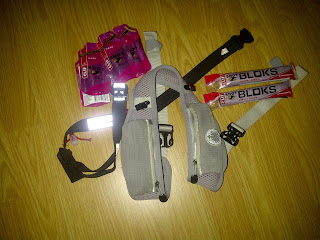 Around Square One shopping centre, to the front entrance, and onto Burnhamthorpe Road and west on Burnhamthorpe. I found space on the left side, away from the crowd milling near the middle of the road. I swung wide so that I could be alone. And people were still passing on the right. They looked fast too. I had to check my feelings and check myself. Full marathon runners were wearing a blue bib and half-marathon runners where wearing red bibs. So every time someone flew by, I made sure to check the colour of the bib. If it was red, then I felt better about it. After all, they could afford to take off and zoom away. They were only going half the distance. I was happy to note that there weren't too many blue bibbed people zooming by. On the other hand, I knew that there wasn't that many of us blue bibbers. And I really wanted to place well. There's one thing to finish. There's a second thing to finish within a certain amount of time. Lastly, there's the respectable thing to finish in a good position. Not too far back in the pack. Something like the top half would be good. So I knew that there wasn't too many of us and that the ones that were left, coming out in this kind of weather, were probably the die hards. The real runners. No wind, rain, sleet or hail will stop them from getting out of their cozy warm beds to practise the sport they love.
The first 15K of the marathon race is on the same part of the route as the half-marathon runners. So, for the first 15K, the full marathon and half marathon runners run side-by-side. Not exactly side-by-side since most of the half-marathoners are running at a slightly higher pace. At 15K, on Indian Road, the two races part ways. And it's finally clear. You now feel like you're running a marathon because you're with your peers. You look around and everyone is different. Those half-marathon kids are gone and only the serious gladiators are left. These are the warriors. And you're into serious running. I turned onto Indian Road easily and looked ahead at the long road. Up ahead a group of runners and just behind me, I could feel him on my left side, was another marathoner. He stayed there, not passing not surging at all. I had a good pace and I felt really good. My legs were doing all the work and I was listening to music. I wasn't going to change tactics and get uncomfortable. But I was really happy to see the 16K sign coming up. These kilometres were ticking off quite fast. When I felt fatigue, I adjusted my stride and fortunately got my legs back and my breathing under control. Felt great.
The 1/2 marathon mark came up at 21.1K and I didn't see a clock! I don't remember if there was a clock at the halfway mark the last time, but I seem to think that there was one. In any case, the sportstats mats were there so I knew that I'd be able to see that split later on. Turns out that I hit that point at 1:44:37. I was on target. Had I known this, I would have turned on the gas a little since there's a great flat section and a small decline before those rolling hills on the last 10K. But we moved into the industrial area. It's not bad, the road's fine, but it's bare. Nothing to see. Not like the nice homes on Mississauga Road that we'd just left.
The Mississauga Marathon then turns right on Lakeshore heading towards Oakville and at the 25K mark it turns back. There are mats at the 25K mark to make sure that nobody cheats. You have to go out there and turn back. And turning back, you now see runners who are behind you as they make their way to that point. But between 22K and 25K, as you make your way to this turning point, you'll see all the runners that are ahead of you as they're coming back. I was happy to see that there weren't too many. And there weren't too many groups. Only individuals. Not hordes of runners. This is a good feeling. On my way back from the 25K mark, I felt very energetic. I'd consumed about 2 gels at this time and they were kicking in. I switched to a lower gear, raised those knees and burst ahead. I was feeling great heading towards 26K, 27K and 28K. I was still amazed at how quickly those kilometre marks were passing by. I felt like I was in the groove. On my game. In my stride. Nothing could stop me. And I knew that I was close to my regular daily run length, the 11K that I do every morning. Once I got to 30K, I would be able to imagine how far I was from the finish. But there's another thing that happens as you turn around at that 25K mark. You're now facing the wind and it's very obvious. It wasn't so obvious that it was at your back making your way over, but as you turn, the rain's in your face and the wind has that gentle push. It was a gusting wind, gentle at times and blowing relatively hard other times. It wasn't unbearable, but the legs felt the additional workload that they had to do.
The last 13K of the race is along Lakeshore and through the paths along the shores of Lake Ontario. There are undulating hills, some quite steep, but short. There are sections where you can catch your breath after a short climb and some sections where you can take advantage of the downhill slope and elongate your stride to make up those precious seconds lost on the climb. My shoes were doing a great job and my feet were comfortable. My knees weren't even feeling any stress at all. I really didn't think of the knees, even when I got home. I didn't think of my Achilles at all.
 My bib was barely legible and I don't know if I'll appear on any photos. Normally, official photographers on the route will identify runners, email them offering the pictures if they can read the bib numbers. As you can see from the photo, I doubt that they would have been able to make out this number, especially close to the end of the race. Despite some of the muddy sections, my shoes stayed relatively clean.
And even though I could feel the fatigue setting in, my ability to push was reaching its limits, my legs kept clicking on. Amazingly, they didn't want to give up. The long runs, 32K's on weekends helped toughen them up and now they were producing results. No bonking out here. I just had to try and stay relaxed and not think of anything and they would drive me home. The longest part of the race was probably from 38K to 40K. I was anxious to see that 40K mark and kept looking ahead for it. At this point, we were winding in and out of parks. Turning through the park paths, not on the road was good. The park paths made it easier to run since you were seeing new things all the time. Not a long stretch of road but a short distance ahead before a turn. Suddenly a vista of the lake, though at this point none of the runners would have been concentrating on how beautiful that vista was. I don't think I looked at the lake long enough to savour it. If memory serves me right, it was grey and dark. The sky was completely grey because of the clouds and everything looked grey and wet. As we got closer to 41, we were in the city of Port Credit. Now the sound of cheering grew louder. More people. More energy. And I forgot, the past few water stops had volunteers giving out gels. This is a Mississauga phenomenon because I haven't seen any other race organisers giving out gels. They're not cheap and I saw boxes loaded with them. This was the right moment for gels. The other thing that I remember on the stops from 30K on were tables with fruit. Oranges and bananas, already cut. I should have probably digested a couple of oranges, that may have made a difference.
 But onto Port Credit and the energy from the crowds was great. I could feel them and see them, but not individuals. Just people. Masses of faceless, yet encouraging people. Some huddled under umbrellas, not too close to the path. Some not minding the rain and cheering. I wonder what makes them come out in the rain. Perhaps they know someone running and it's possible that with 1100 marathoners, 4000 half-marathoners and the rest of the different race groups, you'd get at least half that many spectators. And 41K came by and now I could see the finish. It was on the other side of a pier. I would have to run along the edge of the lake, across a bridge and then turn back onto the pier towards the finish. But that was only 1.2K away. I knew I'd made it and my legs weren't going to give up on me. I wasn't tired but I didn't have anything left to push any more. I had only cruising speed. No acceleration at all. Just enough to keep the current pace. One step at a time, getting closer and closer. The path narrowed, more spectators and much closer. You could see faces and cheering. There were other people on the way to the finish line. People who'd started the walking marathon at 6:00 AM. Some stragglers still finishing the 1/2 marathon. Some speedsters from the relay. But I moved easily past them, all on my cruising speed. I was alone on the home stretch. Now there were barriers on the side to stop people from spilling into the finish gate. I heard cheering behind me and felt steps. I stepped into a narrow gate and onto some timing mats. I heard the beep as they registered by entrance to the last fifty metres. My name was announced. They pronounced Mathenge incorrectly, as they usually do, by softening the "g" the way you'd say Stonehenge. I heard more cheering behind me and glanced back to see how close this supposed sprinter was. Nobody even close. I would be crossing the finish line alone. Great! Looking up at the clock, I saw the time at 3:34. Not bad I said. Something inside me told me that it could have been better. Even as I slowed down on the timing mats, hearing their chatter as a million signals picked up my timing chip, I knew that this was only the beginning of another long successful career.
I'd found myself back on track. Life was looking up. I walked over to someone giving out space blankets. Those sheets made of something that resembles foil. Wrapped myself and then walked over to the guys that were removing the timing chips from the shoes. I almost didn't pick up my medal since the girls giving out the medals were busy chatting among themselves but one of them saw me and walked up to me and asked, "did you get your medal yet?" I said no and she said, "congratulations on a great race." I remember that as she took a full marathon medal and put it around my neck. "Thanks!"
And so the lessons finally learnt.
There's no substitute for preparation. If you don't do the time, you'll pay the price.
It's important to know where you are. I need to get a running watch, probably something better for training, but when running definitely something to pace myself with.
Nutrition during the race is very important as is hydration.
There's no substitute for the long run when preparing for a marathon.
You need to include strength work and speed work as part of exercise.
And lastly, it's all in the head. A positive, happy, optimistic attitude works wonders in training and on race day.


But as soon as I stepped outside, the cold air and drizzle made me realise that I might need more clothes! I had a long sleeved running shirt and perhaps it would be a good idea to run with the wind breaker. I went back inside to get my running gloves. If there's one thing I know, I can't run if my hands are freezing. I stop concentrating and cannot relax as the pain in my hand takes precedence. Looking back, the gloves may have saved that race. I ran with them all the way and I couldn't have been more comfortable.
At the start line looked like there was a healthy crowd. I'd thought that the Toronto marathon would ruin the Mississauga one by moving their race so close to ours. They'd split the runners. And they did. The turnout for the full marathon was close to 1100, which is respectable. Toronto had the same turnout as well. Most of the people had long sleeved shirts and were wearing long running pants. There were some of us with shorts, but we weren't the majority for sure. Many people had jackets on or were wearing the upside-down garbage bags for wind-breaking and warmth-keeping. I had to check in my bag with the dry clothes so I knew that I had to take off my wind breaker. I wasn't going to run in it, but if I took it off I'd start to get cold. But eventually, after a few minutes, when I thought that there were only ten or so minutes to start, I took my jacket off, put it in my bag and went over to the baggage drop-off.
It wasn't as cold as I'd imagined. In fact, I was quite comfortable. This is surprising since I've been in many races where I've had to run with a jacket or a wind breaker, where I thought that the weather was terrible and freezing and saw runners in shorts and sleeveless tops. Now today, on a day that I think is not too bad, I'm the one in a short sleeved t-shirt and they're wearing jackets and long pants. Go figure!
I made my way over to the crowd already assembled in front of the start line. I heard the announcer say "2 minutes to gun time, at this time blah blah blah will sing the national anthem." And it was sung. And then it was only a minute to start time, and then ten seconds and the countdown, and finally the gun.
We were off. Walking at first since the crowd was dense. There was this big guy in front of me that looked like he was never going to get going. Just walking and taking his sweet time even though there was a gap developing in front of him where he could start jogging. And when I started to squeeze myself to the side of him, he started running.
The pack of gels on the belt located on my back started to bounce. That wasn't comfortable so I moved them to the front of the right hip. They stopped bouncing and all was good. I put on my headphones and turned the music on. Low. Felt strange. The legs were still not awake but the body felt like moving. It felt as though everyone was moving really fast. I felt as though I was moving through really think dense air. Not as fluid and as light as I would like to be. But I knew it would pass.
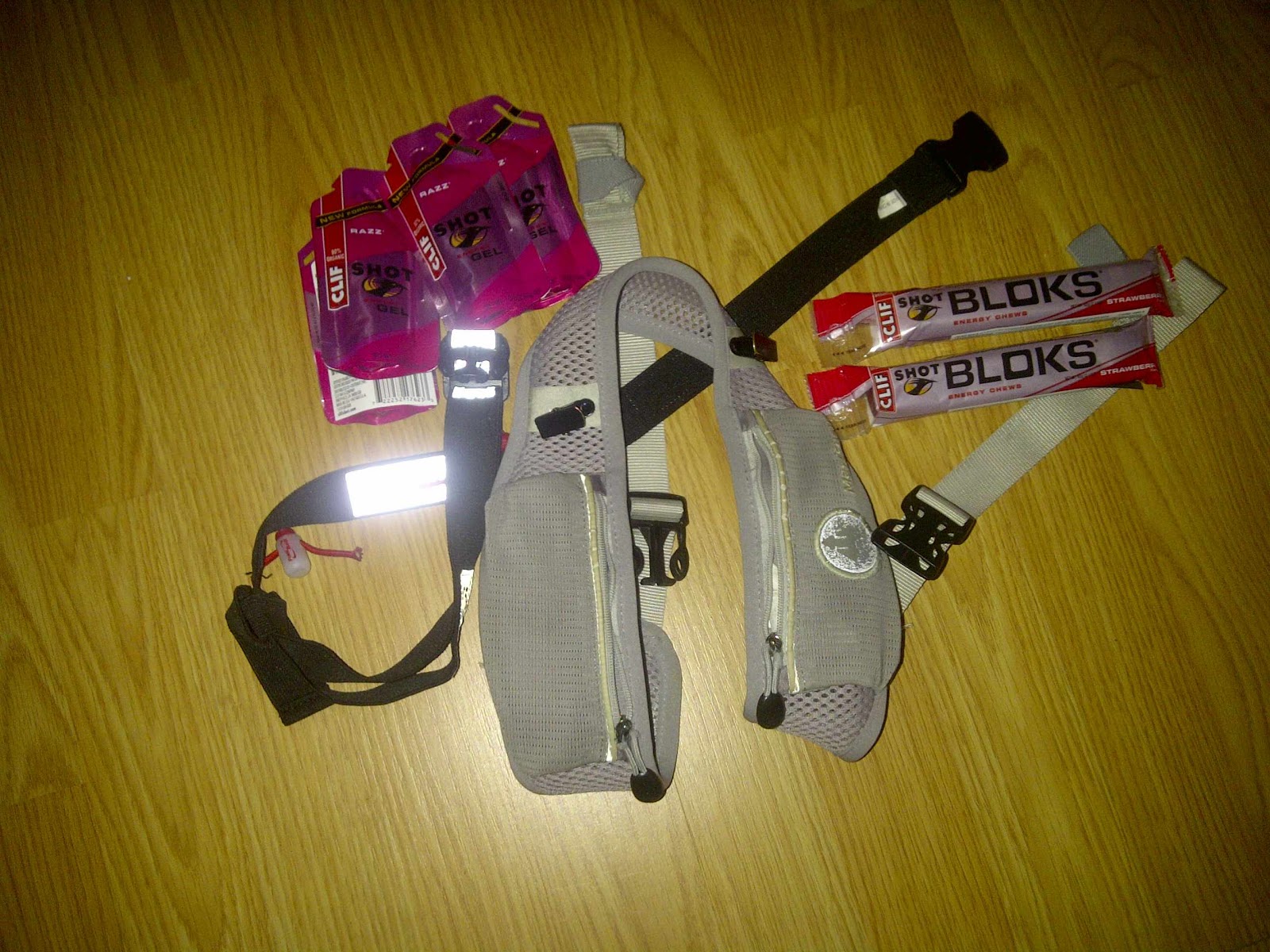
The first 15K of the marathon race is on the same part of the route as the half-marathon runners. So, for the first 15K, the full marathon and half marathon runners run side-by-side. Not exactly side-by-side since most of the half-marathoners are running at a slightly higher pace. At 15K, on Indian Road, the two races part ways. And it's finally clear. You now feel like you're running a marathon because you're with your peers. You look around and everyone is different. Those half-marathon kids are gone and only the serious gladiators are left. These are the warriors. And you're into serious running. I turned onto Indian Road easily and looked ahead at the long road. Up ahead a group of runners and just behind me, I could feel him on my left side, was another marathoner. He stayed there, not passing not surging at all. I had a good pace and I felt really good. My legs were doing all the work and I was listening to music. I wasn't going to change tactics and get uncomfortable. But I was really happy to see the 16K sign coming up. These kilometres were ticking off quite fast. When I felt fatigue, I adjusted my stride and fortunately got my legs back and my breathing under control. Felt great.
The 1/2 marathon mark came up at 21.1K and I didn't see a clock! I don't remember if there was a clock at the halfway mark the last time, but I seem to think that there was one. In any case, the sportstats mats were there so I knew that I'd be able to see that split later on. Turns out that I hit that point at 1:44:37. I was on target. Had I known this, I would have turned on the gas a little since there's a great flat section and a small decline before those rolling hills on the last 10K. But we moved into the industrial area. It's not bad, the road's fine, but it's bare. Nothing to see. Not like the nice homes on Mississauga Road that we'd just left.
The Mississauga Marathon then turns right on Lakeshore heading towards Oakville and at the 25K mark it turns back. There are mats at the 25K mark to make sure that nobody cheats. You have to go out there and turn back. And turning back, you now see runners who are behind you as they make their way to that point. But between 22K and 25K, as you make your way to this turning point, you'll see all the runners that are ahead of you as they're coming back. I was happy to see that there weren't too many. And there weren't too many groups. Only individuals. Not hordes of runners. This is a good feeling. On my way back from the 25K mark, I felt very energetic. I'd consumed about 2 gels at this time and they were kicking in. I switched to a lower gear, raised those knees and burst ahead. I was feeling great heading towards 26K, 27K and 28K. I was still amazed at how quickly those kilometre marks were passing by. I felt like I was in the groove. On my game. In my stride. Nothing could stop me. And I knew that I was close to my regular daily run length, the 11K that I do every morning. Once I got to 30K, I would be able to imagine how far I was from the finish. But there's another thing that happens as you turn around at that 25K mark. You're now facing the wind and it's very obvious. It wasn't so obvious that it was at your back making your way over, but as you turn, the rain's in your face and the wind has that gentle push. It was a gusting wind, gentle at times and blowing relatively hard other times. It wasn't unbearable, but the legs felt the additional workload that they had to do.
The last 13K of the race is along Lakeshore and through the paths along the shores of Lake Ontario. There are undulating hills, some quite steep, but short. There are sections where you can catch your breath after a short climb and some sections where you can take advantage of the downhill slope and elongate your stride to make up those precious seconds lost on the climb. My shoes were doing a great job and my feet were comfortable. My knees weren't even feeling any stress at all. I really didn't think of the knees, even when I got home. I didn't think of my Achilles at all.

And even though I could feel the fatigue setting in, my ability to push was reaching its limits, my legs kept clicking on. Amazingly, they didn't want to give up. The long runs, 32K's on weekends helped toughen them up and now they were producing results. No bonking out here. I just had to try and stay relaxed and not think of anything and they would drive me home. The longest part of the race was probably from 38K to 40K. I was anxious to see that 40K mark and kept looking ahead for it. At this point, we were winding in and out of parks. Turning through the park paths, not on the road was good. The park paths made it easier to run since you were seeing new things all the time. Not a long stretch of road but a short distance ahead before a turn. Suddenly a vista of the lake, though at this point none of the runners would have been concentrating on how beautiful that vista was. I don't think I looked at the lake long enough to savour it. If memory serves me right, it was grey and dark. The sky was completely grey because of the clouds and everything looked grey and wet. As we got closer to 41, we were in the city of Port Credit. Now the sound of cheering grew louder. More people. More energy. And I forgot, the past few water stops had volunteers giving out gels. This is a Mississauga phenomenon because I haven't seen any other race organisers giving out gels. They're not cheap and I saw boxes loaded with them. This was the right moment for gels. The other thing that I remember on the stops from 30K on were tables with fruit. Oranges and bananas, already cut. I should have probably digested a couple of oranges, that may have made a difference.

I'd found myself back on track. Life was looking up. I walked over to someone giving out space blankets. Those sheets made of something that resembles foil. Wrapped myself and then walked over to the guys that were removing the timing chips from the shoes. I almost didn't pick up my medal since the girls giving out the medals were busy chatting among themselves but one of them saw me and walked up to me and asked, "did you get your medal yet?" I said no and she said, "congratulations on a great race." I remember that as she took a full marathon medal and put it around my neck. "Thanks!"
And so the lessons finally learnt.
There's no substitute for preparation. If you don't do the time, you'll pay the price.
It's important to know where you are. I need to get a running watch, probably something better for training, but when running definitely something to pace myself with.
Nutrition during the race is very important as is hydration.
There's no substitute for the long run when preparing for a marathon.
You need to include strength work and speed work as part of exercise.
And lastly, it's all in the head. A positive, happy, optimistic attitude works wonders in training and on race day.

Saturday, May 14, 2011
Mississauga Marathon 2011
It's Saturday morning, May 14, 2011, Ciru's birthday, and the day before the Mississauga Marathon. I'm nervous, I even got up early. 7:00 AM, went outside and got a coffee at Second Cup. My last full marathon was in 2007. It was also Mississauga. A chip time of 3:30, gun time of 3:33. There were a lot of people then. This one will have just under 2,000 full marathon runners. A host of 1/2 marathoners and a ton of 10 K'ers. The smaller field is because the city of toronto (I won't even capitalise the city name) moved their fall marathon to the same day as the Mississauga one. They've split the field.
After 2007 I suffered an Achilles injury which sidelined me for a while. I now know how bad an injury like that is but I also know that simple rest just won't heal it. And don't trust physiotherapists who will apply only ultrasound. My Achilles problem was actually a problem with the hamstrings and hips!
That's a shot of my 2001 running shoes. I'm running in blue this year. Not sad, but the bib's blue, the shoes have blue lining and the shirt's blue! I've trained my butt off and gotten to those magical 120 K weeks with long 32 K runs. I tapered without too much resting and so, I don't think I could have done more from the running front. I should have done more weight training to strengthen the abs and get the quads stronger. But hey, I'm not doing this for money. I just want to be comfortable and enjoy the sport and right now that's what I'm doing.
So as I sit here, in my bed, typing this up, at 9:30 AM, wondering how I'm going to spend this day, and wondering what it will be like running in rain! Yes, look at the forecast below:

It's supposed to rain, and the probability of precipitation is 90%! So, it's going to rain. The temperature looks about right and this morning it was quite mild. I think it's about 16-degrees Celsius right now, at 9:00 AM. So, if it's slightly under 10-degrees in the morning, little wind, with just a spattering of rain, that should really be OK.
I wasn't in this shape back in 2007. I was not getting lazy and actually that 3:30 finish was a pleasant surprise. The finish killed me. Mississauga, though having a net downhill, has wicked little hills at the end. At that time in the race, your legs are mush and you're basically running on fumes. No gas left. Anything you take isn't having an effect. Back then, I'd be surprised if I did more than one long run, a run over 20K. I must have done two just to see how things were and convinced myself that I was good to go.
This year's different. I've been clicking on the mileage throughout the winter. I've done a lot of back-to-back 32K's! That's 64K weekends. The morning runs have been about 11K each morning. Since January 17th, on returning from Kenya, I think I've only missed three or four days. And so there might be an over-training, issue. Definitely not under-training.
 Here's my shirt, shorts (black) and bib. Number 759! That Mississauga running shirt is from 2007. The 2011 ones are red. Not my colour. Nice shirt though and I'll wear it during training, but for this event, I want to continue and strengthen from where I left off.
Just checked, 1352 registered runners for the full marathon. That's really low! I'd really like to make the top half, somewhere in the 500 range would be presentable.
So today will be spent resting and meditating. Stretching a little, not trying to cause an injury here or leave myself bruised, and hydrate all day. The tapering week I think was good. Long back-to-back runs over the last weekend. Wasn't sure if I should do that since the posts I read from runners online seem to indicate that a two week taper schedule is better. Mine was one week, or less. In fact, all my weekends will have had long runs including the marathon. I did two 11 K runs this week. That was satisfying since I ran the Tuesday 11 K in under an hour.
 As usual, I'm running with my favourite fuel. Cliff's energy gels. Danny Kassap recommended those Cliff Bloks that you see on the right side of my belt. I'll get those in early, between 5K and 10K to make sure my electrolytes are in order. And hit the gels after the 10K mark. 4 gels and 2 blocks. Mississauga is really well organised with water stops every 2K so no need to carry personal water. I'll hydrate with what they have.
A quick note about Danny Kassap. He was a runner from the Congo who passed away on Sunday May 1 after stepping out of the Sporting life 10K race in Toronto at the 7K mark. He was an excellent runner who had won the Scotiabank Waterfront Marathon in 2:14. He used to work at the Commerce Court Running Room and that's where I'd see him. I didn't know him personally but chatted with him when I went in there. He's the one that recommended I try the Cliff Bloks. They're a solid gel, unlike the gooey ones I normally take, that are chewable. They seem to take a shorter time to kick into the system but they're very easily digestible and don't cause stomach problems.
So that's it. Rest, water and later on in the afternoon, say 5'ish, do the carb eating thing. Get some cassava and sweet potatoes from the market across the street and bake those. Early night and it's all done!

 |
| Running shoes and bib |
That's a shot of my 2001 running shoes. I'm running in blue this year. Not sad, but the bib's blue, the shoes have blue lining and the shirt's blue! I've trained my butt off and gotten to those magical 120 K weeks with long 32 K runs. I tapered without too much resting and so, I don't think I could have done more from the running front. I should have done more weight training to strengthen the abs and get the quads stronger. But hey, I'm not doing this for money. I just want to be comfortable and enjoy the sport and right now that's what I'm doing.
So as I sit here, in my bed, typing this up, at 9:30 AM, wondering how I'm going to spend this day, and wondering what it will be like running in rain! Yes, look at the forecast below:

It's supposed to rain, and the probability of precipitation is 90%! So, it's going to rain. The temperature looks about right and this morning it was quite mild. I think it's about 16-degrees Celsius right now, at 9:00 AM. So, if it's slightly under 10-degrees in the morning, little wind, with just a spattering of rain, that should really be OK.
I wasn't in this shape back in 2007. I was not getting lazy and actually that 3:30 finish was a pleasant surprise. The finish killed me. Mississauga, though having a net downhill, has wicked little hills at the end. At that time in the race, your legs are mush and you're basically running on fumes. No gas left. Anything you take isn't having an effect. Back then, I'd be surprised if I did more than one long run, a run over 20K. I must have done two just to see how things were and convinced myself that I was good to go.
This year's different. I've been clicking on the mileage throughout the winter. I've done a lot of back-to-back 32K's! That's 64K weekends. The morning runs have been about 11K each morning. Since January 17th, on returning from Kenya, I think I've only missed three or four days. And so there might be an over-training, issue. Definitely not under-training.

Just checked, 1352 registered runners for the full marathon. That's really low! I'd really like to make the top half, somewhere in the 500 range would be presentable.
So today will be spent resting and meditating. Stretching a little, not trying to cause an injury here or leave myself bruised, and hydrate all day. The tapering week I think was good. Long back-to-back runs over the last weekend. Wasn't sure if I should do that since the posts I read from runners online seem to indicate that a two week taper schedule is better. Mine was one week, or less. In fact, all my weekends will have had long runs including the marathon. I did two 11 K runs this week. That was satisfying since I ran the Tuesday 11 K in under an hour.

A quick note about Danny Kassap. He was a runner from the Congo who passed away on Sunday May 1 after stepping out of the Sporting life 10K race in Toronto at the 7K mark. He was an excellent runner who had won the Scotiabank Waterfront Marathon in 2:14. He used to work at the Commerce Court Running Room and that's where I'd see him. I didn't know him personally but chatted with him when I went in there. He's the one that recommended I try the Cliff Bloks. They're a solid gel, unlike the gooey ones I normally take, that are chewable. They seem to take a shorter time to kick into the system but they're very easily digestible and don't cause stomach problems.
So that's it. Rest, water and later on in the afternoon, say 5'ish, do the carb eating thing. Get some cassava and sweet potatoes from the market across the street and bake those. Early night and it's all done!

Subscribe to:
Posts (Atom)
