Tuesday, July 27, 2021

2020 - The Year of Drafts

What's that saying, three steps forward, two steps back, is still progress.

I wrote that sentence on December 27th, 2020. And then left it as a draft, to be completed later. It's now 25th of July, 2021, and as I look at that one sentence, I know that I had stuff to say. Something that I wanted to get out, but what happened.

I'm committed to finish this today, because I listened to a podcast on Spotify by Jay Shetty (the British-Indian former monk, who's only 33, as of today and has a gazillion podcasts, books and other stuff he's done) where he talks about 7 things you can do to boost your mental health.

And one of those things can be a book on it's own. While it focusses on the issue of being a perfectionist, it is about procrastination. And here's the tip.

Don't aim for 100% complete, stop at 75%.

He says that all of his videos are 70 to 75 percent complete. That he doesn't even bother going back to correct the mistakes he knows are in the video.

Perfectionism can add a lot of stress in your life, increase anxiety, cause depression and even some suicidal tendencies.

I'm a chronic procrastinator. I have a million projects started, some started years ago. But very few get completed. I'm certain that most of them are past the 75% mark, probably closer to 80% or even 90%, but I still think I can make them better.

Continuous improvement, I call it. But if we want to be truthful, it's procrastination. Because, truthfully, I don't look at the stuff daily, trying to make it better. I just think that it's quite not yet good enough to be launched out there. That there's still something (which I feel, but cannot articulate) yet to be done.

When I studied architecture, in my first year, I had the same mental blocks. I would draw, and draw, and draw and read, and read, and research, and research projects to death. And the grades were somewhat average. Not too shabby, but not reflective of the effort that went into the production.

Sometime in my second year, a professor, Bruce Anderson, told me to go with the first thing that came to me. And develop that. It completely changed my approach and I ended up with the prize in architecture for my year when I graduated. There are no perfect chairs out there. No perfect homes. No perfect stories. No perfect meals. Some are timely (good for a moment). Some are personal (good for some people). But perfection doesn't exist.

And so, get on with it. Just get it done and move along, because the feeling of progress, of movement, of change and growth is much better than stagnating going around in circles, over and over and over again.

Practically...

  • Start something.
  • Get going.
  • At some point, your brain gets tired.
  • Stop.
  • Pick it up later when you're fresh.
  • At some point you get tired again.
  • Stop.
  • Publish - get it out there.

The discipline is allowing yourself only two stops - and then saying to yourself, even though I think there's more, right now, this is good enough to go out.

And with that said, and with my two stops since I started this yesterday, I'm releasing this now.

THE END.


Sunday, April 26, 2020

Observations from self quarantine - day 60

The world is in chaos.

People are getting sick and dying from a disease that we have no cure. We understand that it spreads by hopping from person to person. Through a short hop in the air, from a cough or sneeze. Or from contact, a hug or a handshake.

So we're told to keep away from each other. Because the person standing next to you may have the disease. You can't tell by looking at them. It's invisible to the naked eye.


A lot has been said about how this disease came about. Blame is currently targeted at China. But it could have come from somewhere else. Who knows. It was found in China first. But then again, Livingstone discovered the source of the Nile, or did he? At this point, laying blame is quite useless. Perhaps later when we have some sort of medicine that works, we can go back and do some analysis. If only to see if we could have stopped it. To see if we learned anything from how it started. And to figure out if there are things we could do now to stop another plague from getting to us.

I suspect that if the lesson's learned exercise is done by the same scientists that worked on the lesson's learned from HIV, ebola, SARS or any other immune system attacking virus, we won't be getting any clear answers.


But someone, somewhere, is sitting in a room, head in hands, rubbing temples, and sighing, "Now I am become Death, the destroyer of Worlds."

I'm writing this sitting in an Airbnb in Mississauga, Canada. I've been in self quarantine since I arrived from Nairobi on March 17th. I missed by flight back home to Kenya. It was cancelled. So now I wait for the airlines to tell me when I can fly to Kenya. And for the Kenyan government to let me know when it will be safe to return.
I'm not in isolation. My wife and daughter are with me, so this is quarantine, not isolation. Not sure if I can call this the fire. Or the frying pan. But I've confirmed a few things about myself that I'd like to share.

Quarantine isn't too hard. For me. Really, not hard at all.

I always knew that I was a semi-hermit. I do my best work all by myself. I was built for work from home. Super productive, to the point where the term workaholic seems like being lazy. What do you mean you only worked for eighteen hours?


But I understand that too many of us are getting cabin fever. And this is getting bad. Some news around the world is positive. Number of cases of drunk driving is down. Homicide rates are falling. Robberies and violent crime is down.

But on the other side, cases of rape and spousal abuse are up. Suicides are also up, as is domestic violence. Clearly these are people who need to get out of the house, sooner than later.

But it's not safe. We are still vulnerable. And people are dying.

Technology

Technology had already taken over many parts of our lives. Much like the dependency on electricity. And even though, as a technology nerd, the thought of using technology to do everything has its fascination. I didn't anticipate that I would see that in my lifetime. The Internet is now our portal to community. It's our portal to our family, friends, community and clients. If you were worried that you were spending too much time on Twitter, or Facebook, or Instagram, this period of quarantine certainly won't help.


And things are about to become decidedly worse.

If you couldn't keep away from the Internet when you were at work, nine-to-five. Then thinking that you will suddenly acquire a new hobby in quarantine is not being honest with yourself. It's not part of your DNA. Those social media binges at work will now fill the entire day.

And given that the Internet is full of so much junk, you're now going to face a different kind of infection. And a new mental illness will result from all of this. Not entirely new, but the addiction will require heightened attention. This problem is much worse for those who work in the service industry, where you must interact with your customers. People still need to buy groceries. They just don't need to visit the shelves. You, the grocery store owner, need an Internet store so that you can continue selling to your customers. Those people that used to come through your doors, are now asking you to send an Uber with their stuff.


But the Internet may not be your only nemesis. Having to live with yourself, every day, all day may get to you. You'll find out just how insignificant, bored, boring, uninteresting, unfocused, lazy, selfish, self-interested, self-obsessed and scattered you are.

And I don't say that only to be mean. Many of us have our work (our jobs) as the focus of our lives. Going to work (that job) is a big part of it. The politics and culture of work (the job) take up a lot of room during the day. Lots of room.


Let's say that the work culture is responsible for 40%. And that's a conservative 40%. And that the environment contributed to about another 40% of your focus. This means that your ability to work was due to the fact that you were at work. At the job.

This means that your ability to self-regulate and work via willpower, was due to 20% of your own effort.

Let's repeat that. You can use 20% of your will, in an eight hour workday, to force yourself to work. The environment is responsible for the other 80%. And that environment is now your home.


And again, this is decidedly worse for those who work in the service industry. If your job was in an office cubicle, it may not matter much where that cubicle is located. However, if your job was stocking items on a shelf in a store, that work has now been taken over by the online store. Web designers and database programmers.

For the cubicle workers, it's going to be interesting how your work is valued. I suspect (since I've been there), that showing up was part of the value you provided at work. Now that you're not showing up, how is the quality and quantity of your work going to be valued?

I'll leave that last one up to you.

Extroverts

Extroverts are people who draw their energy when surrounded by other people. They need face-to-face interaction and work well when engaged directly with people. Not computers.

Zoom, GotoMeeting, Skype, WhatsApp video chat and other online video services will be their friend. But there's only so much of this that one can do. Sitting around a meeting room is not the same as sitting in your dining room staring at your computer.


That person on the screen doesn't interact with you the same way as if they were across the table. And so the extrovert will definitely have problems interrupting, and doing what they do best also - having side conversations at the meeting table.

I've worked with many of them. They're loud, boisterous, aggressive, what you'd call type-A personalities. It's not about seeing the person, on a screen. It's being in the room so that social energy from the surrounding people can be inhaled.


Clearly this is a generalization, since many of us have bits of both extroversion and introversion. But if you're on the 80%-plus scale of extroversion, watch out. You're about to get acquainted with yourself. And you just might not like hanging out with yourself so much.

I certainly didn't.

Introverts

Introverts are people who draw their energy from within themselves. I'm one of these. They need time alone to recharge after spending time in social events. Meetings, formal occasions (such as weddings or office functions), public gatherings take a lot of energy out of them. They then need time by themselves to recharge.

Copyright - Book Cover by Susan Cain
There probably was a time in the past when I was somewhat confrontational, maybe. As an architecture student, where each week I had to present drawings and project work in front of my classmates, I developed an argumentative, I'm right, style of speaking about my work.

And looking back, I think it took a lot of effort to do that. Some of my classmates, who I can call introverted, didn't resort to the same tactics, and they did well. And so now, in later life, I have accepted that I don't have to be the loudest person in the room, shout with the most volume, to put forward my ideas. Being introverted has its challenges as you try to climb up the corporate ladder. The higher you go, the louder it gets. But its not an insurmountable challenge. It's one that can be overcome with confidence and knowledge.

I like to do things quietly at my desk, or in front of my computer. Writing and draw. Lots of time. And I'm happiest when I'm in that design mode - with nobody around me. And the presentations themselves are short, and stressful. But they're short.

The New Reality

There's no doubt about it. The way we work and socialise will not go back to how it was before. I'm a bit sad that we were forced into it by a pandemic, but not sad that we're losing the old hassle and bustle life of commuting to offices, and wasting time arguing face-to-face.

Businesses will resume. I'm confident of this. The restaurants will re-open and so will the movie theatres, the parks, the bars and the malls. But we will have gone through this period where we will have evaluated the need to go out and spend time on these activities.

For some components of the service industry, there will be some competition with new ways of doing business, on the Internet. And quite likely, some businesses will make adjustments to figure out how they will move forward.

For those of us that worked in offices, this will be a bigger change. After a few months of working from home, a real need to evaluate whether or not all that rented office space is needed will be done. And some of us may be called to justify what it is exactly that we do in the office. It won't be all about just showing up.

Reflection

As we sit at home. Some out of work because our jobs simply cannot be done at home. And some stretching the hours, since we now have more available office time. We need to reflect on what we do and how we do it. For business owners, this is looking at this pandemic as an opportunity to review processes. For employees, this is also an opportunity to review how you are most effective.

It may be that you thought you were the most important person in the office. Now to realise that the office is running perfectly efficiently without you. Most managers (and above) will fit into this category.

Or it may be that you thought that your job couldn't be done without you. And now you find that the company has hired some Internet kid to process the orders that you used to glow about.

Perhaps you thought that there wasn't enough time in the day to complete all the tasks assigned to you. And now you're able to finish everything on time as well as take some time for yourself.

Maybe you realise that the thing that motivated you about your job was your corner office. You and your corner office, together, excelled. But your home office in your basement isn't moving you. And your dining table isn't helping. There's nobody to walk around and envy your corner office. Your work is completed in isolation and there's nobody for you to constantly bug and hi-five for approval.


One thing that I confirm about myself is that I truly love the quiet. And that the days are completely full. And that I'm not too conscious of Mondays or Fridays. And that it's in my DNA to look for results, and not the definition of work in physics, (work done = force x distance).

For myself, there's greater clarity in the silence and isolation. And the interface with colleagues through Internet meeting tools works great - for people like me. But I have some sympathy for those who need to sit around the table and talk. Some sympathy - not a alot.

Final thoughts

This is a serious health crisis. It's likely to get worse, even though, optically, it seems that governments are responding adequately.

We won't get out of this living the same way were were before.

Handshakes are a thing of the past. Are as hugs.

Your smartphone, tablet and computer have just become very essential resources.

Our economies will survive.

Individually, or personally, we will need to become more intelligent about work and life. Crime and fraud will escalate as more and more work is pushed online.

Take time to take stock. Make lifelong learning a part of your lifestyle, like exercise, or eating healthy. Keep your brain engaged and learn to be self sufficient within your own mind. Develop an introvert's mindset.

Wednesday, April 22, 2020

Be Like Water

Be like water, making its way through cracks.
Do not be assertive, but adjust to the object,
and you shall find a way round or through it.
If nothing within you stays rigid,
outward things will disclose themselves.
- Bruce Lee

That is one of many excellent quotes from Bruce Lee. The water metaphor is powerful applicable to so many of life's challenges.


As a philosophy on how to approach tasks, whether they are challenges or not, difficult or easy, it is unmatched. Antithetical to today's rushed approach to getting stuff done yesterday.

A journey of a thousand miles begins with a single step. A building of a hundred storeys, starts with a single brick. These are water quotes. They embody being like water. Because water builds everything over time. Like grand canyons.


I've run many marathons. I've loved the training part. And the race-day part. I look forward to race day, but I'm always very anxious. People ask me how I'm able to run for such long distances, and enjoy it. The fact that it's enjoyable cannot be understood by those who don't run, but also many who do.


I suspect that for those of us that don't run competitively nonetheless use competition to keep motivated. The finish line isn't the goal. Interesting. The finish line isn't the goal. Rather it's the repetitive motion, that slow, relentless, footfall-after-footfall pace.

And if you don't enjoy that slow, repetitive motion. And what it does to you internally. Fill you with endorphins. Calm you. Energize you. And get you to that finish line. Then you should heed Bruce Lee's words and be like water.


Bruce Lee also said the following:

Empty your mind, be formless. Shapeless, like water.
If you put water into a cup, it becomes the cup.
You put water into a bottle and it becomes the bottle.
You put it in a teapot, it becomes the teapot.
Now, water can flow or it can crash.
Be water, my friend.
- Bruce Lee

Someone on Quora said the following about this quote:
This saying is basically to remind you to just relax, go with the flow, be present and in the moment; let things happen and enjoy that you're there to take it all in.

I agree.


There's great power in thinking about the might of water, and being like water. It means that you should:
  • Not push too hard.
  • That gentle force makes huge differences.
  • That long time combined with gentle force does more than short time and aggressive force.
  • That malleability is a greater force than obstinacy.
  • That if you continue to keep knocking gently eventually the door will open.
  • That to be in the present moment you have to temporarily ignore the future.
These are all very difficult things.

The tendency, when faced with an obstacle is usually to grunt and press on. But if you were like water, you'd close your eyes, sigh and then press on.

It doesn't mean turning back. It definitely doesn't mean turning the other cheek. Bruce Lee didn't. But it does insist on continually applying water-like pressure. Which we all know is soft and malleable.

Insurmountable Odds

One reason why projects fail is that the goal looks so big. And so far away.


And well meaning project teams try to break things down into smaller steps. The idea is that the smaller, digestible steps form the perfect path to the finish line. But in my experience, what seems to happen, eventually, is that the target becomes the focal point of most discussions in project meetings.

Are we still on track? Can we make bigger steps? Can we insert more force to make sure that the target is not jeopardized. This isn't water-like thinking. That is brute-force thinking.

Here are a couple of examples.

Say you want to write a novel. You pick up your pen and then you stare at the blank sheet of paper for a while. In your head, you are thinking of this epic story, where this insanely clever prisoner manages to con his way out of prison, steal a car, make his way to his incarcerator's home, to begin the slow process of revenge. The revenge, of course, takes on many forms.


But there you are, you kinda know the finish. You kinda know parts of the middle. You kinda know some of the the characters. At least two of them. But you don't know what to write.

Being like water tells you that your first draft isn't the story. And that perhaps you should just write something, and start filling up the page. Doesn't matter if your story's not taking shape. But words are getting on the page. Like water slowly flowing, eventually it finds the places on the earth that have the least resistance and it slowly carves it's route. And the water eventually becomes a river.

The words fill the page and you, in absolute amazement, realise that the story isn't going the way you think it should. Your character is weak. He's incapable of this escape. You now begin to see his weaknesses, they seem so much like yours. You can't write. He can't escape. How can he hope to do something in the imaginary world, you think, that you couldn't possibly do in the real world.

And slowly, this dialogue in your head, one word at a time. One sentence at a time. One paragraph at a time takes shape. Some parts are good. Some will be lost. Like the water that wants to become the river. It doesn't know that it wants to be the river, only later, when it has forged a path does it become apparent that it's a river.


Say you want to build a house. You have some scattered ideas about the rooms you want. And some vague notion of the shape. So you pick up a pen and a blank piece of paper.


Final thoughts

Being like water isn't a call to complacency, or not being assertive. But it's having the confidence that the single brick that you're holding in your hand is the key to the magnificent structure that you will build. That the single word you've written on that page is absolutely miraculous.

Moments to be like water are everywhere. When you're in business, or at work. If you are at home having dinner. When you're washing the dishes, cleaning the house or taking out the garbage. Fully being in that moment when you are doing that task, and not thinking of when it will get done is the key. You have a sink full of dishes. You pick up the first one and concentrate on washing it, as though it was the only dish you had to wash. The other thirty, dirty dishes go out of focus. Focus on the one dish in your hand.

Be like water. Be in the moment.

Monday, April 20, 2020

I've been hacked

Isn't anything sacred?

My personal website at https://www.mathenge.ca is under siege. Hackers have broken into the server, and there's nothing that I can do about it.

The website is based on Drupal 7. And that's not the issue, per se. The problem is the underlying scripting language, PHP.


I've been hacked before. I've had viruses on my computer also. I've dealt with them swiftly. After all, I consider myself an I.T. guy. But this particular hack comes at a friggingly inconvenient time.

Its taken me a really long time to build up that website. I've had to learn how to use Drupal. Spent countless hours finding and configuring a theme. Frankly speaking, it would have probably been easier doing this the hard way - using notepad and hard code.

And then there's the content.

Oh lordy, all that content. Stuff that I'm passionate about. Some tutorials that I've written. Essays. Stories. And even some touchy-feely stuff.

They said that the cloud would be safe. If your laptop, or home computer, crashed, you'd have nothing to cry about. It would all be safe in the cloud.

That's what they said.


And I preached this constantly. Put your shit in The Cloud. Put all your shit in the Cloud. Leave nothing on your laptop, or desktop computer. Put it all away - in the Cloud. What on earth are you doing with all that storage on your laptop. Who in today's world needs a terabyte of data close at hand? When you can have a petabyte in The Cloud?

End of Rant

Now that I've gotten that off my chest, I still think that the Cloud is great. This was all my fault. I thought I'd have the time to take care of the details of hosting my own website. Updating the software. Keeping the content current. And keeping the hackers at bay.

Update, update, update.

Apple and Microsoft realised this eons ago. And now Mac and Windows computer updates are automatic. Don't trust the end user to apply updates. Wait till they go to sleep, and then update their software. When they wake up in the morning, they'll thank you for it.

But I’m an I.T. guy, so I did what I.T. guys do. I bought my own hosting plan from GoDaddy, installed my own web software, configured it and built my website. From scratch. With my own two hands. And, in typical I.T. guy fashion, didn’t ask anyone for advise or help.

And the website was was working fine. I was able to add lots of content, when I had the time. And when I remembered, I would also update the website software. What I.T. guys call the backend. With security updates. I wasn’t constantly watching over the website like it was a baby. Somewhere in the back of my mind, I didn’t think that anyone in the world would be interested in taking a look at what I was doing. Why hack me? I have nothing that you want.

I was wrong.

And it was somewhere in that moment of not looking that I got hit. I cannot recall the exact date, but one day I tried to login to my website and it wasn’t there. Just a blank white page.


I don’t recall panicking. I don’t recall any feelings of frustration. I actually don’t recall anything other than bland curiosity. Hmm, a blank page. I wonder what that means?

And after some time, it occurred to me to check the backend.


Drupal is software for building websites. It’s made up of a bunch of files sitting in a folder (called the filesystem). And data, that’s stored in the database. I’ve never really bothered to inventory all the files, so I couldn’t tell if there was a problem. And if the issue wasn’t so glaring, I probably wouldn’t have found it.

I discovered that the main Drupal launch file, a file named index.php, had been tampered with. The details of the tampering are the content of a different post. However, suffice it to say that getting the files on the filesystem back to their original state was quite easy. All I had to do was download a squeaky clean copy of the latest version of Drupal. Delete all my Drupal files (except a couple of files with site settings). And then copy the new files to effectively replace the deleted ones.

And my baby was back.

But not for long.

Barely a few days later and the index.php file was corrupted again. And I went through the same motions to clean it. And it happened again. And I cleaned it again. And again. And again. And again.

Curiously, after some time, even with some corruption, the website continued humming along. I could still login, create new content, and save it successfully.

It wasn’t entirely my fault

I said this earlier, it wasn’t entirely my fault. It wasn’t. GoDaddy shares some blame in this too. Apparently, the hosting plan that I have was deprecated. GoDaddy was encouraging existing clients to upgrade to other hosting plans, and this specific hosting plan was not being sold to anyone.

But GoDaddy also wasn't forcing their clients off this old, buggy, full-of-security-holes platform. As long as you were an existing customer, paying your annual subscription, GoDaddy was happy to keep you on that old plan, and let you bear the consequences for that action.

Most importantly, GoDaddy stopped upgrading the version of PHP on this server. And I suspect the database software also. As of this writing, PHP is at version 7.2.30. And the version installed on my hosting plan is 5.3.13.

... beware, boring numbers coming up ...


So how many updates have I missed?

Drupal Version Final Version Missed Updates
5.3 29 16
5.4 45 46
5.5 38 39
5.6 40 41
7.0 16 17
7.1 33 34
7.2 30 31
7.3 17 18
7.4 5 6

The current version, as I write this is 7.4.5. And so I’ve missed a whopping 248 updates. From 8 May, 2012 when version 5.3.13 was released. That’s almost eight years ago. Close to three thousand days.


No wonder I got hacked.

But I found a solution - well, it seems to be working for now. My gratitude to the owner of https://www.evagabond.me/2018/05/clean-fixed-hacked-drupal-site.html.

It's been about 24 hours since I followed the advise on that website, and so far, so good.

And the next step is to move from the current hosting to a plan that can be updated. And get away from Drupal. Maybe join the dark side and use WordPress. Ugh.

Monday, April 29, 2019

Eliud the Greatest Ever

Read it here - https://mathenge.ca/content/eliud-greatest-ever

Moving from Blogger to Me

I've been posting on Blogger for a while. I've rambled on, on many things. And sometimes when I read some of them I laugh.

What was I thinking?

There's some good stuff there, and there's also some not-so-good stuff.


But there have been rumours that Google may sunset (or shutdown) Blogger. In which case, I may have to download all this stuff so that I can repurpose it.

Not that I get a lot of traffic, it's marginal. The discussions with some readers are fun. Others, naah, not too crazy about.


But I have my own platform on https://mathenge.ca/content/my-blog which will allow me to continue to write without having to worry about Google's plans. I won't be in their grip anymore.

What I'll probably do is link the stories here. Not store them here.

See you soon.

Friday, October 05, 2018

Binge watching Netflix The Flash

I wasted a considerable amount of time this past weekend watching The Flash, a Netflix Original.


Granted, I was injured so I couldn't move, however, consider this.

There are 4 seasons of The Flash.

Each Season has about 29 episodes.

Each Episode is about 42 minutes.

I managed to watch 2 seasons.

That's 2,436 minutes of Netflix. Good thing I have unlimited Internet.

That's 41 hours and 36 minutes of Netflix.

Considering that the weekend is 48 hours long, you're probably wondering how is that possible? Did I only get 6 hours and 24 minutes of sleep?

Well, I actually started on Friday night, so there's a bit of an adjustment, but yes, sleep was secondary.


The theme around The Flash is about this guy who get's the ability to run super fast. This ability came to him after lightning struck his lab and he was subsequently doused in chemicals.

In reality, my interest with The Flash isn't in the fact that he can run really fast, but the spinning of science around the story. Specifically time travel and the discussions around what happens when you go back in time and change the past.

This reminds me of the movie, The Butterfly Effect.

With The Flash, his mother was killed when he was a kid by another super fast villain. When The Flash realises that he can go back in time (by running really fast as to create a hole in the space/time continuum), he goes back and does just that. He goes back in time to stop his mother's death.

However, as always with these plots, things go wrong. And so he returns to the present, to find that it wasn't like he left it. He has altered the past, which invariably has had a ripple effect on the future.

And what does The Flash do? He goes back again to try and fix it. Even to the point where he allows his mother to die, so that things can get back to where they were before.

We learn that going back to the past, isn't a remedy for fixing the way things are today. Perhaps there's an underlying moral story here, but it's a stretch to have to think and get it. What happened to me as I watched it was this sense of how stupid The Flash actually was. He never learned. Even after he was told, repeatedly, by people from the future, that going back was going to make things worse, he kept trying.

Like the saying, "youth is wasted on the young" in this case, "super power was wasted  on this idiot."

The series had a lot of science. Mostly futuristic stuff, with some sense of believability. This is science for the common person. Like being able to create a machine that alters your chemistry, allowing your brain to alter the atmospheric atoms around you, commanding them into different shapes, some of the shapes lethal. The machine itself, based on quantum physics, lots of electricity, and a superficial knowledge of biochemistry.

I loved this stuff. Quite unbelievable, but interesting to listen to. How these super bright kids (at the start of the series), can hack into almost anything, anywhere and stop any type of criminal was a good story. And this is how the world moves. By imagination and creativity. Star Wars and Star Trek allow us to dream of space and then NASA makes it happen.

There are other movies that tell of strange and wonderful things happening, but they rely on magic, mystery, sometimes religion and the supernatural. I think the science approach tells a better story. Because they try to appeal to your sense of logic. When the story tells you that your cells can be altered to vibrate at a different frequency, therefore giving you the ability to merge with solid objects, that vibrate at the same frequency, allowing you to walk through walls, this is good stuff. Because we know that atoms are mostly space, so molecules are mostly space, so our bodies, are mostly space.

Quite convincing.

And electricity seems to feature in all life. Vibrant and life-giving. Those synapses firing in our brains allowing messages to be passed. After all, we are conductors of consciousness. So I'm told. And if you can map the mind, you can download your consciousness into a disk drive, and then transfer it into a different body, hence allowing you to live forever by simply replacing the machine that carries around your consciousness.

While The Flash was interesting to watch, and able to sustain my attention for the four seasons, the character of Barry Allen (The Flash) was frustrating to no end. Most of the Marvel super heroes do have an illogical, stupid side to them. We see it when we're watching (don't go in there!!!), but at the end of the day, if you're a super hero and you cannot die, then you can be as stupid as you want to be.

I give this 3.5 out of 5 stars.

Sunday, September 23, 2018

Eliud the Super Great

I wrote an article Eliud the Great back in August of 2016. And at that time, I knew that Eliud Kipchoge was the greatest marathon runner in history.

Not just in the recent time.

But the greatest marathon runner in history.

On Sunday, September 16, 2018, Eliud Kipchoge made history, again, at the 45th Berlin Marathon. He is the first person ever to run a marathon in under 2 hours and 2 minutes.

His time, an astonishing 2 hours, 1 minute and 39 seconds broke the former record by almost 1 minute and 20 seconds.


Running at an average pace 2 minutes 83 seconds per kilometre, is simply astounding for 42.2 km. I cannot even sustain that pace for 1 km, even when I was running slightly under 3 hours for the race.

Even on a treadmill, that pace is astounding.

So, how fast can marathoners really go? From the first officially recorded win in 1908, at 2 hours 55 minutes, to Eliud's time of 2 hours 2 minutes (if you just round the numbers), you have a increase in performance of 53 minutes.

In a little over a hundred years, 53 minutes have been knocked off the marathon. And the next challenge is to see if a human being can run in under 2 hours.

Back to Eliud.

In May 2017, Nike organised a run on a track with three marathoners to see if the marathon 2 hour barrier could be broken.

The event was aptly named Breaking2.

Eluid Kipchoge was in that race and ran the marathon, on the track, in 2 hours and 25 seconds. He was only 25 seconds short of breaking the mark.

The race was not an official marathon race because of many factors. The runners were paced by different pace runners, coming in and out of the race. There was even a pace car. Fluids were handed to the runners, while in a regular marathon, the runners have to get to the water stops and pick up their water bottles off a table - sometimes missing them.

What did we learn from Breaking2?

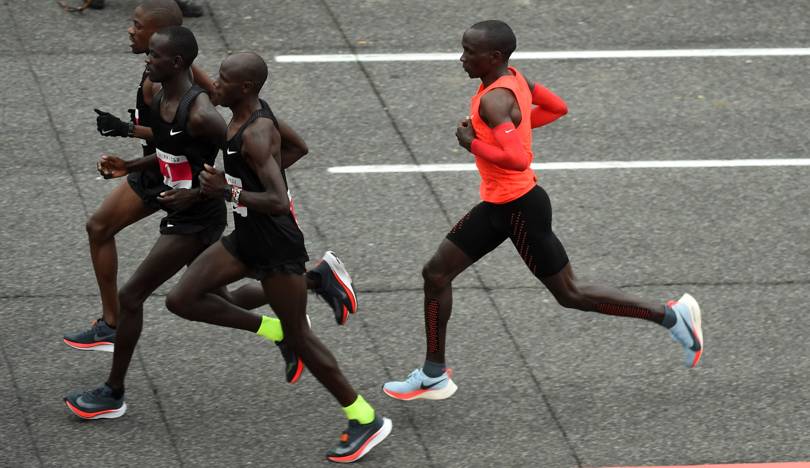
Wall of pace runners protecting Eliud during Breaking2
Breaking2 taught us that the two hour barrier is a mental one. And while I don't think that it will be broken for the next ten or so years, I believe it will be broken in my lifetime.

David Epstein, the author of "The Sports Gene" had a very interesting TED talk titled, "Are athletes really getting faster, better, stronger?" It's an interesting take on sports and performance. While there is an allusion to the possibility of various forms of enhancement, he sticks to the fact that the human body has evolved. His book, "The Sports Gene," presents a denser academic version of that talk.

Eliud Kipchoge is the greatest marathoner in history. He's run 11 marathons and only lost one (he came second to Wilson Kipsang who broke the world record to beat him).

Eliud Kipchoge is a great ambassador for Kenya, and stands uniquely among those athletes who are true heroes. Soft spoken, intelligent, determined and extremely dedicated to the sport that the world has come to know him for.

Eliud Kipchoge is my hero, and he inspires me to get out and run.

On Writing

Writing is a craft.

Writing is a profession.

Writing is a discipline.

Writing does not happen miraculously.

Writing takes agonising patience and dedication.

Most writers will tell you that the act of writing is the hardest thing that they ever did.

Then why write?

Why?

Because the act of writing, when done well, has spurts of pleasure.

When done well, the act of writing feels as pleasurable as an injection of endorphin.

Like the runner's high.

Samuel Jackson said that, "great works are performed, not by strength, but by perseverance."

While Steven Wright said, "I'm writing a book. I've got the page numbers done."

And the one that I like the best is,

Willa Cather wrote, "Most of the basic material a writer works with is acquired before the age of fifteen."

So, don't let anyone tell you that you cannot write. Write if you have something to say.

Sunday, September 10, 2017

My Relationship with FOOD


Everyone has a relationship with food. Whether it's just for survival, comfort, psychological well-being, socialising, fuelling, competition, or whatever.

I'm not sure if I had any thoughts of what I ate when I was younger, only that it needed to taste good. Chapati, an Indian, pita-like, bread, with stew, preferably either chicken or beef was high on the list of good things. Ugali, a Kenyan dish made of cornmeal was very low. However, facing extreme hunger I would eat ugali.

Unlike people who literally have to beg for food, eat what's given to them, I had a choice of what to eat, ever since I was a child. I had no wants. I had no needs. If I didn't like something, I could find something else that I liked. I had the choice to avoid any food that I did not like to eat. And so during my university years, my selection of foods focussed singularly on only those things that I wanted. And none of the foods I chose had anything to do with a healthy lifestyle.

Why am I eating?

Fuel for my brain. It has to keep ticking and doing the things that it needs to do to keep me gainfully employed. After all, my employment, hence my income, depend on me being able to use my brain. So my brain needs food.

How much food to keep the brain going?  According to my premier source of information, Google, the brain needs oxygen and sugar. But the health of the neurotransmitters is also critical, and they're made of amino acids, proteins. At a minimum, I have to keep breathing and consuming glucose as well as the occasional protein, to help refresh the neurotransmitters.That doesn't seem like an awful lot. Except that the sugar should come from a good clean source, so that there's not a lot of work to make it into the acceptable glucose that my brain needs. And just enough, we don't want to repackage it as fat and store it up. The protein could come from fish.

What about the body?

For me, this is truly a matter of fuel. Energy to do things like run and walk about. Should be for most people. What about when I'm invited out for lunch, or dinner? Should I refuse to eat, just because someone has handed me some food? Not really, since that's rude. You should eat, but then that eating is planned around the other stuff you've eaten that day, plus the other stuff you propose on eating later. It's easy to choose what to eat, even when I'm invited, so it should not be too difficult to continue my brain feeding/body fuelling attitude.

Balance

I tend to think that it's not as easy as eating 2000 calories a day. The debate on that number specifically is well documented online. Just do a Google search for "why are we asked to eat 2000 calories daily?"  and you'll see some interesting stuff.


Food is essentially fuel, but in today's society, it's more than just fuel. It means more and it's used for more. Both the way our food is now made, and the way we use it have become dangerous to our health. And in the end, after all, it is about our health, isn't it?

Quiet...

“So stay true to your own nature. If you like to do things in a slow and steady way, don't let others make you feel as if you have to race. If you enjoy depth, don't force yourself to seek breadth. If you prefer single-tasking to multi-tasking, stick to your guns. Being relatively unmoved by rewards gives you the incalculable power to go your own way.”
        ---- Susan Cain

That quote is taken from Susan Cain's book, "Quiet: The Power of Introverts in a World That Can't Stop Talking."

We live in a world where everyone is interested in talking, but nobody wants to listen. The art of careful reflection is now looked upon as inactivity. The art of careful reflection is seen as an inability to be decisive. An inability to lead and make decisions. As though being quiet isn't a sign that work is being done.

The world of the aggressive, take charge, take no prisoners, lead by intimidation leader has already come to an end. Because the aggressive, take-charge leader of the past was a very different leader than that one of today.

And the wool can no longer be pulled over our eyes.

And it's showing glaringly in the problems we're seeing at the top of the food chain. Unlike the leader of the past, forged from the fires of trial-and-error, having lived and built. Today's fire and brimstone leader is made in the hallways of university. Where the knowledge of "how to lead" is being taught. Today's leader has actually never built anything. They've found something. And they've been placed near the top, to lead it. To bring ideas, mostly having never thought of anything original themselves.

Think of Alexander the Great.

He was skilled. He didn't have followers who knew more than he did. He was a skilled teacher. A skilled leader.


Or Mohandas Karamchand Gandhi?


Or Winston Churchill.


Or Bill Gates.

And I could go on.

Saturday, April 08, 2017

Reading

The Internet has changed the way we interact with books. The way we think. The way we study. The Internet has irreversibly changed us.


But it's not just the easy access to a lot of reading material. It's the very nature of information today. No one has the patience for the epic novel. It's information in titbits. One chunk at a time. A tiny morsel. A buffet of snacks. No sumptuous meal.

Can anyone sit through an epic novel like, say, Leo Tolstoy's War and Peace? All one-thousand two-hundred and twenty-two pages? The patience to read one word at a time. And slowly paint a scene in your mind? How about the six-hundred and seventy-two pages in James Michener's Caribbean?


Patience is a virtue. The ability to sit and wait. To read slowly and digest deliberately. Even in this fast food culture of taking large gulps, it helps to chew slowly. Taking small bites.


Reading is an art form. Grossly undermined. We learn to read as children. Are read to by our parents. Are read to by our teachers. And are read to when we watch TV. It takes a lot of patience to sit quietly alone and read, by yourself, without interference. And this is why it's an art form.

Like drawing, it doesn't come easily. Drawing is about looking and seeing. Not about accurately putting to paper the world as others see it. Drawing is about exploring your world. About looking carefully and observing light, shadow and colour. Drawing is about slowing down to take a really good hard look at your world.

And reading is quite similar. Reading is about taking a string of words off a page, meditating on each one, carefully forming a sentence in your mind with each word and then painting an image. The image is purposeful and real. As real as the words on the page. And therefore when you read a sentence, you absolutely have to pause as your brain assembles the complete picture.

One word at a time.

One sentence, or phrase, at a time.

One paragraph at a time.

One page at a time.


Reading is a physical activity. It involves a huge amount of concentration. Something that we've lost. Like taking a long walk. You get tired and want to rest along the way. Reading is a lot like going for a long marathon run. You should not be looking for the finish line at every step. When running a marathon, you should be concentrated on the moment. The feeling of the moment and what you are doing in the present time. Because if you take care of the present time, the rest will take care of itself. And the finish line will appear.

When you read, to take small bites. You chew. You savour the words in your mouth and roll them around your tongue. You feel the different flavours of each piece, each morsel, each word. You make sure that you also pay attention to the combination of words, the full bodied flavour. Taking in the scent. And finally you swallow and enjoy the feeling of satisfaction. The feeling of having understood what you just experienced. Don't be in a rush to jump into the next sentence. Are you sure you got it all? Was there something in there that's missing?

I know that's a lot of work. I know it's a lot of work to sit there and learn to be patient as you extract meaning out of a sentence. But believe me, once you practice reading this way, you'll never read a different way, ever again.

I once took a speed reading course. Self taught. It was fairly good. Taught you where on the page you should look. How to centre your eyes without too much side-to-side movement. Focusing on a spot, somewhere in the middle of the page, with your eyes between two lines. Trying as much to take an image, a picture, a snapshot of two lines with barely discernible movement of the eyeballs. The image of the two lines now imprinted on the back of the retina, your brain digests and strips the meaning out of the words just read. Without necessarily focussing on individual words. Like taking a handful of peanuts in your hand and throwing them all in your mouth. With great crushing bites, chewing for impact. Not one peanut at a time. That would take too long. Handfuls. Great flavourful lunges of peanut joy. It's OK if you don't get a taste of each nut. You get the big picture by taking handfuls. And very soon, the entire bowl of peanuts is finished and your brain is free to process the experience.

It's one huge experience. Looking only for the message. The climactic finish. No need to enjoy each piece. If you can fly there, why go by car. Why bother walking? It's faster, better, more economic and time saving to fly. Nobody walks any more.

So I always encourage the slow-paced reading method. Even though I thought that the speed reading course was great. And I did get a lot out of it. It was also taxing and tiring. A lot was missed, and hopefully unimportant stuff. But there's a lack of enjoyment when you use the speed reading method. It's like unhealthy fast food (not the tasty fast food, the unhealthy stuff) that makes you feel hungry a few minutes later. Jamming the information into your brain just because. Not really taking the time to savour the richness of what you're trying to understand. Even if you do, re-telling it to your mind with your own words.

Read slowly, purposefully, consciously, contemplatively, meditatively, calmly, respectfully, engaged and inquisitively.

Sunday, August 21, 2016

The Olympic Bragging Competition

As my title says, it's no longer the Games. The Olympics are mostly about showing off. It's an environment for the western world, primarily, to show off.

The playing field isn't level.

The competition can hardly be called fair. The amateur component having been taken off a long time ago, and now, like any professional business, the Olympics is an environment for the wealthier countries to show off.

But I still believe that the games should be held. It's the only place that the world gathers together to meet and compete. Even if the playing field isn't fair, the interaction is worth the effort, even for some of the countries without the means to train and prepare. It's a place for them to come and enjoy the brotherhood and sisterhood of participating in something that does not involve diplomatic muscle.

In that sense, I believe everyone's a winner.


Most of the medals are concentrated in sports that only some of the western world competes in. Or have the technology and wealth to afford.

Even when it comes to determining which place a country places, counting medals is done suspiciously differently by various countries.

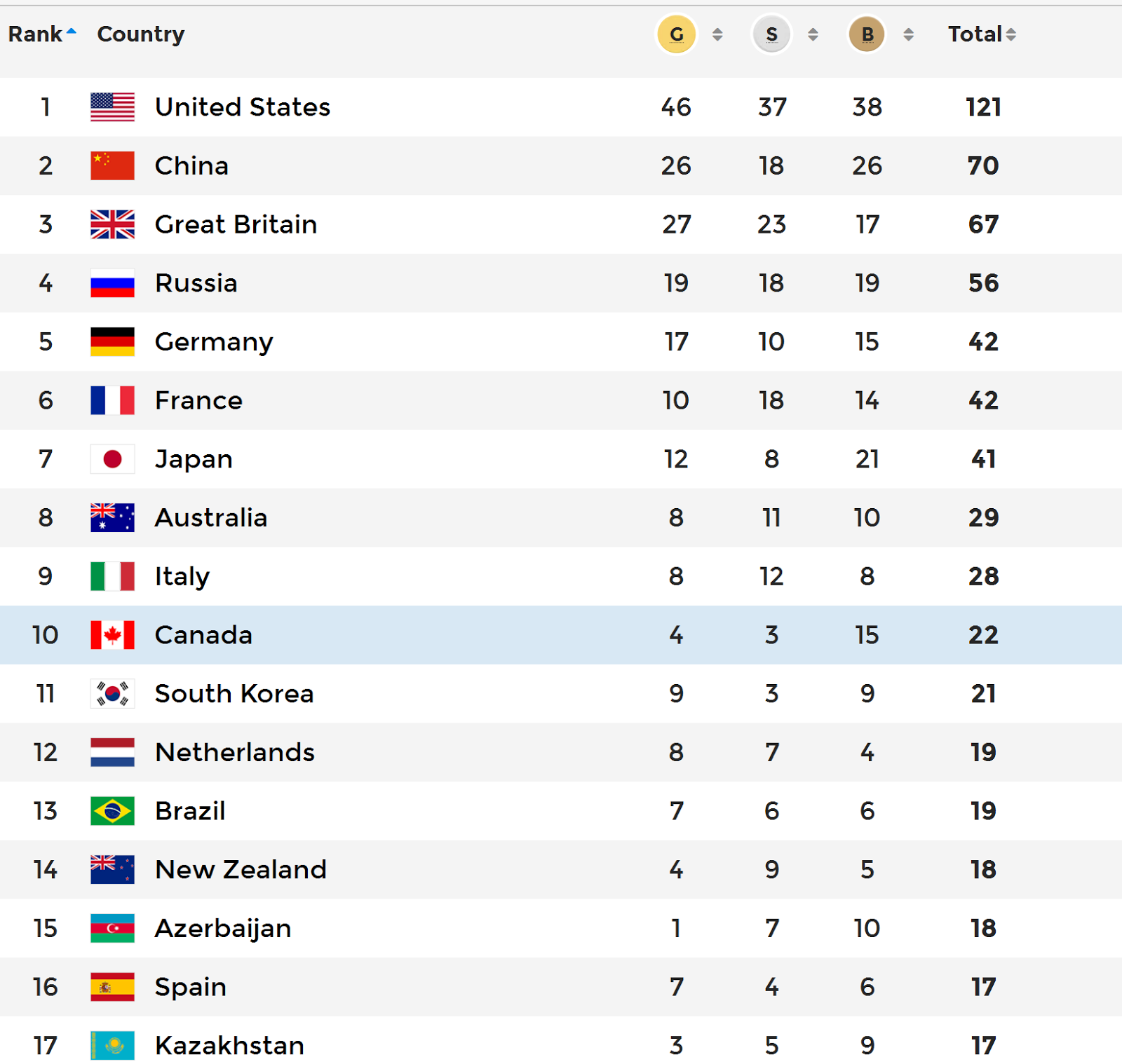
For example, in the 2016 Olympics, it's clear that the U.S. won the entire games. They had the most gold medals of any nation, 46. They had the most silver medals of any nation, 37. And they had the most bronze medals of any nation, 38. They had the most medals of any nation, 121.

Then it gets tricky. China had the next highest total count of medals. 70 medals in total. However, Great Britain had more gold medals than China, so most media was reporting GB in second place.


But as you can see from the list above, Canada isn't listed.

Because here's how the Canadian media is reporting the standings.


To be fair, they give you the option to sort the list, but when you read the various reports on CBC's website, they refer to their position as 10th overall. At a press conference of the Canadian Olympic Committee, they also refer to this 10th place position as being a success given their 12th place overall target.

Similarly, GB's press are extremely excited about having beaten China in the standings.

But did they?

New Zealand has an interesting way to rank countries, which seems much fairer. A metal count per capita.

See http://www.stats.govt.nz/browse_for_stats/population/estimates_and_projections/olympics-2016.aspx

It's hardly possible for a country with a million people to beat one that has three-hundred million in these competitions. Better to look at the events that they're competing in and determine who actually bested whom?

I personally don't like statistics that don't have an ultimate purpose. Something to help humanity. Statistics for statistics sake. Statistics that don't add value to any conversation. Statistics that don't add value to the welfare of humanity. Or provide insight to help us become better. Or give us warning signs.

If you take New Zealand's analysis a bit further you may come to the following interesting facts:

Based on the ratio of total medals won to the number of athletes the country sent, Azerbaijan wins. They sent 56 athletes and won a total of 18 medals. Ratio is 32.1%.

Contrast that with the announced winner, the U.S. They sent 558 athletes who won a combined total of 121 medals. Medals to athletes ratio is 21.7%. In this scenario, the U.S. is in 5th place. Not shabby given the number of athletes.


It gets a little interesting if you focus only on the gold medals to judge ranking. When you do that, the country that won the Rio Olympics is Tajikistan. They sent 7 athletes and won a single gold medal.

In this scenario, the U.S. is in 8th place.


You can see the camaraderie in the opening and closing ceremonies. When all the athletes are together.

Everyone's a winner.